

A message from my heart, after more than 35 years of watching children and parents learn to love each other better
A Sentence We Never Realise Is So Heavy
Picture a child walking home from school with a little smile. Her marks have improved since the last test. She has worked hard for this, and she cannot wait to show her mother.
The mother looks at the paper and says, “Good, but why could you not score like your cousin?”
The smile goes. The paper goes back into the bag. The child says nothing, but something inside her has quietly changed.
Or picture a boy struggling with mathematics. His father sighs and says, “Look at your sister. She never had this problem.”
The father believes he is motivating his son. The son hears something else entirely: “I am not good enough as I am.”
Have you ever compared your child with another child because you truly wanted them to do better? Have you ever wondered what your child heard beneath your words?
I have spent more than 35 years in education, as a teacher, as a Principal, and as someone who has sat across from thousands of parents and children. & I have seen proud parents and nervous children, and I have seen what a single careless sentence can do.
I am not writing this to point a finger at anyone. & I am writing it because I know that almost every parent who compares does so out of love.
But love, when it is poorly expressed, can feel like pressure. And that is what I want to talk about today.
Why Do Parents Compare Their Children?
Let me say this first: comparison rarely comes from a cruel heart. In all my years, I have hardly met a parent who wanted to hurt their child. Let me share the reasons I have seen again and again.
Fear About the Child’s Future

Today’s world feels fast and competitive. Parents worry that their child will fall behind in studies, in career, in life. Comparison becomes a measuring tape: “Where does my child stand compared to the others?”
The worry is real and it comes from care. But worry does not automatically make every parenting method helpful.
Pressure From Society and Other Parents
Relatives ask, “How many marks did he get?” Neighbours talk about whose son got into which college. WhatsApp groups fill with achievements. Slowly, parents begin to feel judged too.
Under that pressure, many of us start watching how our child compares with others instead of watching what our child actually needs.
Repeating What We Heard as Children
This is the reason people rarely admit, and the one I find most important. Many of us grew up hearing, “See how well Sharma ji’s son is doing.” We were compared with siblings, cousins, classmates.
Because it feels familiar, we repeat it, without ever stopping to ask whether it was good for us.
Believing That Comparison Creates Motivation
Many parents sincerely believe that “Look how well your friend has done” will light a fire in the child. Sometimes it does, for a short while. But more often, I have seen it bring discouragement, shame, silence, or quiet resentment.
The effect depends on the child, the relationship, and the way the words are said. Which brings me to the next question.
What Does Comparison Actually Do to a Child?
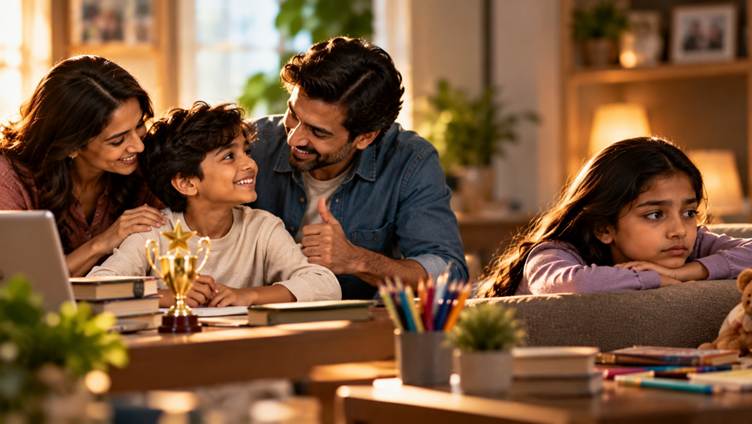
I want to be careful here. Every child is different, and not every child reacts in the same way. What I share below are patterns I have noticed over the years, not diagnoses and not certainties. A child’s response depends on temperament, on the home environment, on how often comparison happens, and on whether the child has other sources of support.
1. It Can Make a Child Feel “Not Enough”
When a child is repeatedly measured against someone else’s results, their own effort starts to feel invisible. They begin to believe that approval must be earned by being better than another person.
2. It Can Slowly Damage Confidence
A confident child asks, “Am I improving?” A compared child often starts asking, “Am I better than everyone else?”
The second question is exhausting, because there will always be someone ahead.
3. It Can Create Distance Between Siblings
Brothers and sisters have ordinary differences. Comparison turns those differences into a contest.
I have seen a child quietly resent a sibling who was always praised, even though that sibling did nothing wrong. The sibling was only standing in the spotlight the parent had placed there.
4. It Can Make Children Afraid of Failure
If struggling means being compared or criticised, a child learns to avoid anything unfamiliar. They stop raising their hand. They stop asking questions. & They hide their mistakes.
- They begin choosing tasks where success is guaranteed, instead of the ones where real learning happens.
5. It Can Make Love Feel Conditional
This is the one that touches me most. Some children begin to connect their parents’ pride with performance. They feel they must bring marks, trophies, and achievements home to deserve a warm smile.
No child should have to earn the feeling of being loved.
The Sentences We Say Without Thinking
Here are some comparisons I have heard, in school corridors, at parent-teacher meetings, and at family gatherings. Look at what we mean, and what the child may hear.
| What we say | What we may intend | What the child may hear |
| “Your brother never behaves like this.” | “I want you to be more responsible.” | “I am the bad one in this family.” |
| “Look at your cousin’s marks.” | “I want you to work harder.” | “My effort does not count.” |
| “Your friend has already learned this. Why haven’t you?” | “I want you to catch up.” | “I am slow and something is wrong with me.” |
| “When I was your age, I did much more.” | “I want you to value your opportunities.” | “I will never be as good as my parents.” |
| “Why can’t you be more like that child?” | “I want you to improve.” | “Someone else would be a better child for you.” |
| “Other children don’t trouble their parents like this.” | “I am tired and worried.” | “I am a burden.” |
Children do not always understand words the way we mean them. That is why we must look not only at our intention but also at the impact.
Every Child Blooms in Their Own Season
In a school, you see something beautiful. In one classroom, there is a child who solves a problem in seconds. Next to her sits a boy who struggles with numbers but can calm down a crying classmate without being asked. Behind him sits a girl who cannot sit still, but whose drawings stop you in your tracks.
Which of them is “successful”? That depends on who is looking, and what they are looking for.
Children differ in their interests, learning pace, confidence, communication, and strengths. One may be academic. Another may be creative, thoughtful, persistent, practical, or wonderful with people. A single ruler cannot measure all of them.
Now please do not misunderstand me. Recognising strengths does not mean ignoring poor results, behaviour problems, or the need to improve. Guidance and discipline are part of love. It simply means understanding the child before deciding how to guide them.
Here are some questions I invite you to ask yourself:
- What does my child find truly interesting?
- Where have I noticed improvement, even if the result is not perfect?
- What kind of support does my child need to move forward?
- Am I responding to my child’s real needs, or comparing them with someone else’s strengths?
- What would progress look like for this child, at this stage?
Fair expectations come from knowing the child in front of us, not the child next door.
The Hidden Connection: Are We Passing On Our Own Childhood Wounds?
This is the part of the article I want you to read slowly.
Over the years, I have noticed something. The way we speak to our children often carries the voice of the way we were spoken to.
A parent who was always compared with an elder sibling may grow up believing that love has to be earned through achievement. Later, without any intention to hurt, that parent may do the same to their own child.
A parent who was rarely praised may become strongly focused on performance. Another parent may feel a rush of anxiety every time their child struggles, because somewhere inside, their own sense of worth has become tied to how their child performs.
None of this makes us bad parents. It makes us human. But it is worth pausing to ask ourselves some honest questions:
- Was I compared with siblings or cousins when I was young?
- Did I feel I had to achieve something to make my parents proud?
- Was I allowed to make mistakes without feeling ashamed?
- Do I become unusually anxious or angry when my child performs below expectations?
- Am I responding to my child in the present, or reacting to a feeling I remember from my own childhood?
Our past can influence us, but it does not decide our future. We can notice old patterns and choose new responses. And we do not need to be perfectly healed before we become good parents. We only need to be willing to look.
An Invitation to Look Within
Sometimes, changing how we respond to our children begins with understanding what we carry inside from our own childhood. This is exactly why I created Shadow Journaling for Inner Child Healing.
It is a guided journaling and reflection course that helps you explore childhood experiences, emotional patterns, and beliefs that may be shaping your present life. It is not a verdict on you as a parent. & It is a gentle, structured space for self-understanding, and self-understanding is where change begins.
If something in this section made your heart go quiet, you may want to explore it here: Shadow Journaling for Inner Child Healing
How to Encourage Your Child Without Comparing
Let me now share what I have seen work. These are not magic formulas. They are small, steady habits.
1. Compare the Child With Their Own Progress
Instead of asking whether your child has beaten a classmate, notice how far they have come. Try: “What felt difficult last time, and what feels easier now?”
2. Praise Effort, Strategy, and Persistence
Appreciate the preparation, the problem-solving, the willingness to try again. Keep your praise specific and sincere. Children can sense empty praise from a mile away.
3. Correct the Behaviour, Not the Identity
Instead of “You are so irresponsible,” try: “You forgot your homework today. Let us think about how you can remember it tomorrow.”
The first sentence attacks who the child is. The second helps the child move forward.
4. Let Siblings Be Different People
Avoid fixed labels like “the intelligent one,” “the difficult one,” or “the responsible one.” Labels become cages. Let each child grow without a sibling standing beside them as a measuring stick.
5. Ask Before Assuming
When your child struggles, get curious. It may be lack of practice, confusion, stress, or a skill that simply needs more time. It does not always mean laziness or lack of ability.
6. Make Home a Safe Place to Make Mistakes
Keep reasonable expectations and consequences, but let your child know that mistakes are part of learning. A child who can say “I got it wrong” without fear of humiliation is a child who can grow.
7. Celebrate Others Without Using It Against Your Child
Teach your child that another person’s success does not shrink their own potential. Congratulate the cousin, appreciate the classmate, and stay curious about your own child’s dreams.
What If You Have Already Been Comparing Your Child?
Please do not carry guilt. I say this to every parent who sits in my office with tears in their eyes: you did what you knew, and now you are learning something new.
Here are four steps to repair and begin again:
- Acknowledge the pattern. Notice when comparison has become a habit.
- Apologise sincerely. Children are very forgiving when the apology is honest.
- Change your language. Replace comparisons with specific observations, questions, and constructive guidance.
- Be consistent. One conversation will not undo years of hurt. Let your child experience the new way again and again, until trust grows.
You might say something like this:
“I realise that I have sometimes compared you with other children because I wanted you to do well. But I understand that my words may have made you feel that you were not enough. I am sorry. I want to understand you better and help you grow in your own way.”
Parents do not have to be perfect. What matters is the willingness to take responsibility, to listen, and to change.
A Few Quiet Questions for You
Before you close this page, sit with these five questions. Answer them honestly, only for yourself.
- Do I appreciate my child’s strengths, or do I mainly notice what they lack?
- When my child struggles, am I curious about the reason, or do I quickly compare them with someone else?
- Does my child feel safe telling me about mistakes and disappointments?
- Are my expectations coming from my child’s needs, or from my own fears and unresolved childhood experiences?
- What is one sentence I can stop saying, and one more supportive sentence I can start using?
Choose just one small change and practise it from today. The purpose here is awareness, never guilt.
A Gentle Word on Forgiveness
Many parents discover, while reflecting on their own upbringing, that old hurts and unspoken feelings come to the surface. If that happens to you, please be kind to yourself. You can understand your past without blaming your parents, and without excusing anything that truly hurt you. Forgiveness is personal, and it is never compulsory.
For those who find peace in reflection and compassion practices, you may also like my Advanced Ho’oponopono Healing Journey. It is a gentle practice of reflection and forgiveness, and it is offered as a personal growth practice, not as a replacement for professional mental-health support.
Your Child Needs Guidance, Not a Constant Comparison
Let me be very clear about one thing. Children need boundaries. They need encouragement, discipline, and chances to improve. Loving your child does not mean removing all expectations or never correcting them.
The difference lies in how we speak.
A child can be guided firmly without being made to feel small. A child can be pushed to work harder without being told that someone else is better. & A child can learn from another person’s success without believing that their own worth depends on matching it.
Your child may not be the highest scorer in the class. They may not be the most confident speaker, or the one who achieves everything first. But they deserve the chance to discover their own strengths without feeling that someone else is the standard they can never meet.
Your child does not need to become someone else’s child to make you proud. Your child needs to feel that you see them, understand them, and value who they are.
So let us guide our children towards growth, without ever making them feel that who they are today is not enough.
With love,
Dr. Neeti Kaushik
FAQs
Q1. Why do parents compare their children?
Ans. Most often it comes from fear about the child’s future, social pressure, a belief that comparison motivates, or a pattern the parent experienced in their own childhood.
Q2. What are the effects of comparing children with others?
Ans. Depending on the child, it can reduce confidence, create sibling rivalry, increase fear of failure, and make approval feel conditional. Not every child reacts the same way.
Q3. How can parents stop sibling comparison?
Ans. Avoid fixed labels, praise each child for their own efforts, give each one individual time, and compare a child only with their own past progress.
Q4. How can I encourage my child without comparing them?
Ans. Praise effort and persistence, correct behaviour instead of identity, ask questions before assuming, and make home a safe place for mistakes.
Q5. How can parents recognise inherited parenting patterns?
Ans. Notice which phrases, reactions, or anxieties feel familiar from your own childhood, and ask whether you are responding to your child or to an old memory. Journaling can help with this reflection.

Very nice suggestion and advice many problems faces we are everyday