

How to stop putting yourself last, let go of inherited beliefs, and rediscover the person you may have forgotten while taking care of everyone else.
Think about your day for a moment. Who got your attention first this morning? Who ate before you did? Whose needs did you think about before your own?
For many of us, caring for everyone else comes so naturally that we never notice when we stopped caring for ourselves. Nobody sat us down and told us to do it. It happened slowly, one small “I’ll do it later” at a time.
I want to share how I understood this in my own life. It began with a woman I loved deeply, MY MOTHER.
The First Lessons About Love We Learn at Home
When I look back at my childhood, I see my mother’s complete dedication to our family. She gave her time and energy to her children, her husband, and her in-laws. Her selflessness was admirable. I still respect it today.
But I also noticed something as I grew up. She often put her own needs, wishes, and happiness aside. Nobody ever told me, “A woman should come last.” I simply watched, and children are always watching.
Children learn about love, duty, and womanhood by observing the adults around them. Without anyone saying a word, I absorbed an idea: taking care of yourself is selfish, and real fulfilment comes from serving others.
Some of us pick up beliefs like these at home:
- A good woman always puts her family first.
- Resting is a form of laziness.
- Spending time or money on yourself is unnecessary.
- Keeping everyone happy is your personal responsibility.
- Your dreams can always wait until later.
These are examples of beliefs some people may carry. Every family is different, and every woman’s story is her own. But if any of these felt familiar, you are not alone.
One thing I have learned is that we can respect our parents’ choices without repeating every pattern we saw. My mother did what she believed was right, out of love. I can honour that love and still choose differently for myself. We can honour the women who came before us while building a healthier relationship with ourselves.
When I Realized I Was Forgetting Myself
As I grew older, I noticed that I was following similar patterns. I put other people’s needs before mine. I fulfilled my responsibilities, and there were moments of satisfaction in that. But underneath, there was a quiet feeling of emptiness and frustration that I could not explain.
I began asking myself some difficult questions:
- Why do I feel guilty when I want something for myself?
- Why does taking care of myself feel like an indulgence?
- Why is it so easy to understand everyone else’s needs, but so hard to admit my own?
These questions were uncomfortable. But they were honest, and honest questions are where change begins.
Self-neglect is rarely dramatic
We usually imagine self-neglect as something big. In reality, it hides in small everyday decisions. Here are a few examples of how it can look (these are illustrations, not events from my life):
- Eating last, or eating whatever is left over.
- Saying “I’m fine” when you are exhausted.
- Agreeing to a plan you do not want, just to avoid an argument.
- Cancelling something you were looking forward to because someone else needs you.
- Not buying something you need, but buying it easily for others.
Each one seems small. Together, over the years, they teach us a painful lesson: my needs do not matter. That is not true, and it never was.
The Moment That Changed How I Understood Self-Love

The turning point came through my mother, in a way I never expected.
After my father passed away, I watched her struggle. She had relied on him in many parts of her life, and without him there was uncertainty and a lot to learn. It was a hard and painful time. I will never describe it as anything else.
But slowly, I saw something change. In the middle of her grief, my mother began to find a new sense of independence. She started doing small things she had never done for herself before. She bought clothes she liked. & She chose beautiful footwear. & She enjoyed the foods she loved.
These may sound like ordinary things. To me, they meant something much bigger. She was acknowledging her own preferences. She was giving herself permission to enjoy her own life.
Watching her taught me something I did not fully understand at the time. And one thought stayed with me, again and again: I wished she had discovered this freedom earlier.
Not because loss should be the teacher. Nobody should have to lose someone they love to find themselves. I wish she had found it while she still had her husband beside her, in the middle of everyday life.
That is the lesson I want to pass on to you:
We should not have to wait for loss, exhaustion, or a major life change before we give ourselves permission to live.
Self-love does not need a dramatic moment. It can begin right now, while we are still caring for our families, doing our jobs, and living our ordinary days.
My Own Journey Begins
When I saw myself in my mother, I made a decision. I did not want to wait until it was too late to understand my own worth.
So, I started my own self-love journey. I sat down and made a list of everything I had been denying myself. It was humbling to see it on paper.
I also realized how many masks I wore. One mask at work, another as a wife, another as a mother. I was trying so hard to fulfil each role that I had lost touch with parts of my real self.
Over time, I began working on some important things:
- Facing my own body-image issues
- Releasing limiting beliefs I had carried for years
- Practising gratitude
- Learning to accept myself as I am
Here is what I came to understand: self-love is not about rejecting our responsibilities. It is about learning to value ourselves while we fulfil them.
What Self-Love Really Means
Let me answer some questions simply, because they matter.
What is self-love? Self-love is the practice of recognizing that your needs, feelings, health, interests, and dreams deserve care and consideration, just like everyone else’s.
Why is self-love important? Because it shapes how we treat ourselves, the choices we make, the boundaries we keep, and how worthy we feel. When our self-worth is steady, we can love others from a place of fullness, not exhaustion.
Is self-love selfish? No. Selfishness means ignoring others to benefit yourself. Self-love means including yourself in your own circle of care. Our needs do not always have to come first. They just should not automatically come last.
Here are a few differences worth remembering:
- Self-love and selfishness: One includes yourself. The other excludes everyone else.
- Self-acceptance and giving up: You can accept who you are today and still grow.
- Responsibility and self-neglect: You can keep your duties without erasing yourself.
- Caring for others and carrying everyone’s happiness: You can support people without being responsible for how they feel.
| Self-love | Self-neglect |
| Saying no when necessary | Saying yes while feeling resentful |
| Making time for rest | Waiting until exhaustion forces a break |
| Expressing needs respectfully | Assuming your needs should not matter |
| Caring for others while respecting yourself | Believing everyone else’s happiness is your responsibility |
| Accepting imperfections while growing | Treating every mistake as proof that you are not good enough |
Seven Life Lessons About Self-Love Every Woman Needs to Learn
Lesson 1: You Do Not Have to Earn the Right to Rest
Many of us believe we can rest only after everything is done. But the list is never finished. There is always one more thing.
Try this: Pick one time slot today, even 15 minutes, and rest without apologizing. Rest is not a reward for finishing. It is part of being human.
Lesson 2: Saying No Does Not Make You a Bad Person
Disappointing someone is not the same as harming them. A kind and clear “no” protects your energy so your “yes” can be genuine.
Try this: Next time, say, “Let me think about it and get back to you.” That small pause gives you room to choose instead of reacting out of guilt.
Lesson 3: Your Worth Is Not Measured by How Much You Do for Others
Being useful, productive, or always available is not the same as being worthy of love. You were worthy before you did anything for anyone.
Try this: Spend one hour doing something that helps nobody but you. Notice what comes up. That discomfort is worth listening to.
Lesson 4: Stop Speaking to Yourself in Ways You Would Never Speak to Someone You Love
Think of the words you use for yourself in the mirror, after a mistake, or when you compare yourself to others. Would you say them to your daughter, your sister, or your best friend?
Try this: When a harsh thought appears, ask, “What would I say to someone I love in this situation?” Then say that to yourself. This is how self-acceptance grows, one kinder sentence at a time.
Lesson 5: Your Dreams Do Not Expire Because You Have Responsibilities
A dream postponed is not a dream cancelled. Maybe it is learning something new, travelling, painting, or simply having a quiet hobby again.
Try this: Write down one thing you once wanted to try. Then take the smallest possible step toward it this week.
Lesson 6: You Are Allowed to Enjoy Simple Things Without Justifying Them
This is the lesson my mother taught me. Her favourite clothes, her beautiful footwear, the foods she loved were never about luxury. They were about saying, “My choices matter too.”
Try this: Do one small thing this week purely because you like it, and do not explain it to anyone.
Lesson 7: You Can Love Your Family Without Abandoning Yourself
This is the heart of everything I have shared. Caring for others and caring for yourself can live side by side. In fact, when you are nourished, you have more to give, and you give with joy instead of resentment.
Try this: The next time you plan your day, put one thing for yourself on the list, with the same seriousness you give to everyone else’s tasks.
How to Begin Practising Self-Love in Everyday Life
If you are wondering how to practise self-love every day, or how to stop putting everyone else first, start here. You do not need an expensive routine, a perfect lifestyle, or hours of free time. You need small, consistent decisions.
- Spend five minutes each day asking yourself what you need. Just ask. Listen to the answer.
- Identify one thing you keep postponing for yourself. Name it clearly.
- Notice when guilt is making your decisions. Guilt is often a habit, not a fact.
- Practise expressing one need or boundary respectfully. Calm and clear is enough.
- Replace harsh self-talk with honest, compassionate language. Be truthful, but be kind.
- Make room for one small activity you genuinely enjoy. Even ten minutes counts.
- Keep a record of small promises you make and keep to yourself. This quietly rebuilds your self-trust and self-worth.
If you struggle with doubting yourself along the way, you may find my article on self-doubt and empowerment helpful.
A Seven-Day “Come Back to Yourself” Practice
Here is a gentle seven-day practice. Keep a small notebook nearby.
- Day 1: Notice yourself. Write down three needs you have been postponing.
- Day 2: Listen to yourself. Notice when you agree to something out of guilt rather than real willingness.
- Day 3: Change your self-talk. Respond to one self-critical thought with more compassion.
- Day 4: Enjoy something simple. Make time for an activity you love.
- Day 5: Practise a boundary. Communicate one need or limit respectfully.
- Day 6: Revisit an old wish. Write down something you once wanted to learn, try, or experience.
- Day 7: Make one promise to yourself. Choose a small self-loving habit to continue.
Please do this without perfectionism. If you miss a day, you have not failed. Just begin again. Coming back to yourself is something you do over and over, and every return counts.
My Invitation to You: Begin Your Self-Love Journey
Understanding self-love in your mind is only the beginning. Living it takes reflection, consistency, and the courage to question patterns that have felt normal for years.
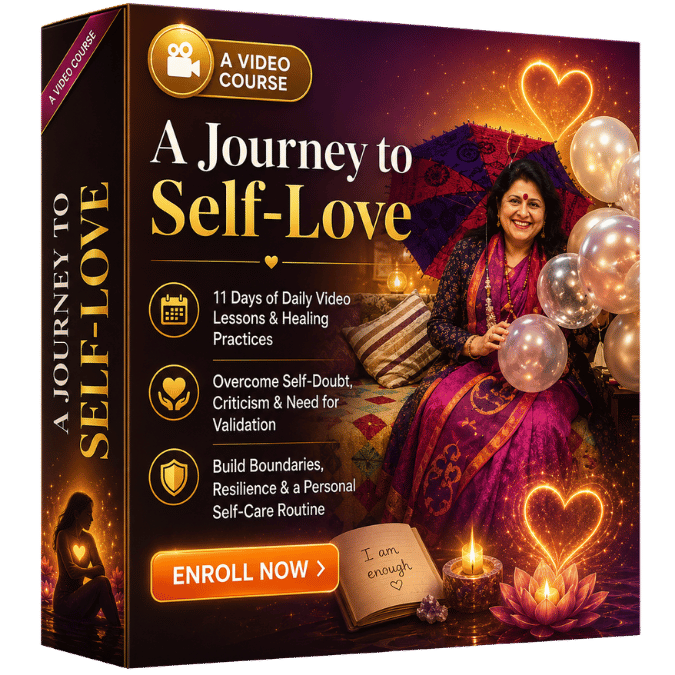
I created my 11-day Self-Love Course for those who want to take this understanding further and begin building a more loving relationship with themselves. Through the activities, you can give yourself time to reflect, reconnect with your needs, and practise choosing yourself in everyday life.
Join Dr. Neeti’s 11-Day Self-Love Course
If you would like to read where this journey began, you can also read my original article, How Important Is Self-Love?, and watch my video “Self Love: 6 Transformative Realizations” on my YouTube channel.
You Deserve to Be Part of the Life You Are Building
I think about my mother often. I think about her years of giving, and about the quiet joy on her face when she chose something just for herself. Both are part of her story, and both are part of mine.
Many women spend years loving everyone around them while forgetting that they, too, deserve care. If that is you, I want you to remember a few things:
- You can appreciate your family’s sacrifices without repeating every one of them.
- You can be loving without being endlessly available.
- You can fulfil your responsibilities without giving up your identity.
- You can begin again at any stage of life.
- You do not have to wait for a crisis to start choosing yourself.
Perhaps one of the most beautiful things we can do for the women who came before us is to honour their love while giving ourselves permission to live more freely. And perhaps the greatest gift we can give the women who come after us is to show them that loving others and loving ourselves were never meant to be opposites.
You do not have to stop loving the people around you to finally start loving yourself. When you are ready, my 11-day Self-Love Course is here, and so am I.
With love,
Dr. Neeti Kaushik
drneetikaushik.com
Frequently Asked Questions
Q1. What is self-love, and why is it important?
Ans. Self-love means recognizing that your needs, feelings, health, and dreams deserve care. It is important because it shapes your self-worth, your boundaries, and your choices. When you value yourself, you can love others from fullness, not exhaustion, and you make healthier decisions in every part of life.
Q2. Is self-love selfish?
Ans. No. Selfishness ignores others for personal gain. Self-love simply includes you in your own circle of care. It does not mean your needs always come first. It means they do not automatically come last. Caring for yourself often helps you show up better for the people you love.
Q3. How can I practise self-love every day?
Ans. Start small. Spend five minutes asking yourself what you need, make time for one activity you enjoy, speak to yourself kindly, and express one boundary respectfully. Keep small promises to yourself. Self-love does not need hours or money. It grows through simple, consistent daily choices.
Q4. How do I stop putting everyone else before myself?
Ans. Begin by noticing when guilt drives your decisions. Pause before saying yes, and ask what you genuinely want. Practise small boundaries, and include one thing for yourself in your daily plans. You do not have to stop caring for others. You just stop disappearing in the process.
Q5. How can I build self-worth and self-acceptance?
Ans. Remember that your worth does not depend on how much you do for others. Replace harsh self-talk with honest, kind words, accept imperfections while continuing to grow, and keep small promises to yourself. Practising gratitude and releasing limiting beliefs also helps self-acceptance grow steadily over time.
Q6. How can Dr. Neeti Kaushik’s 11-day Self-Love Course help me explore self-love?
Ans. The 11-day Self-Love Course offers activities and guided reflection to help you understand self-love and practise it in daily life. It gives you time to reconnect with your needs and begin choosing yourself. You can register at courses.drneetikaushik.co.in/self-love.