
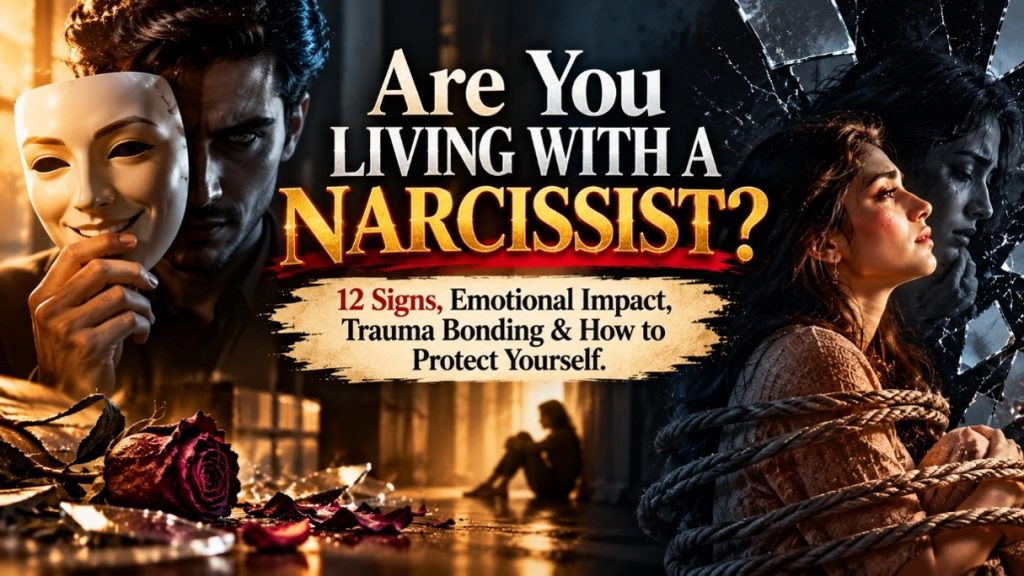
12 Signs, Emotional Impact, Trauma Bonding & How to Protect Yourself
How to recognize narcissistic patterns, understand what they can do to your emotional wellbeing, rebuild your boundaries, and begin finding your way back to yourself.
Everyone else sees a charming, helpful, wonderful person. At home, you see something different. The same person is critical, hard to reason with, and unable to say “I was wrong.” Somehow every conversation ends with you apologizing, even when you started it hurt.
Slowly, a quiet question settles in your mind: Am I the problem?
In my years of working with people, I have heard this question more times than I can count. If you are reading this, I want you to hear something first.
You can love someone and still recognize that their behaviour is hurting you.
This article is not about diagnosing your partner. I cannot do that, and neither can a checklist. It is about recognizing unhealthy patterns, understanding what narcissistic abuse can do to a person, and learning how to protect yourself and heal. Please read it slowly.
What Is Narcissism, Really?
The word “narcissist” is used very casually today. Someone posts too many selfies and gets called a narcissist. A rude boss gets the label too. But being selfish, proud or self-focused at times is human.
Here is the difference:
| What it means | |
| Selfish behaviour | Occasional self-centredness that a person can notice and correct |
| Narcissistic traits | A repeated pattern of needing admiration, avoiding accountability and struggling with empathy |
| Narcissistic Personality Disorder (NPD) | A formal mental health diagnosis that only a qualified professional can make |
So, I never ask you to label your partner. I ask you to look at patterns and how they affect you. Whether or not a diagnosis exists, a relationship that keeps shrinking you needs your attention.
People with strong narcissistic patterns often show a deep need for admiration, a sense of entitlement, sensitivity to criticism, and difficulty understanding another person’s feelings.
Two Commonly Described Presentations
Psychologists often describe narcissistic traits in two ways. These are descriptions, not two neat boxes, and real people are more complicated.
Grandiose traits are the outwardly confident, dominant and entitled style. This person wants to be the centre of attention and looks down on others.
Vulnerable or covert traits look quieter. This person may seem sensitive, withdrawn or always hurt. They may play the victim and respond to even gentle feedback with deep injury. Because it looks like fragility, a covert narcissist can be harder to recognize, and the partner often ends up apologizing and comforting them.
Neither style is automatically “worse.” Both can hurt the people close to them.
12 Signs You May Be Living With Narcissistic Patterns
If several of these feel familiar, please do not use that as proof. Use it as a reason to pay closer attention to your own experience.
Everything Somehow Becomes About Them

You share good news and the conversation turns to their achievements. You share a problem and it becomes their problem.
Example: You mention a tough day at work and they respond with how tough their day was, every time.
How it feels: Invisible, as if your life is only a side story.
2. They Make You Question Your Reality
This is gaslighting, a pattern where someone denies, twists or dismisses your memory or perception until you stop trusting yourself.
Example: “I never said that. You are imagining things. You are too sensitive.”
How it feels: Confusing. You start keeping notes just to check your own memory.
3. Your Feelings Are Consistently Dismissed
Your hurt is called an overreaction, drama or a mood.
Example: You say a comment hurt you and hear, “It was just a joke. Why can’t you take one?”
How it feels: Lonely, because you learn that expressing emotion makes things worse.
4. They Idealize You and Then Devalue You

At the beginning, there is intense attention, praise and promises. Later, the warmth cools and criticism grows. Not every difficult relationship follows a fixed script, but this swing from “you are perfect” to “you are never enough” is commonly described.
How it feels: You keep chasing the person they were in the first months.
5. You Feel Like You Are Walking on Eggshells
You rehearse sentences before speaking. You read their mood the moment they enter the house.
How it feels: Anxious and exhausted, because peace depends on you managing them.
6. They Rarely Take Genuine Responsibility
When confronted, the blame comes back to you. You may also see DARVO: Deny, Attack, and Reverse Victim and Offender. You raise a concern, they deny it, attack your character, and somehow end up as the injured one.
How it feels: You walk in with a complaint and walk out apologizing.
7. Silence Becomes a Form of Punishment

Healthy space is saying, “I need an hour to calm down, then let’s talk.” The silent treatment is days of coldness used to control or punish you.
How it feels: Like emotional starvation, which makes you desperate to fix things.
8. Everyone Thinks They Are Wonderful
Friends and relatives praise them. At home, the behaviour is very different.
How it feels: Isolating. You fear that if you speak up, nobody will believe you.
9. They Gradually Isolate You
Friends are called “bad influence.” Family visits become fights. Over time, your circle shrinks.
How it feels: Like you have nobody to turn to, which makes leaving harder.
10. They Use Comparison or Triangulation
They bring a third person into the relationship to create insecurity. “Why can’t you be like my colleague?” or “My ex never complained.”
How it feels: Competitive and insecure, as if you must keep earning your place.
11. Your Needs Keep Becoming Smaller
First you stop asking for big things, then small things. Eventually you stop asking at all.
How it feels: Like you are asking for too much, even when you are asking for basic respect.
12. You No Longer Recognize Yourself
You used to laugh easily, have opinions and dream. Now you feel quiet, careful and unsure what you even like.
How much of yourself have you been shrinking just to keep the relationship peaceful?
What Living in This Kind of Relationship Can Do to You

Emotional abuse does not leave visible marks, but it does leave an impact. Here is how people often describe it. These are common experiences, not a medical checklist.
Your Mind
- Confusion and constant self-doubt
- Difficulty trusting your own decisions
- Second-guessing every word you say
- Mental exhaustion from analysing every interaction
Your Emotions
- Shame and guilt, even when you did nothing wrong
- Anxiety and hypervigilance, always scanning for the next mood change
- Emotional numbness, as a way of coping
- Feeling responsible for another adult’s emotions
Your Body
Living with prolonged stress can affect sleep, energy, concentration and overall wellbeing. Many people feel constantly tired or tense. If you notice physical symptoms, please speak to a doctor. I would never tell you that this experience causes one specific disease, but your body does carry stress.
Your Sense of Self
This is the part that hurts me most to see. I have watched capable, bright people stop speaking in meetings, abandon dreams, forget their favourite music, and begin living according to someone else’s emotional weather.
If this is you, please know that it is not weakness. It is what happens when a person adapts to survive.
Why Can’t I Just Leave? Understanding Trauma Bonds
People who have never been in this situation often ask, “Why don’t you just leave?” It is a painful question, because the answer is rarely simple.
A trauma bond is an attachment that can develop through cycles of harm and affection. The painful moments are followed by apologies, tenderness or hope. This is called intermittent reinforcement. Because kindness arrives unpredictably, the mind keeps holding on, waiting for the good version to return.
This is why someone can clearly know a relationship is harmful and still struggle to walk away. It does not make you weak or foolish. It means you are human, and your attachment system did what it was designed to do.
Understanding your attachment can replace self-blame with self-awareness.
The Spiritual Perspective: Why Did This Happen to Me?
At some point, almost everyone asks, “Why me?”
I want to share a spiritual view, and I want to share it with great care. From a Vedic perspective, some relationships are understood as Runanubandha, a karmic bond where two souls meet to learn something. In this tradition, planets like Saturn, Rahu and Ketu are associated with lessons around boundaries, attachment, illusion and release.
These are spiritual interpretations, not scientific facts, and you are free to hold them or not.
Now, please hear this clearly:
- You did not attract abuse.
- You did not deserve it because of any past life or karma.
- Spiritual ideas must never become another reason to blame yourself.
If there is a lesson, I believe it is not “you caused this.” It is about reclaiming what may have been given away:
- Choice: you are allowed to decide what you accept
- Dignity: you deserve to be treated with respect
- Boundaries: your “no” is valid
- Inner voice: your intuition was never wrong to speak
- Personal power: you can choose yourself
That, to me, is real spirituality. It returns your power. It never takes it away.
How to Protect Yourself and Begin Healing
Here are practical steps. Take them at your own pace. Healing from narcissistic abuse is not a race.
Step 1: Start Trusting Your Own Experience
Write privately about what happens, what was said and how you felt. Where it is safe, keep notes with dates. This helps you trust your memory again. Keep the journal somewhere only you can access.
Step 2: Reconnect With Safe People
Contact one friend, cousin or colleague who makes you feel calm. You do not have to explain everything. Simply rebuilding contact is powerful.
Step 3: Set Clear Emotional Boundaries
Boundaries are about what you will do, not about controlling the other person. “I will leave the conversation if I am shouted at” is a boundary. “You must stop shouting” is a demand, and demands are easy to ignore. Boundaries need to be calm, consistent and followed through.
Learning to protect your emotional space. If you are realizing that your biggest struggle is not only understanding the other person but learning how to protect your own emotional space, my course How to Set Emotional Boundaries may help. It covers people-pleasing patterns, emotional triggers, manipulation and boundary violations.
Step 4: Stop Over-Explaining Yourself
When you keep justifying, you hand the other person more material to twist. You can say, “I have shared my view. I am not going to argue about it,” and stop there. Some people choose a “grey rock” approach, giving short, neutral and uninteresting replies, to reduce conflict where they cannot leave. It can help, but it is a tool for protection, not a way to live.
Step 5: Consider Low Contact or No Contact Where Appropriate
This depends entirely on your situation. Marriage, children, shared finances, elder-care duties and family ties make it complicated. There is no one-size-fits-all answer, and I will never tell you to walk out tomorrow. Low contact, meaning fewer and more structured interactions, is sometimes the realistic middle path.
Step 6: Create a Safety Plan
If there are threats, intimidation, stalking, physical violence, financial control or fear of retaliation, please treat this as a safety matter first. Reach out to a local domestic-violence helpline, a trusted person or a professional who can help you plan safely. In India, you can contact the Women’s Helpline 181 or emergency services at 112. Do not confront the person alone if you fear for your safety.
Step 7: Seek Professional Help
A qualified therapist, ideally one familiar with trauma and abusive relationship dynamics, can offer support that no article or spiritual practice can. Seeking help does not make you weak. It makes you wise.
Protecting Your Energy: Spiritual Practices and Crystals
Healing is not only about leaving a situation. It is also about rebuilding the relationship you have with yourself.
Many people find comfort in rituals. I use crystals as spiritual tools for intention, reflection and personal ritual. They are not medical treatments. Here are the ones I often suggest for this kind of healing journey, based on traditional associations:
| Crystal | Traditional association | How you might use it |
| Black Tourmaline | Grounding, protection, energetic boundaries | Keep near your bed or entrance |
| Rose Quartz | Self-love, tenderness, emotional openness | Hold during self-compassion practice |
| Labradorite | Intuition, energetic protection | Carry when you need to trust your gut |
| Rhodonite | Emotional healing, compassion | Keep with your journal |
| Citrine | Confidence, personal power, self-worth | Place on your work desk |
| Malachite | Transformation, emotional release | Use during letting-go rituals |
Please remember: crystals can be used as spiritual or reflective tools, but they should not replace therapy, medical care, safety planning or other professional support.
A Simple Daily “Come Back to Yourself” Practice
This takes 5 to 7 minutes. You can do it morning or night.
- Sit somewhere quiet where you will not be disturbed.
- Keep your chosen crystal beside you, or hold it if that feels comforting.
- Take five slow breaths, letting your shoulders drop.
- Place a hand over your heart.
- Ask yourself: “What do I need today?”
- Write one honest answer in your journal.
- Choose one self-respecting action for the day, such as drinking water, saying no once, or calling a friend.
- Close with this affirmation:
“I take back my energy. I take back my identity. I take back my voice. I remember my worth.”
You are not asking the universe to fix anything. You are simply showing up for yourself, and that is where change begins.
Crystals for love and relationship healing. If this topic touches you, I also teach a dedicated course, Crystals for Love, Healing & Harmony, covering emotional healing, self-love, relationships and crystal practices for gentle, steady recovery.
Healing Does Not Mean Becoming the Old You Again
Healing is not neat. Some days you will feel strong, and some days you will cry over something small. That is normal. You may feel:
- Grief for the relationship you hoped for
- Anger, which is often your boundaries returning
- Confusion and relief at the same time
- A strange urge to try old hobbies again
- Curiosity about friendships you let slip
- A returning voice, shaky at first
You are not becoming someone new. You are reconnecting with the part of yourself that became quiet while you were surviving.
Healing is rarely quick or linear. Some weeks you will move forward, and some weeks it will feel like you stepped back. Be patient with yourself.
A Final Message From Me
If you take only a few things from this article, let it be these:
- What happened to you is not proof that you are unworthy.
- Loving someone does not require abandoning yourself.
- Setting boundaries does not make you selfish.
- Seeking help does not make you weak.
- Spirituality should help you reclaim your power, not blame you for your pain.
- Your identity is bigger than what happened to you.
- You can begin coming back to yourself, one choice at a time.
You do not have to spend the rest of your life proving that you are worthy of love. Start by giving yourself the love, protection and respect you kept asking someone else to give you.
With love,
Dr. Neeti Kaushik
Frequently Asked Questions
1. What are the signs of living with a narcissist?
Common signs include constant self-focus, gaslighting, dismissal of your feelings, blame shifting, silent treatment, isolation, and feeling like you are walking on eggshells. These are patterns to notice, not a diagnosis. A professional must assess any personality disorder.
2. What is the difference between narcissistic traits and NPD?
Narcissistic traits are repeated behaviours such as entitlement or low empathy, and many people show some of them at times. NPD is a formal diagnosis made only by a qualified mental health professional after proper evaluation.
3. What is gaslighting in a relationship?
Gaslighting is when someone denies, twists or dismisses your memory or perception so that you begin doubting yourself. Examples include “that never happened” or “you are imagining it.” Over time, it can erode confidence and make you dependent on the other person’s version of reality.
4. What is a trauma bond?
A trauma bond is an attachment that can form through cycles of harm and affection. Because kindness arrives unpredictably, hope keeps you attached. It is not a sign of weakness. It is a pattern that can be understood and gradually changed with support.
5. Why is it difficult to leave a narcissistic relationship?
Trauma bonding, lowered self-esteem, isolation, shared finances, children and fear of retaliation can all make leaving hard. Struggling to leave does not mean you accept the behaviour. Planning, support and professional guidance can make the process safer.
6. How can I set boundaries with a narcissistic partner?
State clearly what you will do, such as leaving a conversation if shouted at, and follow through calmly. Avoid long explanations. Boundaries cannot control another person, but they protect you. If you fear for your safety, seek professional or helpline support first.
7. Can a narcissist change?
Change is possible for some people, but only when they honestly recognize their behaviour and commit to long-term professional help. You cannot force it or cause it. Your wellbeing should not depend on waiting for someone else to change.
8. Can crystals help with healing from emotional abuse?
Crystals are not a medical treatment. Some people use them as spiritual tools for intention, reflection and ritual, such as holding rose quartz during self-compassion practice. They can support a healing routine but should never replace therapy, medical care or safety planning.
9. When should I seek professional help?
Seek help if you feel constantly anxious, numb, unsafe or unable to trust yourself, or if sleep and daily life are affected. Get help immediately if there is violence, threats or stalking. A trauma-informed therapist can guide your recovery.