
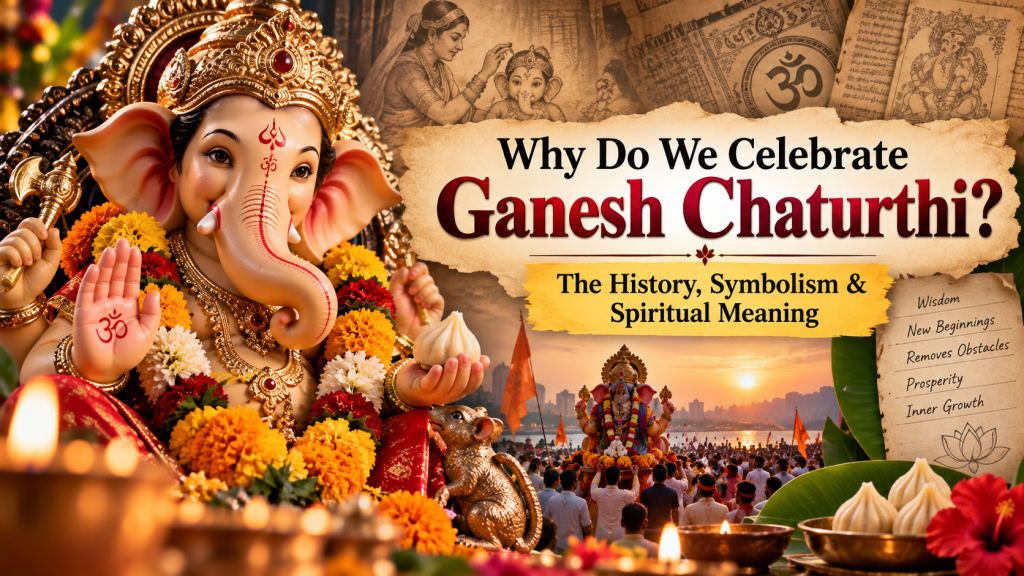
The History, Symbolism & Spiritual Meaning
Every year, in millions of homes across the world, we welcome Ganesha. We bring Him in with flowers, drums, incense, and the sweetness of modak. But have we ever stopped to ask ourselves – what are we actually welcoming?
Not just an idol. Not just a festival. Not just prosperity.
I believe we are welcoming something deeper – wisdom, clarity, new beginnings, humility, and the courage to remove what is blocking our own path.
For me, Ganesh Chaturthi has always felt like more than a religious celebration. As someone who has spent over t decades studying spirituality and the human mind, I now see it as one of the most profound teachings hidden in plain sight.
| Ganesh Chaturthi is not only about asking Ganesha to remove our obstacles. It is also about understanding the obstacles within us. |
In this article, I want to take you beyond the rituals – the timings, the puja steps, the sweets and walk with you through the history, symbolism, and spiritual wisdom this festival quietly carries.
When Is Ganesh Chaturthi in 2026?
| Detail | Information |
| Ganesh Chaturthi 2026 | Monday, 14 September 2026 |
| Hindu Month | Bhadrapada |
| Tithi | Shukla Paksha Chaturthi |
| Madhyahna Puja Muhurat (Delhi) | 11:02 AM – 1:31 PM |
| Celebrated for | 1.5, 5, 7 or 10/11 days, depending on tradition |
| Main Visarjan / Anant Chaturdashi | Friday, 25 September 2026 |
These timings follow the Delhi Panchang and may shift by fifteen to thirty minutes depending on where you live, so do check your local Panchang before beginning your puja.
What Is Ganesh Chaturthi?
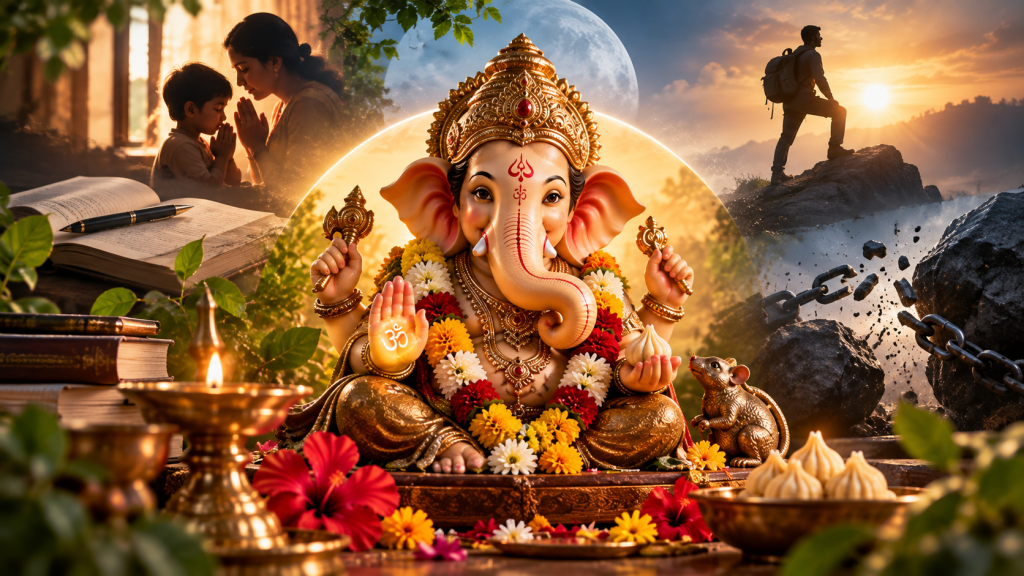
Ganesh Chaturthi commemorates the birth or, as many traditions describe it, the appearance of Lord Ganesha, son of Shiva and Parvati. According to Hindu tradition, this is why it’s celebrated on Chaturthi, the fourth lunar day, in the month of Bhadrapada, usually falling in August or September.
Ganesha is revered as Vighnaharta, the remover of obstacles – which is why so many of us pause to remember Him before starting anything meaningful: a business, a wedding, an exam, even this article.
| Ganesh Chaturthi is both a festival of devotion and a festival of beginnings. It doesn’t only ask us to worship. It asks us to begin – consciously, humbly, aware of what might stand in our way. |
The History of Ganesh Chaturthi: From Sacred Tradition to a Mass Celebration
How Old Is Ganesh Chaturthi?
Ganesha worship has ancient roots within Hindu tradition, and His importance grew steadily over centuries into one of the most beloved forms of the divine. For a long time, Ganesh Chaturthi remained primarily a household and community affair, shaped by local and regional customs. It would be an oversimplification to say the festival “began” in 1893 – that year didn’t mark the birth of Ganesha worship, but its transformation into something much bigger.
The Transformation Under Lokmanya Tilak
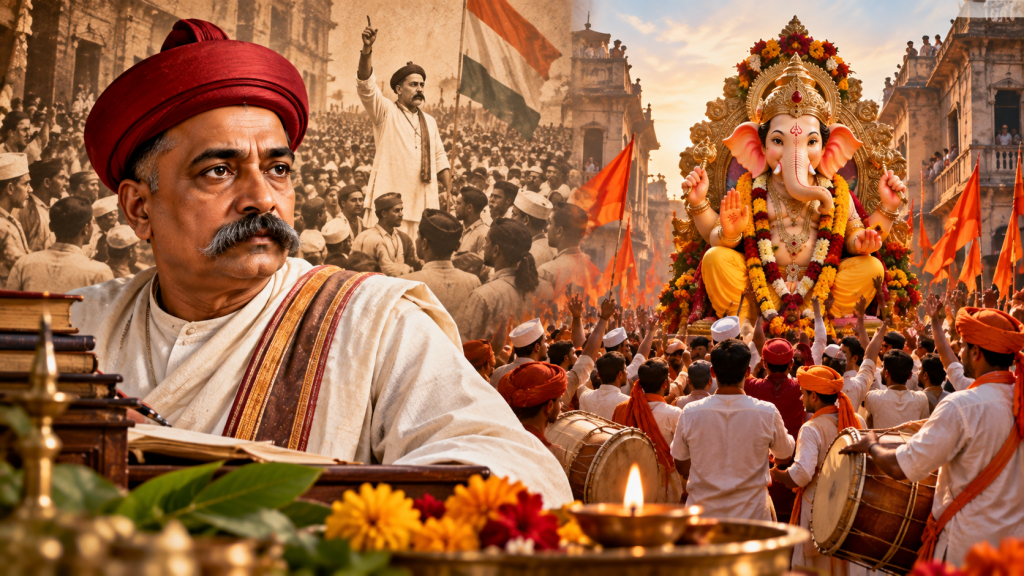
In 1893, freedom fighter Lokmanya Bal Gangadhar Tilak popularised the public celebration of Ganeshotsav in Pune. At a time when the British colonial government restricted public political gatherings, Tilak recognised that a religious festival could bring people together naturally and joyfully. He encouraged communities to install large public idols and celebrate together, turning private devotion into a shared experience that helped foster unity during the independence movement.
| A festival that began in homes became a powerful symbol of community. |
Where Is Ganesh Chaturthi Celebrated?
Maharashtra – the heart of Ganeshotsav. Mumbai, Pune, Kolhapur, and Nagpur come alive with massive public pandals, community mandals, and processions carrying an energy that’s hard to describe unless you’ve felt it.
Across India. The festival is celebrated with deep devotion in Goa, Karnataka, Telangana and Andhra Pradesh (where it’s known as Vinayaka Chavithi), as well as Tamil Nadu, Gujarat, Madhya Pradesh, Delhi, and beyond -each region adding its own flavour.
Around the world. What moves me is how this festival has travelled with the Indian diaspora – community temples and cultural associations across the US, UK, and Gulf countries now host public celebrations every year, proving devotion doesn’t need geography, only intention.
How Is Ganesh Chaturthi Celebrated?
I like to think of the celebration as a journey with clear stages:
- Ganesh Murti Sthapana — welcoming Ganesha into the home or community, marking the start of His stay.
- Prana Pratishtha — the sacred ritual of spiritually invoking and consecrating the idol.
- Puja and Aarti — daily prayers, mantras, and devotional singing through His stay.
- Naivedya — food offerings, most famously modak.
- Community celebrations — pandals, music, dance, and social gatherings.
- Visarjan — the idol is immersed in water, most commonly on Anant Chaturdashi, though shorter traditions immerse on the 1.5th, 3rd, 5th, or 7th day.
What Does Lord Ganesha Symbolise?
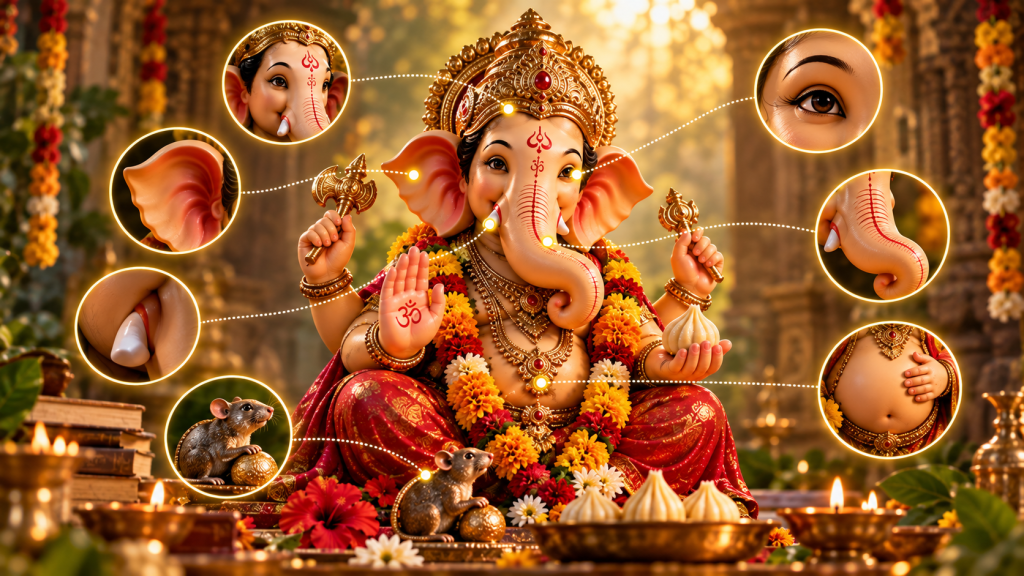
This, to me, is the heart of the festival – every part of Ganesha’s form carries a lesson.
The Elephant Head — Wisdom Over Impulse
It represents intelligence and discernment. Before reacting, pause. Before judging, understand.
The Large Ears — Learn to Listen
Perhaps they remind us that wisdom doesn’t always come from speaking. Sometimes it comes from listening — to others, and to ourselves.
The Small Eyes — Focus
They represent concentration. In an age of constant notifications, focused attention has become a rare form of inner strength.
The Large Belly — Acceptance and Processing
Spiritually, this can be understood as a reminder to digest life’s experiences — pleasant and difficult — rather than pushing them away.
The Trunk — Flexibility and Strength
Strong enough to uproot a tree, sensitive enough to lift a single flower. True strength includes flexibility; rigidity is not the same as strength.
One Broken Tusk — Imperfection Has a Purpose
According to tradition, Ganesha broke His own tusk to serve a greater purpose, often linked to the writing of the Mahabharata. Spiritually, this speaks of sacrifice and resilience – using what remains rather than mourning what’s lost.
The Mouse — Desire Under Awareness
The mouse traditionally represents a restless mind, chasing every small desire. Ganesha sitting calmly above it can be understood spiritually as: your desires may exist, but they don’t have to control you.
The Spiritual Meaning of Ganesh Chaturthi
Sometimes the obstacle is not outside us at all. It is fear, self-doubt, procrastination, attachment, anger, or an old belief we’ve outgrown but haven’t yet released.
Ganesh Chaturthi can become an invitation to ask ourselves:
- What is blocking me?
- What am I afraid to begin?
- Which habit keeps repeating in my life?
- What am I holding onto that I no longer need?
- Where do I need more clarity?
Ganesh Chaturthi and the Psychology of New Beginnings
From a psychological perspective, there’s a beautiful principle hidden in what we do: rituals can create a genuine sense of transition in the mind.
When we set an intention, focus our attention, and repeat a meaningful action, we are, in effect, telling our own minds – something is changing now. This is what I often speak about in my work around manifestation and conscious living: intention, paired with attention and action, changes how we show up in our lives.
| Ganesh Chaturthi, at its core, gives us permission to say, “I am beginning again.” |
Why Do We Bring Ganesha Home Only to Say Goodbye?
Of everything in this article, this is the part that moves me the most.
We welcome Ganesha with such warmth. We celebrate Him. We grow attached to His presence. And then, we let Him go.
The idol, traditionally made from earthly clay, eventually returns to nature through water – a cycle of creation, celebration, attachment, release, and return. What if Visarjan is also teaching us how to let go?
Let go of old identities that no longer serve you. Let go of fear that keeps you small. Let go of resentment that weighs you down. Let go of outdated beliefs, unrealistic expectations, and the exhausting need to control everything around you.
| We ask Ganesha to come into our homes, then willingly let Him go. That paradox is the real teaching – reminding us not to confuse love with possession, attachment with devotion, or control with security. |
Ganesh Chaturthi and Our Relationship With Nature
Traditionally, Ganesha idols were crafted from shadu clay and painted with natural dyes – materials that could return to the earth and water without causing harm. In recent years, there has been a growing and much-needed emphasis on eco-friendly celebration, moving away from Plaster of Paris idols and chemical paints that damage rivers, lakes and seas during mass immersion.
| If our celebration creates devotion but harms the environment, perhaps it’s time to rethink the way we celebrate. |
I say this with love, not judgement. Choosing a clay idol, using natural colours, or immersing at home in a bucket of water that later nourishes a plant – these small choices honour Ganesha’s own connection to the earth.
What Can We Learn From Lord Ganesha? 10 Life Lessons
- Begin with wisdom. Take a moment to think clearly before you act.
- Listen more than you speak. The people who grow most are often the ones who listen most carefully.
- Protect your focus. Your attention is precious – guard it.
- Be flexible without becoming weak. Strength and softness are not opposites.
- Accept your imperfections. What feels broken may be exactly what helps you fulfil your purpose.
- Learn to manage desire. Wanting things is human; being controlled by that wanting is optional.
- Digest difficult experiences. Don’t rush past pain or push it away – allow yourself to process it.
- Don’t let obstacles define you. An obstacle is something you move through, not an identity.
- Know when to let go. Holding tightly to everything isn’t devotion – it’s fear.
- Make room for new beginnings. Every release clears space for something new.
| Carry This Fresh Start Forward If this Ganesh Chaturthi has stirred in you the wish for a real new beginning, my Crystals for New Beginnings collection is a lovely, tangible way to hold that intention close. Explore Crystals for New Beginnings → |
How Can You Celebrate Ganesh Chaturthi Spiritually?
A simple inner practice, alongside your rituals this year:
- Step 1: Sit quietly for five minutes, without distractions.
- Step 2: Look at Ganesha’s form consciously – really look, don’t just glance.
- Step 3: Ask yourself honestly: “What is the biggest obstacle within me right now?”
- Step 4: Write it down, in your own words.
- Step 5: Write one small action you can take to work through it.
- Step 6: Set one conscious intention for the coming days.
A Simple Ganesh Chaturthi Intention Ritual
This Ganesh Chaturthi, instead of making only a wish, I invite you to make an intention.
A wish sounds like: “I want success.”
An intention sounds like: “I am ready to take consistent action toward the work that creates success.”
Do you feel the difference? A wish waits. An intention moves.
Ganesh Chaturthi, Manifestation and Conscious Action
I want to be honest with you here: worshipping Ganesha will not magically manifest your desires without effort on your part. That isn’t how any of this works.
What I do believe is this – spiritual practice can help us clarify what we truly want, strengthen our attention toward it, and remind us, again and again, to act consciously rather than react automatically.
| Intention + Awareness + Action — this is the grounded formula hidden within this festival. |
| Ready to Go Deeper? If you’d like a structured way to align your intentions with the cosmos beyond this festival, my Advanced Manifestation with the Power of Astrology course walks you through exactly that — step by step. Explore the Course → |
Ganesh Chaturthi Is More Than a Festival
We’ve walked through history – from ancient household devotion to Tilak’s public Ganeshotsav in 1893. Through community – from the streets of Mumbai and Pune to temples across the world. Through symbolism – the wisdom in the elephant head, the patience in the large ears, the strength in the flexible trunk. Through nature’s quiet lessons in Visarjan, and the beautiful discipline of letting go.
When I look at Ganesha now, I don’t see only the remover of obstacles. I see a reminder – of who I want to become, and what I still need to release along the way.
Perhaps the greatest prayer we can make this Ganesh Chaturthi is not simply, “Remove my obstacles.”
Perhaps it is:
| “Give me the wisdom to recognise them, the courage to face them, and the strength to move beyond them.” |
Ganpati Bappa Morya. 🙏
Frequently Asked Questions About Ganesh Chaturthi
When is Ganesh Chaturthi in 2026?
Monday, 14 September 2026.
Why is Ganesh Chaturthi celebrated?
To mark the birth of Lord Ganesha and invite His blessings before beginning new ventures.
What is the spiritual significance of Ganesh Chaturthi?
It can be understood as a celebration of wisdom, new beginnings, inner transformation, conscious action, and letting go.
Why is Lord Ganesha called Vighnaharta?
It means “the remover of obstacles” – He is worshipped before new undertakings to clear the way for success.
Why does Ganesha have an elephant head?
According to tradition, it symbolises wisdom, intelligence, and discernment.
Why does Ganesha have a mouse as his vehicle?
The mouse traditionally represents a restless mind. Ganesha’s calm presence above it is spiritually interpreted as mastery over desire.
Why are Ganesha idols immersed in water?
Visarjan symbolises the cycle of creation and dissolution, and reflects letting go with love rather than attachment.
How many days is Ganesh Chaturthi celebrated?
Depending on tradition, 1.5, 5, 7, or the full 10 to 11 days, ending on Anant Chaturdashi.
Where is Ganesh Chaturthi most popularly celebrated?
Maharashtra is the heart of the public Ganeshotsav, though it’s celebrated across India and among Indian communities worldwide.
How can I celebrate Ganesh Chaturthi in an eco-friendly way?
Choose idols made of natural shadu clay with natural dyes instead of Plaster of Paris, and immerse at home in a bucket of water where possible.