
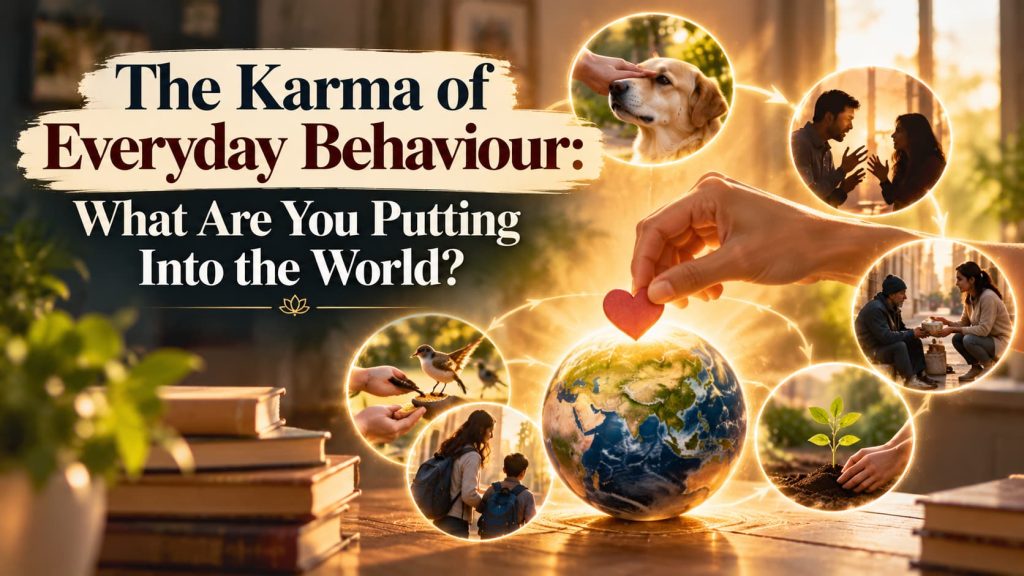
Let me begin with a picture I want you to hold in your mind.
There is a person who speaks beautifully about kindness. On stage, on social media, in family gatherings, they talk about good karma, compassion, and helping others. People admire them. People say, “What a wonderful soul.”
But at home, that same person dismisses a family member’s feelings in one sharp sentence. At work, they humiliate someone who cannot answer back. They make a promise and quietly forget it because keeping it has become inconvenient.
Is this person bad?
I do not think it is that simple. Most of us are not villains. We are human beings who love to be seen as good, and slowly, without noticing, we begin to confuse looking good with being good.
Over the years, I have come to understand that this is one of the quietest traps on any spiritual path. So, I want to ask you something honestly.
- If your kindness disappears when nobody is watching, what was it really?
- Are you becoming a better human being, or are you simply becoming better at appearing to be one?
This article is about the karma of everyday behaviour. It is not about big rituals or big donations. It is about the small, ordinary moments of your day, because that is where your character is actually being written.
Karma Is Not Just About What You Receive
When people talk about karma, the questions are almost always about getting something back. “Will he face the consequences of what he did to me?” “Will my good deeds be rewarded?” “Why is this happening to me?”
I understand these questions, because pain makes us look for fairness. But when I think about karma, I do not see it only as a question of what comes back to me. I also think about what I am contributing.
So let me offer you a different question: “What am I putting into the world through the way I live?”
Karma has been understood differently across spiritual traditions. Even the Bhagavad Gita points us toward our right to perform our duties, but not to the fruits of our actions. Scholars also note that in Indian thought, the results of actions may be delayed and do not always appear immediately. So, I will not tell you that every action brings an instant reward or punishment. Life is not a vending machine. What I can tell you is that our actions matter, and they shape both the people around us and the person we become.
Here are some everyday actions that quietly carry karma:
- Keeping a promise even when it becomes inconvenient
- Treating someone fairly when there is nothing to gain from it
- Speaking honestly instead of manipulating a situation
- Giving credit to the person who actually did the work
- Returning what belongs to someone else
- Respecting another person’s time
- Taking responsibility after a mistake
- Helping without secretly expecting a favour in return
None of these look dramatic. But together, they are the real shape of a life.
The Mask of Goodness: Who Are You When Nobody Is Watching?

This is the part I most want you to sit with.
There is a big difference between having a good reputation and having integrity. Reputation is what people say about you. Integrity is what you do when no one is saying anything at all.
A person can learn all the right words. They can share inspiring quotes, speak about spirituality, and even perform visible acts of charity. But the mask slips in small, subtle ways:
- Being very polite to senior leaders but dismissive towards juniors
- Speaking about equality while treating domestic helpers or service staff as if their time and dignity do not count
- Praising kindness in public while making cruel remarks about people in private
- Helping someone only when it improves one’s image
- Saying “sorry” just to end an uncomfortable conversation, without truly owning the mistake
- Doing favours in a way that later controls the other person
- Talking about loyalty but breaking commitments when it suits us
Here is a simple way to see the difference:
| Public image | Private character | |
| Kindness | Shown when others are watching | Practised even when no one will know |
| Apology | Offered to end the discomfort | Offered because the hurt is understood |
| Promises | Made to please people | Kept even when it costs something |
| Generosity | Visible and praised | Quiet and without conditions |
| Respect | Given to those who are useful | Given to everyone |
Please hear me carefully. Everyone has flaws. Everyone loses patience on a bad day. & Everyone behaves inconsistently sometimes. The question is not whether you have ever failed. The question is whether you are willing to see it, own it, and change.
That is what integrity really is. It is the daily effort to bring our public values and our private behaviour closer together.
Perhaps the truest measure of our character is not how kindly we behave when people are watching, but how consciously we behave when there is nothing to gain from being kind.
If this section made you pause, you are already doing something important. Self-awareness is where change begins. If you would like gentle guidance to understand your patterns and make more conscious choices, you may EXPLORE UNLOCK YOUR INNER POTENTIAL THROUGH JOURNALING.
How You Treat People Who Cannot Benefit You Matters
Many of us, without realising it, divide people into two groups: those who are useful to us and those who are not.
We are warm and respectful with the person who can give us a promotion, introduce us to someone important, or help our business grow. But what about the person who delivers our food, cleans our office, drives us home, or works under our supervision? What about the friend who has nothing to offer us except friendship? What about the family member whose daily work we have started to take for granted?
I often feel that this is where our real values become visible. Anyone can be polite to power. The true test is how we treat people who have less of it.
Think about these everyday situations:
- Employers and employees: Do you pay fairly and on time, and respect their personal time?
- Managers and juniors: Can you correct a mistake without humiliating the person?
- Customers and service workers: Do you speak with patience, even when you are in a hurry?
- Colleagues competing for recognition: Can you stay honest and fair when you feel threatened?
- Family members: Do you notice and thank the people who quietly hold your home together?
Kindness does not mean pretending every relationship is the same. Work has responsibilities. Accountability matters. Boundaries matter. But basic dignity is not something a person has to earn by being useful to us.
Small actions carry great weight here. Letting someone finish explaining. Acknowledging effort. Keeping your word. Saying, “You were right, and I was wrong.” These cost nothing, yet they can change how a person feels about themselves for the entire day.
Kindness Does Not Have to Cost Money

Many people believe that “giving back to society” requires wealth, big donations, or heroic sacrifice. So, they say, “When I have more money, I will do good.” And the years pass.
But some of the greatest generosity in this world is free. You can give your time, your attention, your patience, your fairness, and your words, today, exactly as you are.
Here are some ways:
- Listening patiently when someone needs to talk
- Offering sincere appreciation to someone whose work is usually overlooked
- Helping a colleague understand something without making them feel small
- Giving credit where it is due
- Checking on a friend without waiting to be asked
- Staying respectful even in the middle of a disagreement
- Refusing to spread gossip that could hurt someone
- Choosing honesty when a lie would be easier
- Helping a stranger with directions or a small favour, when it is safe
- Pausing to understand someone who is struggling before judging them
You do not have to fix everyone’s problems. Sometimes kindness simply means not making a hard situation harder.
And science seems to quietly agree. Researchers at the Greater Good Science Center have noted that kindness is contagious, because people who witness or receive kindness are more likely to be kind themselves.
In their BIG JOY Project, early results suggested that people who commit to small daily micro-acts of joy report a boost in positive emotions. Researchers are careful to say this is not a cure-all or a substitute for medical care. But it tells us something beautiful: small, steady kindness changes both the giver and the receiver.
The Intentions Behind Our Actions Matter Too
Two people can do exactly the same thing on the outside. One helps because they genuinely care. The other helps to be praised, or to make the other person feel they owe something.
I am not saying every kind act must be perfectly selfless. Human motivation is mixed, and enjoying a little appreciation does not make your good deed meaningless. I am only inviting you to look gently at your own heart. Ask yourself:
- Do I help because I care, or because I want to be seen as caring?
- Do I give freely, or do I keep an invisible list of what people owe me?
- Do I support someone’s success, or do I feel resentful when they get recognition?
- Do I apologise because I understand the hurt I caused, or because I want the matter to disappear?
- Do I speak kindly because I respect this person, or because I want something from them?
Please do not use these questions to shame yourself. Be curious, not cruel. Honest self-awareness is far more useful than pretending to have perfect intentions. The moment you notice a mixed motive, you have already taken a step toward a cleaner one.
Looking inward is not always easy, and you do not have to do it alone. If you would like a guided path for emotional awareness and conscious living, you may THE ADVANCED HOʻOPONOPONO HEALING JOURNEY
A Personal Karma Check-In
Now let us make this practical. Take five quiet minutes, a cup of tea if you like, and answer these questions honestly. This is not a test of whether you are a good or bad person. It is only a mirror.
- Am I the same person in private that I try to appear to be in public?
- How do I treat people when I am stressed, irritated, or in a position of authority?
- Have I ever taken someone’s kindness for granted?
- Do I keep my promises, or do I make commitments just to please people?
- When I help someone, do I expect gratitude, recognition, or repayment?
- Have I benefited from someone’s work without properly acknowledging it?
- Is there someone I need to apologise to or treat more fairly?
- What is one small act of kindness I can do today without expecting anything in return?
You may feel uncomfortable with some answers. That is not failure. That is awareness waking up. The purpose is not self-condemnation. Please do not promise to change your entire personality overnight. Choose just one action. Send that message. Return that item. Say that thank you. One real step is worth more than a hundred big promises.
What Should You Do When You Realise You Have Been Wrong?
Seeing our own selfishness, carelessness, or hypocrisy can hurt. But awareness is meaningful only when it leads to responsibility, and responsibility always leaves room for hope. Here are four simple steps:
- Acknowledge: Name what you did honestly, without rushing to make excuses.
- Repair: Where appropriate, apologise sincerely, correct the mistake, return what is owed, or give credit to the person who deserves it.
- Change: Understand what led to the behaviour and decide what you will do differently next time.
- Continue: Do not use one good deed to wipe out earlier harm. Keep showing up, again and again, until consistency becomes your nature.
Remember that an apology does not guarantee forgiveness, and some wounds take time. Some situations may also need firm boundaries, professional guidance, or formal accountability. That is not a lack of kindness. That is wisdom.
The goal is never perfection. The goal is to become a little more conscious, responsible, and considerate than you were yesterday. And that is something every one of us can do.
Spirituality Must Change How We Treat People
I want to bring this back to the heart of spiritual life.
Spiritual growth cannot be measured only by how many rituals we perform, how long we pray, how many books we read, or how much knowledge we collect. For me, spirituality must eventually show up in the way we treat people.
So gently ask yourself: Do I become more compassionate when someone makes a mistake? Am I more honest when dishonesty would benefit me? Can I admit when I am wrong? Do I treat others with dignity even when I am tired, busy, or disappointed?
These are not tests of your spiritual worth. They are invitations. Every ordinary day, every phone call, every conversation at home or at work is a small chance to practise the values we say we believe in.
What Are You Leaving Behind in People’s Lives?
Let us return to where we began, that person who looked so good in public.
I hope we can stop measuring goodness only by achievements, praise, status, or visible charity. Perhaps a better measure is quieter. What do people feel in your presence? Do they feel respected? Heard? Treated fairly? Do they feel that their time and effort matter? Can they trust you to keep your word?
This is not about becoming perfect, pleasing everyone, or giving up your own well-being. Kindness never means accepting mistreatment or saying yes to everything. It is about awareness, and about taking responsibility for the impact of your choices.
Perhaps the most meaningful question is not simply what life will give back to us, but what we are choosing to put into the lives of others today. We may not control every consequence, and we may never know the full impact of our actions. But we can choose to leave people with a little more dignity, a little more understanding, and a little less unnecessary hurt than they might otherwise have experienced.
That is the karma of everyday behaviour. It does not ask you to fear anything. It simply invites you to live with greater integrity, starting today, starting small, starting exactly where you are.
Frequently Asked Questions
Q1. What does karma mean in everyday life?
Ans. In everyday life, karma means that our actions, words, and intentions matter. Different traditions interpret it differently, but a practical understanding is that how we treat people shapes the atmosphere around us and the person we become. It is a call to conscious, responsible living, not a fixed formula of instant rewards and punishments.
Q2. Does karma depend on our intentions as well as our actions?
Ans. Many spiritual and ethical traditions say yes. Two people can perform the same action with very different motives, such as genuine care versus seeking praise or control. Our intentions are worth examining with curiosity. You do not need perfectly pure motives, only honest awareness of why you do what you do.
Q3. Can small acts of kindness make a difference?
Ans. Yes. A patient listen, a sincere thank you, or a fair decision can make someone feel respected for the whole day. Early research from the Greater Good Science Center also suggests small, regular acts of kindness can lift mood. They are not a cure-all, but they matter.
Q4. Is being kind the same as pleasing everyone?
Ans. No. Kindness means treating people with dignity, honesty, and respect. It does not mean saying yes to everything, tolerating mistreatment, or ignoring your own boundaries. You can say no firmly and still be respectful. Real kindness includes caring for yourself too.
Q5. How can I practise good karma in my daily life?
Ans. Start small. Keep one promise you have been delaying, thank someone who is usually overlooked, give credit where it is due, or apologise sincerely to someone you have hurt. Choose one action a day, do it without expecting anything back, and let consistency do its quiet work.
References and Further Reading
- Bhagavad Gita, Chapter 2, Verse 47 (text and translation): (Read More)
- Encyclopaedia Britannica, “karma” summary: (Read More)
- Greater Good Science Center, UC Berkeley, “Three Strategies for Bringing More Kindness into Your Life”: (Read More)
- NPR, “How daily moments of joy can help long-term well-being” (on the BIG JOY Project, preliminary findings): (Read More)