

There is a sentence I hear more often than almost any other, from students, from readers, from people who write to me after a workshop with tears still drying on their cheeks. It usually sounds something like this:
“Dr. Neeti, I know this isn’t good for me. I know it. So why do I keep doing it anyway?”
- Maybe you know a relationship isn’t right for you, and yet you find yourself choosing the same kind of person again.
- Maybe you know you are capable of so much more, and yet you keep holding yourself back at the edge of your own potential.
- Maybe you told yourself years ago, “I will never become like my parents,” and now, in a quiet unguarded moment, you catch yourself reacting exactly the way they did.
If any of this feels familiar, I want you to know something before we go any further.
You are not lacking intelligence. You are not lacking willpower. What you are experiencing is one of the most human, and most misunderstood, experiences there is: the gap between what we know and what we actually do.
Why does this gap exist? Why do we repeat something we consciously know is not serving us? The answer, as I have come to understand it through my own life and through years of guiding others, is both psychological and spiritual. And once you begin to understand it, something in you starts to loosen.
Knowing Something Is Not the Same as Believing It
Here is the first truth I want to offer you. Conscious knowledge and subconscious belief are two very different forces, and they do not always agree with each other.
You can consciously believe, “I deserve a healthy relationship.” But underneath that belief, quietly running in the background, there may be an older, deeper program that whispers-
- “Love has to be earned,” or
- “People eventually leave,” or
- “I have to keep everyone happy in order to be wanted.”
In the same way, you might consciously want success and growth, while somewhere underneath, success is subconsciously linked to pressure, judgment, or the fear of leaving your comfort zone.
The conscious mind wants one thing. The subconscious mind, shaped over years by experience and emotion, often chooses what feels familiar over what is actually healthy.
This is where repeating patterns begin. Not because you are weak, but because familiarity feels safer to the subconscious than the unknown, even when the unknown is better for you.
The Patterns We Keep Repeating
Over the years, I have noticed that repeating patterns tend to show up in a few recognisable forms.
Relationship patterns. Some of us keep finding ourselves in dynamics involving emotional unavailability, over-giving, fear of abandonment, or a difficulty saying no. This does not mean you consciously choose pain. It means certain emotional dynamics feel strangely, uncomfortably normal, because they echo something you learned to expect from love a long time ago.
Career patterns. This might look like staying in a job that drains you, underestimating your own worth, avoiding leadership, procrastinating the moment an opportunity appears, or starting things with enthusiasm and rarely finishing them. Sometimes it looks like self-sabotage right at the point of growth, as though something inside you pulls the brakes just when the road opens up.
Self-sabotage. This is one of the most confusing patterns to sit with, because it feels contradictory. You want something, you move toward it, and then, almost without noticing, you find a reason to stop. Fear, old beliefs, and a sense of identity that has not caught up with your growth can all quietly influence this.
None of this makes you broken. It makes you human, and it makes you someone whose subconscious mind learned certain rules long before you had the awareness to question them.
Where Do These Patterns Come From?

I like to think of patterns as having layers, much like the layers of the earth. To understand them, we usually need to look beneath the surface.
Subconscious Beliefs
Repeated messages, experiences, and emotional associations slowly harden into beliefs. Some common ones I have encountered in my years of working with people include:
- “Money is difficult.”
- “People cannot be trusted.”
- “Success changes people.”
- “I must struggle to deserve something good.”
- “This is just how our family is.”
These beliefs rarely arrive with a label attached. They simply become the lens through which we experience life, so quietly that we mistake them for facts.
Family Patterns
We learn far more from watching than from being told. We absorb how our parents handled conflict, how they spoke about money, how they responded to failure, how they expressed love, and what they believed was possible for people like us.
I want to be very clear about something here. This is not about blaming your family. Most parents pass on what was passed on to them, often without ever examining it. Understanding a pattern is not about assigning fault. It is about giving yourself the chance to consciously choose what you want to carry forward, and what you are finally ready to release.
Karma or Conditioning: Are You Repeating a Lesson, or a Learned Habit?
This is one of the questions I sit with often, both in my own life and alongside the people I work with.
From a spiritual lens, some of us understand recurring experiences as karmic lessons, as something the soul is still working through until the learning is complete.
From a psychological lens, the same recurring experience can be understood through conditioning: learned beliefs, emotional associations, and behaviours we repeat because they were once reinforced.
I do not believe we always need to choose one explanation over the other. In my experience, both lenses can illuminate the same experience from different angles, and both can be true at once.
So instead of only asking, “Why does this keep happening to me?” I invite you to also ask a gentler, more useful question:
“What is this pattern trying to help me understand about myself?”
That single shift, from why me to what now, is often where real transformation quietly begins.
Why Awareness Alone Doesn’t Break the Pattern

I want to be honest with you about something, because I think honesty serves you better than false promises. Awareness is essential, but awareness by itself rarely changes behaviour overnight.
You might read this article, nod along, recognise your pattern completely, and still find yourself repeating it next week. That does not mean the awareness failed. It means transformation follows a sequence:
Awareness → Understanding → Practice → New Response → Repetition → Change
Someone can clearly identify, “I know I have people-pleasing tendencies,” and still say yes when every part of them wants to say no. Knowing is the doorway. It is not the whole house.
Ask Yourself
Before we move into practice, sit with these questions honestly. There is no need to rush or judge your answers.
- What situation keeps repeating in my life?
- What emotion usually rises just before I repeat the pattern?
- What do I tell myself in that exact moment?
- What am I afraid might happen if I responded differently?
- What belief might be sitting underneath this reaction?
- Where might I have first learned this belief?
- Does this belief still serve the person I am becoming?
| Layer | What It Looks Like | What It Asks of You |
| Conscious knowledge | “I know I deserve better.” | Awareness and honesty |
| Subconscious belief | “Love has to be earned.” | Gentle questioning |
| Emotional trigger | Anxiety, fear of rejection, urge to please | Noticing without judgment |
| Old pattern | Repeating the familiar choice | Pausing before reacting |
| New response | Choosing differently, even imperfectly | Practice and repetition |
The Inner Work: How I Begin to Break a Pattern
Over time, I have come to rely on a simple, honest framework whenever I want to shift something in myself.
Step 1: Name the pattern. You cannot consciously change what you refuse to acknowledge. Naming it out loud or in writing takes away some of its hidden power.
Step 2: Find the belief beneath it. Ask yourself, “What would I have to believe about myself for this behaviour to make complete sense?” The answer is often surprisingly clear once you ask it directly.
Step 3: Notice the trigger. Which situations tend to switch on the old response? Awareness of the trigger gives you a few precious extra seconds before you react.
Step 4: Question the belief. Ask, “Is this actually my truth, or is this something I learned and never questioned?”
Step 5: Create a new belief. I want to be gentle but honest here. Affirmations are not magic sentences that erase years of conditioning overnight. What they do is repeatedly introduce a new internal conversation, one that slowly becomes as familiar as the old one once was.
Step 6: Take one different action. This is the step most people skip, and it is the one that matters most. A new belief only becomes real when your behaviour starts to support it, even in one small way.
Step 7: Repeat. Transformation is rarely one dramatic breakthrough. It is usually a quiet accumulation of small, conscious choices, made again and again, until they become who you are.
Journaling: The Conversation That Reveals What Your Mind Has Been Hiding

Journaling has been one of the most valuable tools I return to, both personally and in my work with students, because it slows down the automatic mind long enough to actually see what is happening beneath the surface.
Here is a short exercise you can try today. Complete each sentence honestly, without editing yourself.
- The pattern I keep repeating is…
- I usually feel…
- The thought I have in that moment is…
- The belief underneath that thought may be…
- I may have learned this belief from…
- A healthier belief I want to practise is…
- One different action I can take next time is…
If you feel that journaling like this could help you understand your own patterns more deeply, my course Unlock Your Inner Potential Through Journaling takes this practice much further. It is built around ten journaling methods designed to help you unlock mental blocks, build a sustainable journaling habit, and gain real clarity in the decisions you make. If this resonates, you can explore the course and begin your own journaling journey whenever you are ready.
A Personal Reflection
My own connection to inner work and manifestation goes back further than most people realise, all the way to childhood, when I would spend hours daydreaming and vividly imagining what I wanted my life to look like. I did not have a name for it then. I only knew that some part of me was always quietly working with intention, long before I understood the psychology or the spirituality behind it.
Over the years, working closely with so many students, I have noticed something interesting again and again. It is rarely a lack of desire that holds people back. It is not that they cannot want something enough. What holds them back is a quieter belief, one that rarely announces itself directly. Sometimes the real limitation is not “I cannot.” It is “people like me don’t do that.”
That sentence deserves to be questioned, gently and honestly, by every single one of us.
Some of these old, inherited beliefs are connected to emotional experiences from much earlier in life, moments that shaped what we believed was safe, acceptable, or possible. If you sense that some of your patterns are rooted in those older emotional layers, my course Shadow Journaling for Inner Child Healing was created to help you explore that inner landscape gently, through guided reflection and journaling, at a pace that allows you to process deeply rather than rush through it.
When the Pattern Is About What You Believe You Deserve
Many repeating patterns, especially around money, opportunity, and self-worth, are quietly shaped by our relationship with abundance itself. We can want more, plan for more, and still feel an invisible ceiling stopping us.
Manifestation, in my understanding, was never simply about asking the universe for something and waiting. It is about becoming deeply aware of the beliefs, emotions, and actions that are already shaping how you move toward, or away from, what you desire.
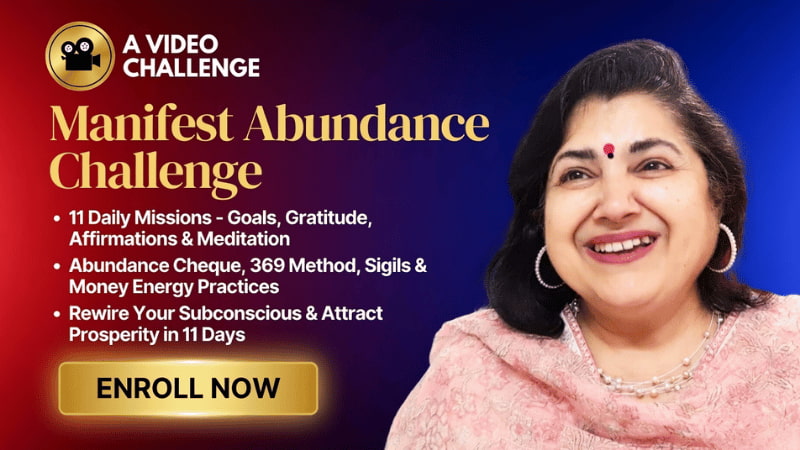
If this idea speaks to you, my Manifest Abundance Challenge is designed exactly for this: an eleven day structured practice to help you identify where scarcity thinking has taken root and consciously shift toward a mindset of genuine abundance.
Creating Space for the Shift
Sometimes the most important part of this work is not more thinking, but more stillness. Our minds are so full of noise, deadlines, and old chatter that we rarely give ourselves the quiet needed to actually feel what is happening inside us.
If you feel you need that kind of space, one of sound, silence, and gentle release, my audio course The Frequency Shift was created to support exactly that. It offers a guided way to slow down, release what you are holding onto, and create the inner alignment that makes real, lasting change possible.
The Final Shift: From “Why Me?” to “What Is This Teaching Me?”
I will not pretend this work is simple, or that it finishes in a week. You may not be able to change every circumstance around you. You may never fully understand every karmic thread running through your story. & You may not immediately trace every belief back to its origin.
But you can begin to notice. You can pause before reacting. You can question a thought instead of obeying it automatically. & You can choose, even once, to respond differently to an old trigger. And every time you do, you create quiet evidence that the old pattern does not get to define who you are becoming.
Awareness is the doorway. Conscious choice is the practice. Repetition of that new choice is what finally creates change.
One Companion for the Whole Journey
If everything I have shared with you today, the pattern, the belief beneath it, the release, the new choice, feels like a lot to hold onto, I want to tell you about something close to my heart.
I have poured years of my own journey with lunar energy into a book: Manifesting by the Moon. It is not a textbook you read once and shelve. It is a companion you return to, month after month, moon after moon.

From New Moon intention setting to Full Moon release rituals, from making moon water to charging your crystals under moonlight, it walks you through every part of this work we have talked about today: letting go of what no longer belongs to you, working with your beliefs instead of against them, and slowly, gently, becoming the version of yourself you are meant to grow into.
If you feel ready to hold something in your hands that walks beside you through every phase of this transformation, you can pre-order your copy of Manifesting by the Moon here.
The Moon has been waiting for you. And so has this book.