The 9 Laws of Energy You Must Respect
A Personal Guide to Protecting Your Peace, Your Time and Your Heart
Have you ever replayed one small conversation in your head for hours? Maybe someone said something careless at work, and by evening it was still sitting in your chest like a stone. Or maybe you gave and gave to everyone around you until one day you looked in the mirror and felt completely empty.
I have been there. There was a phase in my life when I was tired all the time, and not from lack of sleep. It was a deeper tiredness, the kind that comes when your energy goes in ten directions and nothing comes back to you. I kept asking myself, “What is wrong with me?” It took me a long time to understand that nothing was wrong with me. I simply did not know how to respect my own energy.
Over the years, through my own journey and my work in spirituality, I have come to understand nine simple principles. I call them the 9 laws of energy. These are not scientific laws. They are spiritual principles, gentle reminders that help me live more consciously. They have changed how I think, how I love, how I say no, and how I heal.
If you are feeling drained, confused or stuck, sit with me for a few minutes. I want to share them with you the way I would with a close friend.
Quick Overview: The 9 Laws at a Glance
| Law | The Core Message |
| 1. Attention | What you focus on grows stronger |
| 2. Exchange | Energy flows where value is honoured |
| 3. Boundaries | What you allow becomes your atmosphere |
| 4. Intention | Unclear desires lead to unclear outcomes |
| 5. Timing | Some doors open only at the right time |
| 6. Reflection | Repeated patterns show what needs healing |
| 7. Release | Holding on makes moving forward hard |
| 8. Silence | Not everything needs to be shared |
| 9. Clarity | Confusion needs reflection before action |
Law 1: The Law of Attention
What you focus on grows stronger.

Think about the last time someone criticised you.
Did you remember the ten good things people said, or the one hurtful comment?
Most of us hold on to the one. Our mind is like a torch. Wherever we point it, that area becomes bright and big, and everything else goes dark.
I have noticed this in my own life many times. When I kept my attention on what was missing, I found more things that were missing. When I turned my attention towards what I could do and what I was grateful for, the same day felt lighter.
Please understand, this does not mean pretending your problems do not exist. Real problems need real attention. It means you first acknowledge what is happening, and then you choose where to place your focus.
Try this today:
- When a worry starts looping, ask, “Is there any action I can take right now?”
- If yes, take one small step. If no, gently move your mind to something useful.
Your attention is the most precious thing you own. Spend it like it matters.
Law 2: The Law of Exchange
Energy flows where value is honoured.
Some of us are the “always available” person in the family or friend circle. We listen, we help, we adjust. And somewhere inside, we feel proud of it. But there comes a day when we are exhausted, and we realise nobody has asked how we are.
For years, I believed that giving more made me a better person. Now I understand that real kindness does not mean self-neglect. A healthy relationship has ‘give and take’. It will not be perfectly equal every single day, because life does not work like that. But over time, there should be respect, appreciation and effort from both sides.
If you only give and never allow yourself to receive, you will slowly run dry. A cup that is always pouring needs to be filled too.
Ask yourself:
- Who in my life values what I give?
- Do I allow anyone to support me in return?
Law 3: The Law of Boundaries
What you allow becomes your atmosphere.
Your home has a door. You decide who comes in, who stays for tea and who needs to leave. Your energy needs the same kind of door.
I used to say yes to everything because I was scared of disappointing people. The result? I felt overloaded, a little angry and quietly resentful. I was not angry at them. & I was angry at myself for not speaking up.
Boundaries are not walls. They do not mean you are cold, selfish or unkind. They simply protect your time, your values and your peace, so you can show up for people without resentment.
Simple sentences you can use:
- “I would love to help, but I cannot take this on right now.”
- “Let me think about it and get back to you.”
- “I understand your feelings, but this does not work for me.”
You can say these politely and still be firm. Protecting your energy does not mean you stop helping others. It means you help from a full heart, not an empty one.
Law 4: The Law of Intention
Unclear desires can lead to unclear outcomes.

Many people tell me, “I just want peace.” And then, in the next breath, they talk about the arguments they keep entering, the comparisons they keep making and the people they keep trying to please. You cannot ask for peace while walking towards chaos every day.
Intention is not only wishing. It is knowing what you truly want and then making small choices that match it. If you want peace, you may need to stop arguing about things that do not matter. If you want a healthy life, your daily habits must say so.
I love manifestation as a spiritual practice. Setting an intention gives your mind a direction and your heart some courage. But I will be honest with you: an intention does not guarantee a result, and it does not replace effort. It works best when your actions walk with it.
Before you ask the universe for something, ask yourself: do I really know what I want?
Law 5: The Law of Timing
Some doors open only when the time is right.
Waiting is hard. Maybe you see friends getting married, getting promoted or buying homes, and you wonder if you are falling behind. I have felt that pinch too.
Here is what I have learnt about timing.
Patience is not the same as sitting idle. Waiting does not mean doing nothing.
While the door is closed, you can keep learning, keep preparing and keep growing, so that when it opens, you are ready to walk through.
I also want to say this gently: not every delay is a divine message, and not every disappointment happens for a hidden reason. Sometimes life is simply slow, or unfair. But how we use our waiting time shapes who we become.
While you wait:
- Build one skill.
- Take care of your health.
- Keep showing up, even in small ways.
Law 6: The Law of Reflection
Repeated patterns can reveal what needs attention and healing.
Have you ever noticed the same kind of problem coming back in a different form?
- A new job, but the same overworking.
- A new friend, but the same one-sided effort.
- A new relationship, but the same feeling of not being heard.
When something repeats, it is like life tapping our shoulder and saying, “Look here.”
I have learnt to pause and ask, “What is my part in this pattern?”
This is not about blaming yourself. If someone treated you badly, that is their responsibility, not yours. Reflection is only about finding what you can learn and what you can change, such as how you respond, what you tolerate and what you avoid saying.
And please do not ever believe that every painful thing happened because you “attracted” it or deserved it. You did not.
Reflection is a tool for growth, not a reason for guilt.
Law 7: The Law of Release
Holding on to what no longer serves you can make moving forward difficult.

Some of us carry old arguments, old guilt and old expectations everywhere we go. We replay the past, hoping that this time we will find the perfect words that make it all feel different. But the past does not change, however many times we visit it.
Letting go is often misunderstood. It does not mean you forget. It does not mean you excuse someone’s behaviour. & It does not mean you must forgive immediately. Release can begin very quietly, by simply accepting what happened, taking the lesson and deciding where your energy should go now.
I keep one question close to my heart, and I invite you to write it down:
“What am I continuing to carry that I no longer need to carry in the same way?”
Sit with it. Let the answer come slowly. Some days, putting down even a small piece of the load can feel like a deep breath after a long time.
Some things cannot be released by thinking alone. They need to be felt, calmed and healed. In my 7 Days of Chakra Healing Meditation Audio Course, I guide you through simple daily meditations to help you let go and feel lighter. Start the 7 Day Healing Journey
Law 8: The Law of Silence
Not every intention, plan or personal experience needs to be shared with everyone.
When we are excited about a new goal, we want to tell the whole world. But I have seen, and felt myself, that when you share too early, you also invite too many opinions, too much doubt and too much pressure. Your small, fragile idea gets crushed before it can even grow roots.
Silence gives your plans room to breathe. It lets you think clearly and act without the noise of everyone’s expectations.
But please hear this part too. Silence is not secrecy about everything. If you are struggling, if you are unwell, or if you are in an unsafe situation, you must reach out to trusted people or professionals. Do not carry that alone.
The real wisdom is in thoughtful sharing. Not sharing everything, not sharing nothing, but choosing carefully what to share and with whom.
Law 9: The Law of Clarity
Confusion calls for reflection and guidance before action.
When we are confused, we often rush. We quit the job in anger, send the angry message or make a big decision when our heart is still shaking. Later, we regret it.
Let me give you an example. Suppose you feel unhappy at work. Is it the workload? Lack of recognition? A difficult boss? Or are you simply unsure about what you want next? Each of these needs a different solution. Until you know the real reason, you will keep fixing the wrong thing.
When you feel confused, try these steps:
- Pause. Do not decide in the heat of the moment.
- Separate facts from assumptions.
- Write down what matters most to you.
- Talk to someone wise and trustworthy.
- Choose one small, practical next step.
You do not need every answer today. Clarity often comes in pieces, and that is perfectly fine.
How the 9 Laws Work Together in Real Life
These laws are not nine separate rules. They work like friends who hold hands. Let me show you with a simple example.
Imagine a woman named Meera (an imaginary example). She is tired because she is always taking care of her family, her job and a friend who calls only when she needs something. Here is how the laws can guide her:
- Attention: She stops dwelling on how unfair everything feels and asks, “What can I actually change?”
- Exchange: She notices that her friendship is entirely one-sided.
- Boundaries: She gently tells her friend, “I can talk for ten minutes today, but I cannot stay on the call for an hour.”
- Intention: She decides what she wants: more rest and more respectful relationships.
- Timing: She accepts that change will not happen overnight.
- Reflection: She notices that she always says yes out of fear of being disliked.
- Release: She lets go of the hope that her friend will suddenly change.
- Silence: She shares her feelings only with one or two people she truly trusts.
- Clarity: She chooses her next step, such as spending Sunday morning for herself.
Nothing dramatic happened. No magic. Only small, conscious choices. But over a few months, her life began to feel very different. That is the beauty of living with awareness.
A Simple Daily Energy Check-In
You do not need candles, crystals or special rituals for this. Just a few honest minutes.
Morning
- Ask yourself, “What deserves my attention today?”
- Set one meaningful intention.
- Choose one practical action that supports it.
During the day
- Notice when you feel overwhelmed.
- Pause for one breath before saying yes or reacting.
Evening (three questions)
- Where did I invest my time and attention today?
- Did I respect my own needs while respecting others?
- What can I learn from today, and what can I leave behind?
This is a self-reflection practice. It is not a guaranteed way to get wealth, love or success. It is a way to know yourself better, one day at a time.
A Gentle Word About Spirituality and Inner Peace
I want to be honest with you about something. Spirituality, for me, is not about controlling everything or keeping a “perfect vibration” every moment. That is impossible, and chasing it only creates more stress. Spiritual growth is about becoming more aware of our thoughts, our choices, our relationships and our responses.
These nine laws are spiritual beliefs and reflections. They are not scientific facts, and I do not want you to take them as proven rules of the universe. Please also never think that your hardships come from “negative energy” or that you failed to manifest correctly. Life is complicated. Sometimes things go wrong without any reason, and you are not to blame.
What these laws offer is a way to walk through life with more peace, more courage and more kindness towards yourself.
Reading about your energy is the first step. Living it is the real transformation. If you feel ready to go deeper, I invite you to explore my courses, each created to help you heal, find clarity and live with more peace. Start with the one that calls to you.
View All Courses at www.drneetikaushik.com
My Closing Words for You
If you take only one thing from this article, let it be this: respecting your energy is not selfish. It is the foundation of everything good you give to the world.
You do not have to change everything tomorrow. Start with one law. Maybe today you will redirect your attention. Maybe you will say one gentle no. Maybe you will let go of one small hurt you have carried for too long. Each small step is an act of love towards yourself.
The 9 laws of energy are not here to make life perfect. They are here to make you feel more like yourself, calm, clear and whole. And I truly believe, from my heart, that you deserve that peace.
Be gentle with yourself. You are doing better than you think.
With love and light,
Dr. Neeti Kaushik
Self-Love Is Not Selfish: The Life Lesson Every Woman Needs to Learn
How to stop putting yourself last, let go of inherited beliefs, and rediscover the person you may have forgotten while taking care of everyone else.
Think about your day for a moment. Who got your attention first this morning? Who ate before you did? Whose needs did you think about before your own?
For many of us, caring for everyone else comes so naturally that we never notice when we stopped caring for ourselves. Nobody sat us down and told us to do it. It happened slowly, one small “I’ll do it later” at a time.
I want to share how I understood this in my own life. It began with a woman I loved deeply, MY MOTHER.
The First Lessons About Love We Learn at Home
When I look back at my childhood, I see my mother’s complete dedication to our family. She gave her time and energy to her children, her husband, and her in-laws. Her selflessness was admirable. I still respect it today.
But I also noticed something as I grew up. She often put her own needs, wishes, and happiness aside. Nobody ever told me, “A woman should come last.” I simply watched, and children are always watching.
Children learn about love, duty, and womanhood by observing the adults around them. Without anyone saying a word, I absorbed an idea: taking care of yourself is selfish, and real fulfilment comes from serving others.
Some of us pick up beliefs like these at home:
- A good woman always puts her family first.
- Resting is a form of laziness.
- Spending time or money on yourself is unnecessary.
- Keeping everyone happy is your personal responsibility.
- Your dreams can always wait until later.
These are examples of beliefs some people may carry. Every family is different, and every woman’s story is her own. But if any of these felt familiar, you are not alone.
One thing I have learned is that we can respect our parents’ choices without repeating every pattern we saw. My mother did what she believed was right, out of love. I can honour that love and still choose differently for myself. We can honour the women who came before us while building a healthier relationship with ourselves.
When I Realized I Was Forgetting Myself
As I grew older, I noticed that I was following similar patterns. I put other people’s needs before mine. I fulfilled my responsibilities, and there were moments of satisfaction in that. But underneath, there was a quiet feeling of emptiness and frustration that I could not explain.
I began asking myself some difficult questions:
- Why do I feel guilty when I want something for myself?
- Why does taking care of myself feel like an indulgence?
- Why is it so easy to understand everyone else’s needs, but so hard to admit my own?
These questions were uncomfortable. But they were honest, and honest questions are where change begins.
Self-neglect is rarely dramatic
We usually imagine self-neglect as something big. In reality, it hides in small everyday decisions. Here are a few examples of how it can look (these are illustrations, not events from my life):
- Eating last, or eating whatever is left over.
- Saying “I’m fine” when you are exhausted.
- Agreeing to a plan you do not want, just to avoid an argument.
- Cancelling something you were looking forward to because someone else needs you.
- Not buying something you need, but buying it easily for others.
Each one seems small. Together, over the years, they teach us a painful lesson: my needs do not matter. That is not true, and it never was.
The Moment That Changed How I Understood Self-Love

The turning point came through my mother, in a way I never expected.
After my father passed away, I watched her struggle. She had relied on him in many parts of her life, and without him there was uncertainty and a lot to learn. It was a hard and painful time. I will never describe it as anything else.
But slowly, I saw something change. In the middle of her grief, my mother began to find a new sense of independence. She started doing small things she had never done for herself before. She bought clothes she liked. & She chose beautiful footwear. & She enjoyed the foods she loved.
These may sound like ordinary things. To me, they meant something much bigger. She was acknowledging her own preferences. She was giving herself permission to enjoy her own life.
Watching her taught me something I did not fully understand at the time. And one thought stayed with me, again and again: I wished she had discovered this freedom earlier.
Not because loss should be the teacher. Nobody should have to lose someone they love to find themselves. I wish she had found it while she still had her husband beside her, in the middle of everyday life.
That is the lesson I want to pass on to you:
We should not have to wait for loss, exhaustion, or a major life change before we give ourselves permission to live.
Self-love does not need a dramatic moment. It can begin right now, while we are still caring for our families, doing our jobs, and living our ordinary days.
My Own Journey Begins
When I saw myself in my mother, I made a decision. I did not want to wait until it was too late to understand my own worth.
So, I started my own self-love journey. I sat down and made a list of everything I had been denying myself. It was humbling to see it on paper.
I also realized how many masks I wore. One mask at work, another as a wife, another as a mother. I was trying so hard to fulfil each role that I had lost touch with parts of my real self.
Over time, I began working on some important things:
- Facing my own body-image issues
- Releasing limiting beliefs I had carried for years
- Practising gratitude
- Learning to accept myself as I am
Here is what I came to understand: self-love is not about rejecting our responsibilities. It is about learning to value ourselves while we fulfil them.
What Self-Love Really Means
Let me answer some questions simply, because they matter.
What is self-love? Self-love is the practice of recognizing that your needs, feelings, health, interests, and dreams deserve care and consideration, just like everyone else’s.
Why is self-love important? Because it shapes how we treat ourselves, the choices we make, the boundaries we keep, and how worthy we feel. When our self-worth is steady, we can love others from a place of fullness, not exhaustion.
Is self-love selfish? No. Selfishness means ignoring others to benefit yourself. Self-love means including yourself in your own circle of care. Our needs do not always have to come first. They just should not automatically come last.
Here are a few differences worth remembering:
- Self-love and selfishness: One includes yourself. The other excludes everyone else.
- Self-acceptance and giving up: You can accept who you are today and still grow.
- Responsibility and self-neglect: You can keep your duties without erasing yourself.
- Caring for others and carrying everyone’s happiness: You can support people without being responsible for how they feel.
| Self-love | Self-neglect |
| Saying no when necessary | Saying yes while feeling resentful |
| Making time for rest | Waiting until exhaustion forces a break |
| Expressing needs respectfully | Assuming your needs should not matter |
| Caring for others while respecting yourself | Believing everyone else’s happiness is your responsibility |
| Accepting imperfections while growing | Treating every mistake as proof that you are not good enough |
Seven Life Lessons About Self-Love Every Woman Needs to Learn
Lesson 1: You Do Not Have to Earn the Right to Rest
Many of us believe we can rest only after everything is done. But the list is never finished. There is always one more thing.
Try this: Pick one time slot today, even 15 minutes, and rest without apologizing. Rest is not a reward for finishing. It is part of being human.
Lesson 2: Saying No Does Not Make You a Bad Person
Disappointing someone is not the same as harming them. A kind and clear “no” protects your energy so your “yes” can be genuine.
Try this: Next time, say, “Let me think about it and get back to you.” That small pause gives you room to choose instead of reacting out of guilt.
Lesson 3: Your Worth Is Not Measured by How Much You Do for Others
Being useful, productive, or always available is not the same as being worthy of love. You were worthy before you did anything for anyone.
Try this: Spend one hour doing something that helps nobody but you. Notice what comes up. That discomfort is worth listening to.
Lesson 4: Stop Speaking to Yourself in Ways You Would Never Speak to Someone You Love
Think of the words you use for yourself in the mirror, after a mistake, or when you compare yourself to others. Would you say them to your daughter, your sister, or your best friend?
Try this: When a harsh thought appears, ask, “What would I say to someone I love in this situation?” Then say that to yourself. This is how self-acceptance grows, one kinder sentence at a time.
Lesson 5: Your Dreams Do Not Expire Because You Have Responsibilities
A dream postponed is not a dream cancelled. Maybe it is learning something new, travelling, painting, or simply having a quiet hobby again.
Try this: Write down one thing you once wanted to try. Then take the smallest possible step toward it this week.
Lesson 6: You Are Allowed to Enjoy Simple Things Without Justifying Them
This is the lesson my mother taught me. Her favourite clothes, her beautiful footwear, the foods she loved were never about luxury. They were about saying, “My choices matter too.”
Try this: Do one small thing this week purely because you like it, and do not explain it to anyone.
Lesson 7: You Can Love Your Family Without Abandoning Yourself
This is the heart of everything I have shared. Caring for others and caring for yourself can live side by side. In fact, when you are nourished, you have more to give, and you give with joy instead of resentment.
Try this: The next time you plan your day, put one thing for yourself on the list, with the same seriousness you give to everyone else’s tasks.
How to Begin Practising Self-Love in Everyday Life
If you are wondering how to practise self-love every day, or how to stop putting everyone else first, start here. You do not need an expensive routine, a perfect lifestyle, or hours of free time. You need small, consistent decisions.
- Spend five minutes each day asking yourself what you need. Just ask. Listen to the answer.
- Identify one thing you keep postponing for yourself. Name it clearly.
- Notice when guilt is making your decisions. Guilt is often a habit, not a fact.
- Practise expressing one need or boundary respectfully. Calm and clear is enough.
- Replace harsh self-talk with honest, compassionate language. Be truthful, but be kind.
- Make room for one small activity you genuinely enjoy. Even ten minutes counts.
- Keep a record of small promises you make and keep to yourself. This quietly rebuilds your self-trust and self-worth.
If you struggle with doubting yourself along the way, you may find my article on self-doubt and empowerment helpful.
A Seven-Day “Come Back to Yourself” Practice
Here is a gentle seven-day practice. Keep a small notebook nearby.
- Day 1: Notice yourself. Write down three needs you have been postponing.
- Day 2: Listen to yourself. Notice when you agree to something out of guilt rather than real willingness.
- Day 3: Change your self-talk. Respond to one self-critical thought with more compassion.
- Day 4: Enjoy something simple. Make time for an activity you love.
- Day 5: Practise a boundary. Communicate one need or limit respectfully.
- Day 6: Revisit an old wish. Write down something you once wanted to learn, try, or experience.
- Day 7: Make one promise to yourself. Choose a small self-loving habit to continue.
Please do this without perfectionism. If you miss a day, you have not failed. Just begin again. Coming back to yourself is something you do over and over, and every return counts.
My Invitation to You: Begin Your Self-Love Journey
Understanding self-love in your mind is only the beginning. Living it takes reflection, consistency, and the courage to question patterns that have felt normal for years.
I created my 11-day Self-Love Course for those who want to take this understanding further and begin building a more loving relationship with themselves. Through the activities, you can give yourself time to reflect, reconnect with your needs, and practise choosing yourself in everyday life.
Join Dr. Neeti’s 11-Day Self-Love Course
If you would like to read where this journey began, you can also read my original article, How Important Is Self-Love?, and watch my video “Self Love: 6 Transformative Realizations” on my YouTube channel.
You Deserve to Be Part of the Life You Are Building
I think about my mother often. I think about her years of giving, and about the quiet joy on her face when she chose something just for herself. Both are part of her story, and both are part of mine.
Many women spend years loving everyone around them while forgetting that they, too, deserve care. If that is you, I want you to remember a few things:
- You can appreciate your family’s sacrifices without repeating every one of them.
- You can be loving without being endlessly available.
- You can fulfil your responsibilities without giving up your identity.
- You can begin again at any stage of life.
- You do not have to wait for a crisis to start choosing yourself.
Perhaps one of the most beautiful things we can do for the women who came before us is to honour their love while giving ourselves permission to live more freely. And perhaps the greatest gift we can give the women who come after us is to show them that loving others and loving ourselves were never meant to be opposites.
You do not have to stop loving the people around you to finally start loving yourself. When you are ready, my 11-day Self-Love Course is here, and so am I.
With love,
Dr. Neeti Kaushik
drneetikaushik.com
Frequently Asked Questions
Q1. What is self-love, and why is it important?
Ans. Self-love means recognizing that your needs, feelings, health, and dreams deserve care. It is important because it shapes your self-worth, your boundaries, and your choices. When you value yourself, you can love others from fullness, not exhaustion, and you make healthier decisions in every part of life.
Q2. Is self-love selfish?
Ans. No. Selfishness ignores others for personal gain. Self-love simply includes you in your own circle of care. It does not mean your needs always come first. It means they do not automatically come last. Caring for yourself often helps you show up better for the people you love.
Q3. How can I practise self-love every day?
Ans. Start small. Spend five minutes asking yourself what you need, make time for one activity you enjoy, speak to yourself kindly, and express one boundary respectfully. Keep small promises to yourself. Self-love does not need hours or money. It grows through simple, consistent daily choices.
Q4. How do I stop putting everyone else before myself?
Ans. Begin by noticing when guilt drives your decisions. Pause before saying yes, and ask what you genuinely want. Practise small boundaries, and include one thing for yourself in your daily plans. You do not have to stop caring for others. You just stop disappearing in the process.
Q5. How can I build self-worth and self-acceptance?
Ans. Remember that your worth does not depend on how much you do for others. Replace harsh self-talk with honest, kind words, accept imperfections while continuing to grow, and keep small promises to yourself. Practising gratitude and releasing limiting beliefs also helps self-acceptance grow steadily over time.
Q6. How can Dr. Neeti Kaushik’s 11-day Self-Love Course help me explore self-love?
Ans. The 11-day Self-Love Course offers activities and guided reflection to help you understand self-love and practise it in daily life. It gives you time to reconnect with your needs and begin choosing yourself. You can register at courses.drneetikaushik.co.in/self-love.
Are You Living With a Narcissist?
12 Signs, Emotional Impact, Trauma Bonding & How to Protect Yourself
How to recognize narcissistic patterns, understand what they can do to your emotional wellbeing, rebuild your boundaries, and begin finding your way back to yourself.
Everyone else sees a charming, helpful, wonderful person. At home, you see something different. The same person is critical, hard to reason with, and unable to say “I was wrong.” Somehow every conversation ends with you apologizing, even when you started it hurt.
Slowly, a quiet question settles in your mind: Am I the problem?
In my years of working with people, I have heard this question more times than I can count. If you are reading this, I want you to hear something first.
You can love someone and still recognize that their behaviour is hurting you.
This article is not about diagnosing your partner. I cannot do that, and neither can a checklist. It is about recognizing unhealthy patterns, understanding what narcissistic abuse can do to a person, and learning how to protect yourself and heal. Please read it slowly.
What Is Narcissism, Really?
The word “narcissist” is used very casually today. Someone posts too many selfies and gets called a narcissist. A rude boss gets the label too. But being selfish, proud or self-focused at times is human.
Here is the difference:
| What it means | |
| Selfish behaviour | Occasional self-centredness that a person can notice and correct |
| Narcissistic traits | A repeated pattern of needing admiration, avoiding accountability and struggling with empathy |
| Narcissistic Personality Disorder (NPD) | A formal mental health diagnosis that only a qualified professional can make |
So, I never ask you to label your partner. I ask you to look at patterns and how they affect you. Whether or not a diagnosis exists, a relationship that keeps shrinking you needs your attention.
People with strong narcissistic patterns often show a deep need for admiration, a sense of entitlement, sensitivity to criticism, and difficulty understanding another person’s feelings.
Two Commonly Described Presentations
Psychologists often describe narcissistic traits in two ways. These are descriptions, not two neat boxes, and real people are more complicated.
Grandiose traits are the outwardly confident, dominant and entitled style. This person wants to be the centre of attention and looks down on others.
Vulnerable or covert traits look quieter. This person may seem sensitive, withdrawn or always hurt. They may play the victim and respond to even gentle feedback with deep injury. Because it looks like fragility, a covert narcissist can be harder to recognize, and the partner often ends up apologizing and comforting them.
Neither style is automatically “worse.” Both can hurt the people close to them.
12 Signs You May Be Living With Narcissistic Patterns
If several of these feel familiar, please do not use that as proof. Use it as a reason to pay closer attention to your own experience.
Everything Somehow Becomes About Them

You share good news and the conversation turns to their achievements. You share a problem and it becomes their problem.
Example: You mention a tough day at work and they respond with how tough their day was, every time.
How it feels: Invisible, as if your life is only a side story.
2. They Make You Question Your Reality
This is gaslighting, a pattern where someone denies, twists or dismisses your memory or perception until you stop trusting yourself.
Example: “I never said that. You are imagining things. You are too sensitive.”
How it feels: Confusing. You start keeping notes just to check your own memory.
3. Your Feelings Are Consistently Dismissed
Your hurt is called an overreaction, drama or a mood.
Example: You say a comment hurt you and hear, “It was just a joke. Why can’t you take one?”
How it feels: Lonely, because you learn that expressing emotion makes things worse.
4. They Idealize You and Then Devalue You

At the beginning, there is intense attention, praise and promises. Later, the warmth cools and criticism grows. Not every difficult relationship follows a fixed script, but this swing from “you are perfect” to “you are never enough” is commonly described.
How it feels: You keep chasing the person they were in the first months.
5. You Feel Like You Are Walking on Eggshells
You rehearse sentences before speaking. & You read their mood the moment they enter the house.
How it feels: Anxious and exhausted, because peace depends on you managing them.
6. They Rarely Take Genuine Responsibility
When confronted, the blame comes back to you. You may also see DARVO: Deny, Attack, and Reverse Victim and Offender. You raise a concern, they deny it, attack your character, and somehow end up as the injured one.
How it feels: You walk in with a complaint and walk out apologizing.
7. Silence Becomes a Form of Punishment

Healthy space is saying, “I need an hour to calm down, then let’s talk.” The silent treatment is days of coldness used to control or punish you.
How it feels: Like emotional starvation, which makes you desperate to fix things.
8. Everyone Thinks They Are Wonderful
Friends and relatives praise them. At home, the behaviour is very different.
How it feels: Isolating. You fear that if you speak up, nobody will believe you.
9. They Gradually Isolate You
Friends are called “bad influence.” Family visits become fights. Over time, your circle shrinks.
How it feels: Like you have nobody to turn to, which makes leaving harder.
10. They Use Comparison or Triangulation
They bring a third person into the relationship to create insecurity. “Why can’t you be like my colleague?” or “My ex never complained.”
How it feels: Competitive and insecure, as if you must keep earning your place.
11. Your Needs Keep Becoming Smaller
First you stop asking for big things, then small things. Eventually you stop asking at all.
How it feels: Like you are asking for too much, even when you are asking for basic respect.
12. You No Longer Recognize Yourself
You used to laugh easily, have opinions and dream. Now you feel quiet, careful and unsure what you even like.
How much of yourself have you been shrinking just to keep the relationship peaceful?
What Living in This Kind of Relationship Can Do to You

Emotional abuse does not leave visible marks, but it does leave an impact. Here is how people often describe it. These are common experiences, not a medical checklist.
Your Mind
- Confusion and constant self-doubt
- Difficulty trusting your own decisions
- Second-guessing every word you say
- Mental exhaustion from analysing every interaction
Your Emotions
- Shame and guilt, even when you did nothing wrong
- Anxiety and hypervigilance, always scanning for the next mood change
- Emotional numbness, as a way of coping
- Feeling responsible for another adult’s emotions
And Your Body
Living with prolonged stress can affect sleep, energy, concentration and overall wellbeing. Many people feel constantly tired or tense. If you notice physical symptoms, please speak to a doctor. I would never tell you that this experience causes one specific disease, but your body does carry stress.
Your Sense of Self
This is the part that hurts me most to see. I have watched capable, bright people stop speaking in meetings, abandon dreams, forget their favourite music, and begin living according to someone else’s emotional weather.
If this is you, please know that it is not weakness. It is what happens when a person adapts to survive.
Why Can’t I Just Leave? Understanding Trauma Bonds
People who have never been in this situation often ask, “Why don’t you just leave?” It is a painful question, because the answer is rarely simple.
A trauma bond is an attachment that can develop through cycles of harm and affection. The painful moments are followed by apologies, tenderness or hope. This is called intermittent reinforcement. Because kindness arrives unpredictably, the mind keeps holding on, waiting for the good version to return.
This is why someone can clearly know a relationship is harmful and still struggle to walk away. It does not make you weak or foolish. It means you are human, and your attachment system did what it was designed to do.
Understanding your attachment can replace self-blame with self-awareness.
The Spiritual Perspective: Why Did This Happen to Me?
At some point, almost everyone asks, “Why me?”
I want to share a spiritual view, and I want to share it with great care. From a Vedic perspective, some relationships are understood as Runanubandha, a karmic bond where two souls meet to learn something. In this tradition, planets like Saturn, Rahu and Ketu are associated with lessons around boundaries, attachment, illusion and release.
These are spiritual interpretations, not scientific facts, and you are free to hold them or not.
Now, please hear this clearly:
- You did not attract abuse.
- You did not deserve it because of any past life or karma.
- Spiritual ideas must never become another reason to blame yourself.
If there is a lesson, I believe it is not “you caused this.” It is about reclaiming what may have been given away:
- Choice: you are allowed to decide what you accept
- Dignity: you deserve to be treated with respect
- Boundaries: your “no” is valid
- Inner voice: your intuition was never wrong to speak
- Personal power: you can choose yourself
That, to me, is real spirituality. It returns your power. It never takes it away.
How to Protect Yourself and Begin Healing
Here are practical steps. Take them at your own pace. Healing from narcissistic abuse is not a race.
Step 1: Start Trusting Your Own Experience
Write privately about what happens, what was said and how you felt. Where it is safe, keep notes with dates. This helps you trust your memory again. Keep the journal somewhere only you can access.
Step 2: Reconnect With Safe People
Contact one friend, cousin or colleague who makes you feel calm. You do not have to explain everything. Simply rebuilding contact is powerful.
Step 3: Set Clear Emotional Boundaries
Boundaries are about what you will do, not about controlling the other person. “I will leave the conversation if I am shouted at” is a boundary. “You must stop shouting” is a demand, and demands are easy to ignore. Boundaries need to be calm, consistent and followed through.
Learning to protect your emotional space. If you are realizing that your biggest struggle is not only understanding the other person but learning how to protect your own emotional space, my course How to Set Emotional Boundaries may help. It covers people-pleasing patterns, emotional triggers, manipulation and boundary violations.
Step 4: Stop Over-Explaining Yourself
When you keep justifying, you hand the other person more material to twist. You can say, “I have shared my view. I am not going to argue about it,” and stop there. Some people choose a “grey rock” approach, giving short, neutral and uninteresting replies, to reduce conflict where they cannot leave. It can help, but it is a tool for protection, not a way to live.
Step 5: Consider Low Contact or No Contact Where Appropriate
This depends entirely on your situation. Marriage, children, shared finances, elder-care duties and family ties make it complicated. There is no one-size-fits-all answer, and I will never tell you to walk out tomorrow. Low contact, meaning fewer and more structured interactions, is sometimes the realistic middle path.
Step 6: Create a Safety Plan
If there are threats, intimidation, stalking, physical violence, financial control or fear of retaliation, please treat this as a safety matter first. Reach out to a local domestic-violence helpline, a trusted person or a professional who can help you plan safely. In India, you can contact the Women’s Helpline 181 or emergency services at 112. Do not confront the person alone if you fear for your safety.
Step 7: Seek Professional Help
A qualified therapist, ideally one familiar with trauma and abusive relationship dynamics, can offer support that no article or spiritual practice can. Seeking help does not make you weak. It makes you wise.
Protecting Your Energy: Spiritual Practices and Crystals
Healing is not only about leaving a situation. It is also about rebuilding the relationship you have with yourself.
Many people find comfort in rituals. I use crystals as spiritual tools for intention, reflection and personal ritual. They are not medical treatments. Here are the ones I often suggest for this kind of healing journey, based on traditional associations:
| Crystal | Traditional association | How you might use it |
| Black Tourmaline | Grounding, protection, energetic boundaries | Keep near your bed or entrance |
| Rose Quartz | Self-love, tenderness, emotional openness | Hold during self-compassion practice |
| Labradorite | Intuition, energetic protection | Carry when you need to trust your gut |
| Rhodonite | Emotional healing, compassion | Keep with your journal |
| Citrine | Confidence, personal power, self-worth | Place on your work desk |
| Malachite | Transformation, emotional release | Use during letting-go rituals |
Please remember: crystals can be used as spiritual or reflective tools, but they should not replace therapy, medical care, safety planning or other professional support.
A Simple Daily “Come Back to Yourself” Practice
This takes 5 to 7 minutes. You can do it morning or night.
- Sit somewhere quiet where you will not be disturbed.
- Keep your chosen crystal beside you, or hold it if that feels comforting.
- Take five slow breaths, letting your shoulders drop.
- Place a hand over your heart.
- Ask yourself: “What do I need today?”
- Write one honest answer in your journal.
- Choose one self-respecting action for the day, such as drinking water, saying no once, or calling a friend.
- Close with this affirmation:
“I take back my energy. I take back my identity. & I take back my voice. & I remember my worth.”
You are not asking the universe to fix anything. You are simply showing up for yourself, and that is where change begins.
Crystals for love and relationship healing. If this topic touches you, I also teach a dedicated course, Crystals for Love, Healing & Harmony, covering emotional healing, self-love, relationships and crystal practices for gentle, steady recovery.
Healing Does Not Mean Becoming the Old You Again
Healing is not neat. Some days you will feel strong, and some days you will cry over something small. That is normal. You may feel:
- Grief for the relationship you hoped for
- Anger, which is often your boundaries returning
- Confusion and relief at the same time
- A strange urge to try old hobbies again
- Curiosity about friendships you let slip
- A returning voice, shaky at first
You are not becoming someone new. & You are reconnecting with the part of yourself that became quiet while you were surviving.
Healing is rarely quick or linear. Some weeks you will move forward, and some weeks it will feel like you stepped back. Be patient with yourself.
A Final Message From Me
If you take only a few things from this article, let it be these:
- What happened to you is not proof that you are unworthy.
- Loving someone does not require abandoning yourself.
- Setting boundaries does not make you selfish.
- Seeking help does not make you weak.
- Spirituality should help you reclaim your power, not blame you for your pain.
- Your identity is bigger than what happened to you.
- You can begin coming back to yourself, one choice at a time.
You do not have to spend the rest of your life proving that you are worthy of love. Start by giving yourself the love, protection and respect you kept asking someone else to give you.
With love,
Dr. Neeti Kaushik
Frequently Asked Questions
1. What are the signs of living with a narcissist?
Common signs include constant self-focus, gaslighting, dismissal of your feelings, blame shifting, silent treatment, isolation, and feeling like you are walking on eggshells. These are patterns to notice, not a diagnosis. A professional must assess any personality disorder.
2. What is the difference between narcissistic traits and NPD?
Narcissistic traits are repeated behaviours such as entitlement or low empathy, and many people show some of them at times. NPD is a formal diagnosis made only by a qualified mental health professional after proper evaluation.
3. What is gaslighting in a relationship?
Gaslighting is when someone denies, twists or dismisses your memory or perception so that you begin doubting yourself. Examples include “that never happened” or “you are imagining it.” Over time, it can erode confidence and make you dependent on the other person’s version of reality.
4. What is a trauma bond?
A trauma bond is an attachment that can form through cycles of harm and affection. Because kindness arrives unpredictably, hope keeps you attached. It is not a sign of weakness. It is a pattern that can be understood and gradually changed with support.
5. Why is it difficult to leave a narcissistic relationship?
Trauma bonding, lowered self-esteem, isolation, shared finances, children and fear of retaliation can all make leaving hard. Struggling to leave does not mean you accept the behaviour. Planning, support and professional guidance can make the process safer.
6. How can I set boundaries with a narcissistic partner?
State clearly what you will do, such as leaving a conversation if shouted at, and follow through calmly. Avoid long explanations. Boundaries cannot control another person, but they protect you. If you fear for your safety, seek professional or helpline support first.
7. Can a narcissist change?
Change is possible for some people, but only when they honestly recognize their behaviour and commit to long-term professional help. You cannot force it or cause it. Your wellbeing should not depend on waiting for someone else to change.
8. Can crystals help with healing from emotional abuse?
Crystals are not a medical treatment. Some people use them as spiritual tools for intention, reflection and ritual, such as holding rose quartz during self-compassion practice. They can support a healing routine but should never replace therapy, medical care or safety planning.
9. When should I seek professional help?
Seek help if you feel constantly anxious, numb, unsafe or unable to trust yourself, or if sleep and daily life are affected. Get help immediately if there is violence, threats or stalking. A trauma-informed therapist can guide your recovery.
Shardiya Navratri 2026: Dates, 9 Forms of Maa Durga, Spiritual Meaning, Rituals & What You Should Do
A complete guide to the nine sacred nights of Navratri, the nine forms of Maa Durga, important dates, traditional practices and the deeper spiritual meaning of Shakti.
Every year, Navratri arrives with colour, music, fasting, Garba, temple bells and the fragrance of incense in almost every home. And every year, beneath all of it, I find myself asking one quiet question: what are these nine nights actually inviting us to transform within ourselves?
For me, Navratri has always been more than a festival we watch from the outside. Over the years, I have understood that worshipping the Goddess is also a way of recognising the Shakti, the divine feminine strength, that already lives within us.
Navratri can be seen as a journey from inner weakness to inner strength, from fear to courage, and from confusion to clarity.
In this guide I will share the Navratri 2026 dates and rituals, but I also want to walk you through the deeper meaning, because that is where the real change begins.
What Is Shardiya Navratri?
“Navratri” simply means nine nights. “Shardiya” comes from Sharad Ritu, the autumn season. The festival is observed in the bright fortnight of the month of Ashwin, which usually falls in September or October. Of all the Navratris in a year, this is the most widely celebrated, which is why it is also called Maha Navratri.
The nine nights are followed by the tenth day, Vijayadashami, also known as Dussehra. What I find beautiful is that it arrives just as the season turns. Nature is changing, and we are invited to change with it.
Shardiya Navratri 2026 Dates
Shardiya Navratri 2026 begins on Sunday, 11 October and the nine days run till Monday, 19 October. Vijayadashami follows on Tuesday, 20 October.
| Date | Day | Observance |
| 11 October | Sunday | Day 1, Pratipada: Shailputri, Ghatasthapana |
| 12 October | Monday | Day 2, Dwitiya: Brahmacharini |
| 13 October | Tuesday | Day 3, Tritiya: Chandraghanta |
| 14 October | Wednesday | Day 4, Chaturthi: Kushmanda |
| 15 October | Thursday | Day 5, Panchami: Skandamata |
| 16 October | Friday | Day 6, Shashthi: Katyayani |
| 17 October | Saturday | Day 7, Saptami: Kalaratri |
| 18 October | Sunday | Day 8, Ashtami: Mahagauri |
| 19 October | Monday | Day 9, Navami: Siddhidatri |
| 20 October | Tuesday | Vijayadashami / Dussehra |
The Story of Maa Durga and Mahishasura
According to the traditional account, the demon Mahishasura received a boon that made him nearly invincible, and his arrogance grew until he defeated the gods and drove them from heaven. Unable to overcome him, the gods combined their energies, and from that radiance the Goddess Durga appeared. Each god gave her a weapon. Riding a lion, she fought Mahishasura through nine days and nights and defeated him on the tenth.
That is the traditional story, and I honour it as faith. But I also read it as a mirror. Mahishasura can symbolise the forces within that overpower us: ego, anger, fear, greed, attachment, arrogance and self-doubt. Maa Durga is the awakened strength that allows us to face them.
What Does Shakti Really Mean?

Shakti is the divine feminine power. It is creative energy, strength and consciousness in action. But it is not only something we worship in a temple. I see it in:
- A mother’s quiet endurance
- The courage to speak the truth
- The ability to begin again
- The strength to leave an unhealthy situation
- Compassion, creativity, discipline and resilience
For me, worshipping Shakti is also a reminder that strength is already within us. The Goddess is not only someone we bow to. She is also a quality we are invited to awaken within ourselves.
The Nine Forms of Maa Durga: A Nine-Day Inner Journey
Here is a quick view of the nine forms of Maa Durga, followed by what each one can teach us. These are spiritual interpretations, offered with full respect for the traditional meaning.
| Day | Goddess | Spiritual Quality |
| 1 | Shailputri | Grounding and new beginnings |
| 2 | Brahmacharini | Discipline and devotion |
| 3 | Chandraghanta | Courage and balance |
| 4 | Kushmanda | Creativity and life force |
| 5 | Skandamata | Nurturing and compassion |
| 6 | Katyayani | Courage and decisive action |
| 7 | Kalaratri | Transformation and fearlessness |
| 8 | Mahagauri | Purification and peace |
| 9 | Siddhidatri | Wisdom and spiritual fulfilment |
Day 1: Shailputri, Ground Yourself
She is the daughter of the Himalayas, often shown riding a bull with a trident and lotus. She teaches us to begin from a steady base, like a mountain.
Ask yourself: what do I need to feel stable?
Day 2: Brahmacharini, Build Discipline
She represents tapasya, patient devotion through sincere effort, and is shown with a rosary and a water pot. Discipline is a promise we keep to ourselves.
Ask yourself: what promise do I need to keep to myself?
Day 3: Chandraghanta, Find Courage
She wears a crescent moon shaped like a bell on her forehead and rides a tiger. She is calm yet ready, courage with balance.
Ask yourself: what am I afraid to face?
Day 4: Kushmanda, Create
She is believed to have created the universe with her gentle smile. Her energy is the spark of life and creativity.
Ask yourself: what wants to come alive through me?
Day 5: Skandamata, Nurture
She is the mother of Skanda (Kartikeya) and holds him in her lap. Strength can be soft, and nurturing is a form of power.
Ask yourself: who or what needs my care, and do I include myself?
Day 6: Katyayani, Act Decisively
Born to Sage Katyayana, she is the warrior form who destroyed Mahishasura. She asks us to stop postponing what we already know is right.
Ask yourself: what decision have I been avoiding?
Day 7: Kalaratri, Face the Darkness
Her fierce, dark form destroys ignorance and fear, yet she is deeply protective. She reminds us that transformation often begins in the dark.
Ask yourself: what must I let go of to become free?
Day 8: Mahagauri, Purify and Find Peace
Radiant and white, she is the Goddess after her long penance. She invites us to clear our hearts and choose peace.
Ask yourself: what do I need to forgive, including in myself?
Day 9: Siddhidatri, Receive Wisdom
Seated on a lotus, she is the giver of siddhis, spiritual accomplishments. She represents completion and fulfilment.
Ask yourself: what have I learned, and what am I grateful for?
Explore the Complete Navratri Journey
If you want to go beyond the surface and feel each Goddess’s energy with clarity, I have created A Complete Navratri Transformation Journey. It covers the spiritual meaning of all nine forms, day-wise practices, chakra, crystal, colour and mantra guidance, and a bonus chapter on Gupt Navratri. Explore the Navratri Transformation Journey
What Should You Do During Navratri?
People observe Navratri differently depending on family tradition, region, age, health and circumstances. There is no single right way. Here are meaningful options:
- Pray, meditate and chant Devi mantras
- Read or listen to Devi scriptures such as the Durga Saptashati
- Keep your home and puja space clean and calm
- Give to charity and help someone in need
- Practise gratitude and spend a few quiet minutes in self-reflection each day
- Fast, if it suits your tradition and health
A Simple Daily Practice
Every morning: light a diya if it is part of your practice, sit quietly for five minutes, take three deep breaths, think of the day’s form of Shakti, and set one intention.
Every evening, ask yourself:
- What did I learn about myself today?
- Where did I show strength?
- Where do I need more courage?
What Should You Avoid During Navratri?
I do not see this as a list of fears. I see it as a list of things to be mindful of: unnecessary anger, gossip, deliberately hurting others, dishonesty, overindulgence, treating fasting as a competition, doing rituals only for show, and fear-based superstition.
The purpose of a spiritual practice is not to make us more fearful. It is to make us more conscious.
Fasting During Navratri
Devotees fast to build discipline, simplify food and turn attention inward. Traditions vary widely. Some eat once a day, some take fruits and milk, and some use special Navratri foods such as kuttu or sabudana.
Fasting is a personal choice, not a requirement. If you are pregnant, diabetic, on medication, have an eating disorder or any other health condition, please follow your doctor’s advice rather than fasting blindly. A prayerful heart matters more than an empty stomach.
Durga Ashtami, Maha Navami, Kanya Pujan and Vijayadashami
- Durga Ashtami is considered one of the most powerful days, observed with special puja, and in many homes with fasting and havan.
- Maha Navami is the culmination of the nine-day worship, often marked by Siddhidatri puja and, in some traditions, worship of tools and weapons.
- Kanya Pujan (Kanjak) is the tradition of honouring young girls as manifestations of the Divine Feminine. They are welcomed, their feet are washed, and they are offered prasad such as puri, halwa and chana. It is done on Ashtami or Navami according to family custom, and in 2026 many families may do it on 19 October.
- Vijayadashami on 20 October marks victory. In some traditions it celebrates Durga’s victory over Mahishasura, and in North India, Lord Rama’s victory over Ravana.
Shardiya Navratri Across India
These are only examples, and every region has its own beautiful variations.
- Gujarat: Garba and Dandiya nights
- West Bengal: Durga Puja with pandals, dhak drums and artistry
- Uttar Pradesh, Delhi, Bihar and Rajasthan: fasting, Devi worship, Kanya Pujan and Ramlila
- Maharashtra: Ghatasthapana and Devi worship at home and in temples
- Karnataka: the royal Mysuru Dasara
- Himachal Pradesh: local Devi traditions and the famous Kullu Dussehra, which begins on Vijayadashami
Shardiya Navratri vs Durga Puja
Shardiya Navratri is the nine-night worship of the Goddess in many regions. Durga Puja is a major regional expression, especially in Bengal and eastern India, with its own customs and artistry. The two overlap in the lunar calendar but have different cultural forms.
My Reflection on Navratri
Over time, I have realised that we stop seeing strength only as achievement. Sometimes strength is starting again, saying no, forgiving yourself, walking away, staying patient, choosing peace, speaking your truth, or continuing when nobody is watching. All of these are Shakti.
So, the nine nights are not only about asking the Goddess to remove our problems. They are also an invitation to ask, what do I need to awaken within myself? It could be courage, discipline, compassion, creativity, boundaries, peace or wisdom. True spiritual practice changes the person performing it.
Navratri reminds us that darkness does not have the final word. Within every difficult phase, there is a form of Shakti waiting to awaken.
You do not need to wait for Navratri to become courageous. You do not need to wait for a temple to reconnect with your strength. The deeper celebration begins when you start living the qualities you worship.
Walk Through These Nine Days With Guidance
If you want a structured, heartfelt way to experience this Navratri, my course A Complete Navratri Transformation Journey is available in two options. It has 26 chapters, day-wise practices for all nine Goddesses, chakra, crystal and colour guidance, meditation and mantra practices, and a bonus Gupt Navratri chapter. It comes with one year of access.
Enroll in the Navratri Transformation Journey
Frequently Asked Questions
1. When does Shardiya Navratri start and end in 2026?
It begins on Sunday, 11 October 2026 and the nine days end on Monday, 19 October. Vijayadashami is on Tuesday, 20 October.
2. What are the nine forms of Maa Durga?
Shailputri, Brahmacharini, Chandraghanta, Kushmanda, Skandamata, Katyayani, Kalaratri, Mahagauri and Siddhidatri.
3. What is the spiritual significance of Shardiya Navratri?
It celebrates the victory of Shakti over negativity and invites us to awaken courage, discipline, compassion and wisdom within.
4. What should we do during Navratri?
Pray, meditate, chant mantras, keep your space clean, help others, practise gratitude and reflect daily.
5. Can everyone fast during Navratri?
No. Fasting is optional. People with health conditions, pregnancy or medication needs should take medical advice.
6. What is the significance of Durga Ashtami?
It is one of the most powerful days of worship, often observed with special puja and Kanya Pujan. In 2026 it is on 19 October.
7. What is Kanya Pujan?
The tradition of honouring young girls as forms of the Divine Feminine on Ashtami or Navami.
8. What is the difference between Shardiya Navratri and Durga Puja?
Navratri is the nine-night Goddess worship across regions. Durga Puja is its major Bengali and eastern Indian expression with distinct customs.
New Moon vs Full Moon: What Should You Actually Do During Each?
A simple guide to understanding the energy of the New Moon and Full Moon, setting intentions, releasing what no longer serves you, and creating your own Moon ritual.
You know there is a New Moon. You know there is a Full Moon. But do you actually know what you are supposed to do during each?
Many of us have been there. We write manifestations on every Moon phase. We burn or tear things on the Full Moon without quite knowing why. We make Moon Water, charge our crystals, open a journal, set intentions and try a ritual we saw online. Then we quietly wonder whether we are doing it right.
Over the years, I have found that the confusion is not about effort. It is about understanding. Once you see the simple logic behind each phase, everything becomes lighter. The Moon cycle can be viewed as a beautiful rhythm of intention and release. That is the heart of this article, and I hope it makes Moon rituals feel easy, personal and free of pressure.
Why Does the Moon Matter in Spiritual Practice?
Look up at the sky over a month and you will see the Moon change shape. It begins almost invisible, grows into a bright circle, then slowly fades again. This is the lunar cycle, and it takes about 29 and a half days.
Across cultures and traditions, people have found symbolic meaning in this journey. In India, lunar days and fasts like Purnima and Amavasya have long been part of spiritual life. Many other traditions around the world also mark the Moon’s phases. I see the Moon as a mirror for our own inner cycles. Please remember that this is a spiritual and symbolic practice, not a scientific claim about the Moon changing our behaviour.
The cycle moves like this: Beginning, Growth, Fullness, Release, Rest, and Beginning again.
Here is a simple framework to hold in your mind:
- New Moon: Set intentions and plant seeds
- Waxing Moon: Take aligned action and build momentum
- Full Moon: Celebrate, reflect, and release
- Waning Moon: Cleanse, rest, and make space
What Is a New Moon?

A New Moon happens when the Moon sits between the Earth and the Sun. The side that is lit faces away from us, so the Moon looks dark or barely visible.
In spiritual practice, this darkness is not emptiness. It is a blank page. The New Moon is traditionally associated with new beginnings, intention setting, planting seeds, quiet reflection, fresh starts and inner work.
For me, the New Moon represents the pause before something new begins.
“The New Moon reminds me that not every beginning needs to be loud. Some of the most important beginnings happen quietly, inside us.”
What Should You Do During a New Moon?
If you are new to Moon rituals, start here. You do not need to do everything below. Pick what feels right.
1. Set Intentions
An intention is different from a wish. A wish says, “I hope this happens.” An intention says, “This is what I am ready to move toward.” Be specific and meaningful.
Instead of: “I want to be happy.”
Try: “I intend to create more space for peace, meaningful relationships and activities that nourish me.”
2. Journal
Keep a notebook for your Moon practice. Here are a few prompts to begin with:
- What am I ready to begin?
- What do I want to create in the next lunar cycle?
- What deserves more of my energy?
- What version of myself am I ready to step into?
- What would feel like real progress a month from now?
3. Visualise
Sit quietly for a few minutes and imagine your intention already unfolding. See where you are, how you feel and what your day looks like. Let it feel real in your body, not just in your mind.
4. Use Affirmations
Speak them slowly, in the present tense:
- I am open to new beginnings.
- I plant my intentions with clarity and care.
- I trust myself to take the next right step.
- I welcome growth into my life.
- I am ready to create what I desire.
5. Meditate
Sit for 5 to 10 minutes. Breathe in gently and let your breath slow down. If your mind wanders, simply bring it back to your breath. You are not trying to empty your thoughts. You are learning to listen to them.
6. Create a Simple Intention Ritual
A ritual does not need to be elaborate. A candle, a journal, a quiet space and one clear intention are enough. What matters is your presence, not your props.
Want to Go Deeper With Lunar Practice?
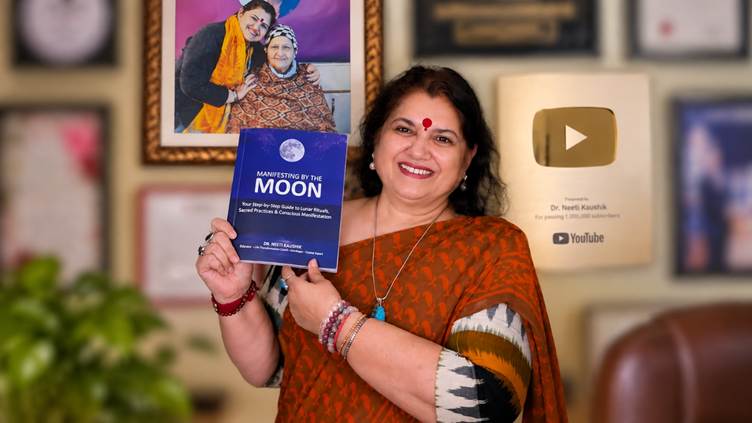
If you want to take this practice beyond a simple New Moon intention, I have written a complete guide to working with lunar cycles in my book, Manifesting by the Moon: Your Step-by-Step Guide to Lunar Rituals, Sacred Practices & Conscious Manifestation. It is meant for anyone who wants to understand how to work with each phase in a grounded and conscious way.
What Is a Full Moon?

A Full Moon happens when the Moon is on the opposite side of the Earth from the Sun. Its Earth-facing side is fully lit, and the Moon appears round and bright in the night sky.
Spiritually, the Full Moon is traditionally associated with completion, illumination, gratitude, reflection, emotional awareness, celebration and release. Many people use it as a symbolic time to look honestly at what they see in their lives.
“If the New Moon asks, ‘What do I want to create?’ the Full Moon asks, ‘What am I ready to see clearly and release?'”
What Should You Do During a Full Moon?
1. Reflect
Look back at the past lunar cycle and ask yourself:
- What has changed since the last New Moon?
- What have I learned?
- What has grown?
- What am I proud of?
2. Practise Gratitude
Write down three things you are thankful for. Include one small thing, one person and one quality in yourself. Gratitude turns our attention to what is already whole.
3. Release
Release is one of the most misunderstood parts of Moon rituals. I do not see it as throwing people or situations away. I see it as releasing attachment, unhealthy patterns, resentment or beliefs that no longer serve you. This could be an old belief, a fear, self-doubt, a habit or a situation that no longer aligns with who you are becoming.
Please do not end relationships or make big decisions impulsively because it is a Full Moon. Release is an inner shift first.
4. Journal
Try these prompts:
- What am I ready to see clearly?
- What is weighing on me that I can put down?
- Where did I grow this month, even in small ways?
- What did I learn about myself?
5. Forgive
Forgiveness is an internal process. It does not always mean reconciliation or saying that what happened was okay. It means loosening the grip that resentment has on your heart, so you can breathe more freely.
6. Rest
Not every ritual needs to be elaborate. Sometimes the Full Moon can simply be a quiet pause. Step outside, look up, take a deep breath and say thank you. That is enough.
Full Moon Rituals and Release Practices
Some readers want more structure for Full Moon work, such as release practices, Moon Water, affirmations and conscious reflection. I have shared these in detail in Manifesting by the Moon, with simple steps you can follow month after month.
New Moon vs Full Moon: The Difference at a Glance
| New Moon | Full Moon |
| New beginnings | Completion |
| Set intentions | Reflect |
| Plant seeds | Observe what has grown |
| Manifest | Give thanks |
| Visualise | Release |
| Look inward | Gain clarity |
| Ask “What do I want to create?” | Ask “What am I ready to let go of?” |
If you want one memorable way to hold this:
New Moon = CREATE
Full Moon = COMPLETE
What About the Waxing and Waning Moon?
The days between the two big moments matter too. They give the lunar cycle a rhythm, so the New Moon and Full Moon do not become isolated rituals.
Waxing Moon is the stretch after the New Moon, when the light grows. Symbolically, it is associated with growth, action, building and momentum. This is the time to work on the intentions you have set.
Waning Moon is the stretch after the Full Moon, when the light fades. It is associated with release, rest, reflection and simplification. This is a good time to clear clutter, slow down and let things settle.
7 Things You Can Do Throughout the Moon Cycle
- Journal
- Meditate
- Use affirmations
- Practise gratitude
- Reflect and analyse
- Take aligned action
The most meaningful part is consistency and conscious reflection, not having a grand ritual every month. A few honest minutes will always beat an elaborate ceremony you feel pressured to perform.
Common Mistakes People Make With Moon Rituals
1. Trying to manifest everything at once. Choose two or three intentions. Focus creates clarity.
2. Treating rituals like a magic shortcut. A ritual is a beginning, not a guarantee. Manifestation asks for effort too.
3. Writing intentions without taking action. If your intention has no next step, it stays a nice thought.
4. Releasing something impulsively because of a Full Moon. Take time to reflect before making major choices.
5. Copying someone else’s ritual without understanding it. What works for one person may not feel right for you. Understand the meaning first.
6. Feeling you have “done it wrong” if you miss the exact Moon phase. You have not. You can begin a day or two later, and it still counts.
A ritual is meant to bring you into greater awareness, not greater anxiety.
Looking for a Step-by-Step Lunar Practice?
If you would like a structured path instead of random rituals from social media, Manifesting by the Moon brings everything together in one place: Moon rituals, sacred practices, conscious manifestation, affirmations, Moon Water, intention setting and release practices.
Create Your Own Simple Moon Ritual
Save this section and come back to it every month.
New Moon Ritual
- Clean your space.
- Sit quietly.
- Take a few deep breaths.
- Write 3 intentions.
- Visualise them.
- Write one action you will take toward each intention.
- Close with gratitude.
Full Moon Ritual
- Sit quietly.
- Reflect on the past lunar cycle.
- Write 3 things you are grateful for.
- Write what you are ready to release.
- Read your release list mindfully.
- Tear it up or safely discard it as a symbolic act.
- End with gratitude.
Please avoid burning paper indoors or doing anything unsafe. Tearing the paper works just as well as a symbol.
My Personal Way of Looking at the Moon
I do not see Moon rituals as a way of outsourcing my responsibility to the universe. For me, the ritual creates a pause. The pause creates awareness. Awareness helps us make better choices. And our choices create change.
“I don’t believe a ritual should replace action. I believe a ritual should help us become more conscious of the action we are ready to take.”
This is why I come back to the Moon again and again. It is not about waiting for the sky to fix my life. It is about giving myself a regular, gentle moment to ask where I am and where I want to go.
Want to Work With the Moon More Consciously?
I created Manifesting by the Moon: Your Step-by-Step Guide to Lunar Rituals, Sacred Practices & Conscious Manifestation for readers who want Moon rituals to become an intentional part of their spiritual practice, one month at a time.
Frequently Asked Questions
1. What is the difference between a New Moon and Full Moon?
A New Moon is when the Moon appears dark and is spiritually linked with beginnings and intentions. A Full Moon is when it appears fully lit and is linked with reflection, gratitude and release.
2. What should I do during a New Moon?
Set intentions, journal, visualise, use affirmations and meditate. Even one clear intention and a few quiet minutes is enough.
3. What should I do during a Full Moon?
Reflect on the past cycle, practise gratitude, release old patterns, journal and rest.
4. Is New Moon good for manifestation?
Many people use it for manifestation because it symbolises fresh starts. It is a spiritual practice, not a guarantee, so pair your intentions with action.
5. What should I release during a Full Moon?
Focus on beliefs, fears, resentment, self-doubt and habits that no longer serve you, rather than making sudden decisions about people.
6. Can I perform Moon rituals at home?
Yes. All you need is a quiet space, a journal and a few minutes. No special tools are required.
7. What is the best Moon phase for setting intentions?
Traditionally, the New Moon. You can also set intentions during the waxing phase as the light grows.
8. Do I need to perform a ritual on every New Moon and Full Moon?
No. Practise when it feels meaningful. Consistency matters more than perfection.
Final Reflection
The Moon is constantly moving through phases. We are too.
Some seasons are for beginning. Some are for growing. Some are for celebrating. Some are for letting go. And some are simply for resting.
“You don’t have to force yourself to be in a season of growth every day. Sometimes you are planting. Sometimes you are growing. Sometimes you are releasing. And sometimes, you simply need to be still.”
The Moon does not have to become another thing you have to do perfectly. It can simply be a beautiful reminder to pause, reflect, choose, act and let go.
New Moon: What am I ready to create?
Full Moon: What am I ready to release?
And in between: What action will bring me closer to the life I want to live?
Are You Losing Yourself While Trying to Keep Everyone Happy?
The Spiritual Meaning of People-Pleasing
When being there for everyone slowly makes you disappear from your own life, it may be time to understand the deeper reason behind your need to please everyone.
When Did You Last Say Yes When You Really Meant No?
Someone asks you for a favour. You are exhausted. Every part of you wants to rest. But you smile and say, “Of course, no problem.”
Later, you sit alone feeling tired, a little resentful, and a little annoyed with yourself.
Or someone asks, “Are you okay?” and before you have even checked, your mouth says, “I’m fine.” You are not fine. But saying so feels like too much trouble for everyone.
Or you stay quiet in a discussion where you disagree, because peace feels safer than honesty.
If you are nodding, I want you to know something. You are not weak, and you are not fake. You are probably a very caring person. But I want to ask you gently: how many times have you chosen someone else’s comfort over your own truth?
Over the years, I have seen this pattern in so many people. It is one of the quietest ways we lose ourselves. Today I want to talk about it with love, because I believe people pleasing has a deeper spiritual meaning, and understanding it can change how you live.
What Is People-Pleasing, Really?
People pleasing meaning is simple to say and harder to notice in ourselves. It is the habit of putting other people’s approval, comfort or expectations above your own needs, again and again.
It is not the same as saying, “I love helping people.” Helping is beautiful. The problem begins when helping costs you your peace, your values or your voice.
Here are some common signs of a people pleaser:
- Finding it hard to say no
- Fearing that you will disappoint someone
- Apologising all the time, even when you did nothing wrong
- Over-explaining every decision
- Avoiding conflict at any cost
- Feeling guilty after setting a boundary
- Changing yourself to fit what others expect
- Feeling responsible for how everyone else feels
- Needing constant reassurance
- Pushing your own feelings down
You may not have all of these. Even two or three are enough to tell you something is asking for your attention.
The Difference Between Kindness and People-Pleasing
This is the most important distinction I can share with you. From the outside, kindness and people pleasing can look exactly the same. Inside, they feel completely different.
| Healthy Kindness | People-Pleasing |
| I help because I want to | I help because I fear saying no |
| I can say no when necessary | I feel guilty saying no |
| I care about others | I feel responsible for their emotions |
| I respect others | I ignore myself to keep them happy |
| I give freely | I give and secretly feel resentful |
| I can disagree lovingly | I hide my opinions to avoid rejection |
Kindness comes from choice. People-pleasing often comes from fear.
Helping others is never the problem. Compassion is never the problem. The problem begins when helping repeatedly asks you to betray your own needs, values or boundaries.
Why Do We Become People-Pleasers?

Please read this section without blaming yourself or anyone else. This pattern rarely begins as a flaw. It usually begins as a way to feel safe.
For some people, it may begin in childhood, when being “the good child” earned love and praise. If you were appreciated most when you were quiet, helpful and easy, you may have learned that love has to be earned through obedience.
Sometimes it grows from criticism. After being judged or dismissed a few times, the heart decides, “I will never give anyone a reason to be upset with me again.”
In many Indian families, we are taught beautiful values like sacrifice, adjustment and putting the family first. These values carry deep love. But when nobody teaches us that our needs matter too, sacrifice can slowly turn into self-erasure. Some of us learn to associate love with giving up our own wishes.
Underneath, people pleasing is often a search for acceptance, safety, belonging and love. Every one of those needs is human. Understanding this is the first step toward changing the pattern.
The Spiritual Cost of Always Trying to Keep Everyone Happy
I have come to believe that the biggest cost of people pleasing is not tiredness. It is distance from ourselves.
We lose touch with our intuition. & We keep asking, “What do they want?” instead of “What do I feel?” Slowly, our inner voice grows quiet because we have stopped listening to it.
We lose our boundaries. Protecting our own energy starts to feel uncomfortable, even wrong.
We lose our sense of identity & We become one version of ourselves with family, another at work, another with friends, and none of them feels fully true.
We lose our peace. So much energy goes into managing other people’s reactions that very little is left for our own growth.
We lose our authentic voice. One day, someone asks what we truly want, and we have no answer.
When you spend your life trying to be everything everyone needs, you may eventually forget who you are when nobody is asking anything from you.
7 Signs You May Be Losing Yourself While Keeping Everyone Happy
1. You say yes before checking what you actually want.
A colleague asks you to take over a task and you agree in a second. Only afterwards do you think, “When will I even do this?”
2. Someone being disappointed with you feels unbearable.
A friend sounds a little cold on the phone and you spend the whole evening replaying what you might have done wrong.
3. You apologise even when you haven’t done anything wrong.
Someone bumps into you and you say sorry. You ask a simple question and begin with, “Sorry to bother you.”
4. You feel guilty whenever you choose yourself.
You take one quiet evening for yourself and instead of resting, you feel selfish for having it.
5. You constantly explain or justify your decisions.
You cannot simply say, “I can’t come.” & You give three reasons, a backup reason, and an apology.
6. You change your behaviour depending on who you are with.
Your opinions, your humour, even your personality shift to match the room, and you feel tired afterwards without knowing why.
7. You feel exhausted but still struggle to say no.
Your body is asking for rest, your calendar is overflowing, and yet another “yes” leaves your lips.
The Question I Want You to Ask Yourself
Please pause here for a moment. Take a breath. Then ask yourself, slowly:
“If I knew nobody would be disappointed with me, what would I choose?”
Let the answer come without judging it. Explore it a little:
- What would you say no to?
- What would you stop tolerating?
- Where would you spend your time?
- What would you finally say out loud?
- What dream would you begin to pursue?
- Which relationship would you redefine?
- What boundary would you set?
Take out a notebook and write your answers. Do not edit them. Do not worry if they surprise you. Sometimes, the first honest sentence we write in years is the beginning of coming home.
Why Saying No Can Feel So Uncomfortable

Many people tell me, “I said no, and I felt terrible. Maybe I was wrong.”
Here is something I have understood with time. Guilt is often just the feeling of doing something unfamiliar.
If you have said yes for ten or twenty years, your first few no’s will feel strange. Your body is used to a certain pattern, and it protests when the pattern changes. That discomfort does not automatically mean you are being selfish. Often, it only means you are growing.
Of course, we should always reflect honestly. But please do not use guilt alone as proof that your boundary was wrong.
The Spiritual Meaning of Learning to Say No
In spiritual life, we speak a lot about love, service and compassion. But we do not always speak about honesty, and true compassion needs it.
Saying no can be an act of self-respect. When you honour your limits, you tell yourself, “I matter too.”
A boundary can be an act of love. A boundary protects relationships from resentment. When I give from a full heart instead of an empty one, my giving is cleaner and kinder.
Detachment does not mean coldness. It means doing what is right with love, without becoming dependent on everyone’s approval. It means allowing others to have their feelings without taking responsibility for controlling them.
Inner peace does not require universal approval. No saint, no teacher, no wise person in history has been understood by everyone.
You are not responsible for making every person comfortable with your choices. You are responsible for making your choices consciously and compassionately.
How to Stop People-Pleasing Without Becoming Cold
Please do not try to change everything overnight. Here is a gentle path, one step at a time.
Step 1: Pause before saying yes. Try this sentence: “Let me think about it and get back to you.” It costs nothing and gives you room to hear yourself.
Step 2: Start with small boundaries. Begin with low-stakes situations, like choosing the restaurant or declining a small invitation. Build the muscle slowly.
Step 3: Stop over-explaining. “No” can be a complete sentence. A calm, kind “I am not able to this time” is enough.
Step 4: Allow people to be disappointed. Their disappointment is not automatically your wrongdoing. You can care about their feelings without fixing them.
Step 5: Notice resentment. Resentment is a messenger. It often shows you exactly where you have been over-giving.
Step 6: Ask yourself what you want. Practise with small choices: what to eat, what to wear, how to spend a free hour. This is how you learn how to stop seeking approval, one small choice at a time.
Step 7: Choose authenticity over approval. Every time you do, your self-worth grows quietly stronger. Your worth was never meant to rise and fall with other people’s opinions.
A Simple Daily Practice: “Me Before Yes”
This is a practice I love to share. Whenever someone asks something of you, pause and ask yourself:
- Do I genuinely want to do this?
- Do I have the emotional and physical space for this?
- Am I saying yes from love or from fear?
- Will I resent this later?
- If they said no to me someday, would I still feel okay saying yes today?
Then decide. Sometimes the answer will still be yes, and that yes will feel light and free. Sometimes it will be no. Both are perfectly fine. What matters is that you are now part of the decision.
Spiritual Practices to Reconnect With Yourself
Meditation. Sit quietly for even five minutes and do not ask what anyone else needs from you. Just be with yourself. In the beginning, it may feel unfamiliar. Stay anyway.
Journaling. Write honestly about these questions:
- What do I want?
- What do I need?
- What am I tolerating?
- Where am I abandoning myself?
Breathwork and quiet time. Take slow, deep breaths and let silence do its work. In silence, your own thoughts finally become audible.
Affirmations. Repeat these slowly, and feel them, not just say them:
“I can be kind without abandoning myself.”
“I am allowed to have boundaries.”
“Someone else’s disappointment does not define my worth.”
“I can love people without living for their approval.”
“I am worthy of love even when I say no.”
Go Deeper on Your Journey
Sometimes, understanding a pattern is only the beginning. The deeper work is learning how to change the way we relate to ourselves. If you feel ready to go further into self-awareness, healing and inner transformation, I invite you to explore the courses and resources I have created at drneetikaushik.com. Choose whatever calls to you, and begin at your own pace.
A Personal Reflection From Me
As we grow older, one truth becomes clearer: keeping everyone happy is impossible.
There will always be someone who disagrees. Someone who misunderstands. Someone who expects more. & Someone who believes you should have chosen differently.
I have seen this again and again in the lives of people who come to me. I have seen how much beauty is lost when a person spends decades editing themselves to be acceptable. And I have also seen the quiet joy that returns when someone begins, gently, to tell the truth.
One thing I have understood with time is this. The people who truly love you can handle your honesty. And those who cannot were often loving only the version of you that was convenient.
So eventually, we have to ask ourselves:
“Am I living my life, or am I managing everyone’s opinion of my life?”
You Don’t Have to Become a Different Person. You Just Have to Come Back to Yourself.
If this article has stirred something in you, please hear this part with your whole heart.
Healing people pleasing does not mean becoming rude. It does not mean becoming selfish, or stopping helping others, or turning emotionally distant. & It does not mean caring less.
It means:
Helping without resentment.
Loving without losing yourself.
Giving without constantly seeking approval.
Setting boundaries without hatred.
Choosing yourself without guilt.
Your kindness was never the problem. It is one of your greatest gifts. You simply deserve to receive some of it too.
My Final Message to You
You have spent enough time asking, “Will they be happy with me?”
Perhaps it is time to ask, “Am I at peace with myself?”
The goal of spiritual growth is not to make everyone happy. It is to live in alignment with your values while staying compassionate toward others. That is a life of integrity, and it is a life of real peace.
You are allowed to take up space. You are allowed to have a voice. & You are allowed to come back to yourself, today, exactly as you are.
And I promise you, you will find someone very beautiful waiting there.
Explore Courses & Spiritual Resources
If this article made you pause and recognise yourself, don’t stop at recognition. Give yourself the opportunity to work on it. Explore my courses, workshops and spiritual resources at drneetikaushik.com.
Frequently Asked Questions
1. What is people-pleasing?
People pleasing is the habit of repeatedly putting other people’s approval, comfort or expectations above your own needs and values. It goes beyond kindness, because it usually involves fear, guilt or self-neglect.
2. Why do people become people-pleasers?
For some people, it begins in childhood when being “good” earned love. For others, it grows from criticism, fear of conflict or rejection, or a belief that love means sacrifice. It is often a way of seeking safety and belonging.
3. What are the signs of a people-pleaser?
Common signs include difficulty saying no, constant apologising, over-explaining, avoiding conflict, feeling guilty after setting boundaries, and feeling responsible for other people’s emotions.
4. How do I stop people-pleasing?
Start small. Pause before saying yes, practise short boundaries, stop over-explaining, notice resentment and make small choices based on your own preferences. Change happens gradually, not overnight.
5. How can I say no without feeling guilty?
Remember that guilt often just signals something unfamiliar. Use simple, kind sentences like “I’m not able to this time.” Over time, saying no feels more natural and the guilt softens.
6. Is setting boundaries selfish?
No. Boundaries protect your energy and keep relationships honest. Selfishness ignores others entirely, while healthy boundaries respect both you and them.
7. What is the spiritual meaning of people-pleasing?
Spiritually, people pleasing can reflect a disconnection from your authentic self and a belief that your worth depends on others’ approval. Growth means returning to your inner voice and living in alignment with your values, with compassion.
8. How can I reconnect with myself after years of people-pleasing?
Give yourself quiet time through meditation, journaling and breathwork. Ask “What do I want?” often, and honour small answers. Be patient, because reconnecting with yourself is a relationship that grows with time.
Pitru Paksha 2026: 3 Meaningful Things You Must Do During Shradh
What Pitru Paksha really means, why we honour our ancestors, what you can do during these sacred days, and the common mistakes to avoid
Every year, around this time, my phone starts filling up with the same questions.
- What should we do during Pitru Paksha?
- What should we avoid?
- When exactly should Shradh be performed?
- Can we buy something new during these days?
And the one that touches me the most, what happens if we cannot perform the rituals the way our parents or grandparents did?
I understand why these questions come up. Pitru Paksha carries so many rules in popular imagination that people often approach it with a quiet kind of anxiety instead of the reverence it actually deserves.
But before we get into a long list of dos and don’ts, I believe it is far more important to understand what Pitru Paksha actually means. Once you understand the spirit behind it, the rules stop feeling like a burden and start feeling like an invitation.
So let us first understand Pitru Paksha itself, and then, before we close, let us talk about the seven common mistakes I see people making during Shradh every single year.
What Is Pitru Paksha?
In simple terms, Pitru refers to our ancestors, and Paksha means a fortnight, a period of about fifteen to sixteen days measured according to the lunar calendar. Put together, Pitru Paksha is the fortnight set aside for remembering our ancestors.
This is also the period during which Shraddha, often written as Shradh, is traditionally observed. Shraddha, in simple terms, refers to an act of remembrance and reverence performed for one’s ancestors. The word itself comes from “shraddha,” which means faith. So, at its heart, this is not a ritual performed out of duty alone. It is meant to be performed with genuine faith and love.
When Is Pitru Paksha 2026?
I always tell people, get the dates right first, everything else becomes easier after that.
| Important Date | 2026 |
| Purnima Shraddha | 26 September 2026 (Saturday) |
| Pitru Paksha begins with Pratipada Shraddha | 27 September 2026 (Sunday) |
| Sarva Pitru Amavasya | 10 October 2026 (Saturday) |
| Sharad Navratri begins | 11 October 2026 |
The main Pitru Paksha sequence, the Krishna Paksha or waning fortnight, runs from 27 September through 10 October 2026. Purnima Shraddha on 26 September is also observed in many households and calendars, which is why you will often see the whole period described as either fifteen or sixteen days. Both counts are correct, families simply follow their own tradition here.
If you know the exact tithi on which your ancestor passed away, Shradh is traditionally performed on the matching tithi during this fortnight. If the tithi is not known, or if a family wants to remember all their ancestors together, Sarva Pitru Amavasya on 10 October is traditionally considered an appropriate day for remembering ancestors collectively, particularly when the relevant death tithi is unknown.
Where This Tradition Actually Comes From
The roots are ancient
The practice of honouring ancestors has very ancient roots in Hindu tradition. Early texts refer to the Pitrs, or ancestors, and to offerings made in their honour. Over time, these ideas developed into the structured ancestral practices we know today.
- Ancient roots: Vedic literature contains references to the Pitrs and ancestral offerings.
- Later development: Dharmasutras and Puranic texts further developed traditions around Shraddha and ancestral rites.
- Pitru Rin: The tradition speaks of an ancestral debt, reminding us of our connection and gratitude towards those who came before us.
- Ancestral practices: Shraddha, Tarpan and Pind Daan became important ways of expressing remembrance and reverence.
Why is Pitru Paksha observed during this period?
Pitru Paksha falls during the waning phase of the lunar month and is traditionally considered an important period for remembering ancestors.
- The southern direction, Dakshina, is traditionally associated with Yama and the ancestral realm, Pitru Loka.
- The dates follow the Hindu lunar calendar, which is why they change every year.
- The period provides a dedicated time for remembrance, gratitude and ancestral rites.
What I find beautiful is that this tradition gives us a specific time to pause and remember where we came from. It reminds us that our lives are connected to generations that came before us.
With that foundation in place, let me now share the story most people already know, the story of Karna.
The Story of Karna and Pitru Paksha
There is a well-known traditional account connected with Pitru Paksha that I find genuinely moving, and it involves Karna from the Mahabharata.
According to this traditional story, Karna was known throughout his life for his extraordinary generosity. He gave away gold, wealth, and material comforts to anyone who asked. When he died and reached the afterlife, he was offered gold and jewels in return for his generosity. But according to the story, he found himself unable to receive nourishment there, because he had spent his life giving material wealth and had never offered anything to his own ancestors.
When he asked why this had happened, he was told that he had never performed Shraddha for his forefathers, since he did not know about his lineage for much of his life. He was then given a period of time, traditionally said to be a fortnight, to return to earth and offer Shraddha in honour of his ancestors. This fortnight, the story tells us, became what we now observe as Pitru Paksha.
It is important to remember that this is a popular traditional account associated with the significance of Pitru Paksha, and different texts and regional traditions explain the observance in different ways.
The story of Karna beautifully highlights the deeper message of the period: material generosity has its place, but remembering and honouring those who came before us is also an important part of our tradition.
What Do Shraddha, Tarpan and Pind Daan Mean?
These three words come up constantly during this period, and I find that once people understand them simply, the whole period feels far less confusing.
| Term | Simple Meaning |
| Shraddha / Shradh | The overall traditional observance performed with reverence for one’s ancestors |
| Tarpan | An offering, traditionally involving water, performed as an act of remembrance and reverence toward ancestors |
| Pind Daan | A specific traditional ancestral offering performed through prescribed rites, often at designated pilgrimage sites |
| Pitru Paksha | The larger fortnight during which Shraddha is observed |
I want to add here that the exact way these are performed can differ quite a lot depending on family tradition, regional custom, and the priest guiding the ritual. There is no single universal method, and that is completely fine.
Why Do We Honour Our Ancestors?
This is the question I actually find most meaningful, more than any specific ritual detail.
Gratitude. Somewhere along the line, someone in your family worked hard, made sacrifices, or simply survived difficult times so that you could exist today. Pitru Paksha gives us a structured moment to acknowledge that.
Remembrance. Stories fade quickly if nobody tells them. I often tell people that talking about a grandparent’s habits, their humour, or their struggles keeps them alive in a real, felt way.
Respect. Simply acknowledging that those who came before us mattered, regardless of how complicated the relationship may have been.
Reflection. Looking honestly at what you inherited, not only material things, but habits, beliefs, and ways of relating to the world.
Healing. Family patterns, the way we handle money, conflict, or love, often travel down generations. This period offers a natural pause to notice them.
Responsibility. Thinking about what you want to consciously pass on to the people who come after you.
In my experience, when people approach Pitru Paksha through these six lenses instead of through a checklist of restrictions, the whole period starts to feel much more personal and far less intimidating.
The Spiritual Significance of Pitru Paksha
When I look at this spiritually, Pitru Paksha is not really about looking backward with sadness. It is an opportunity to pause.
We inherit more than a family name. We also inherit stories, values, habits, patterns, and sometimes wounds. For me, remembering our ancestors is also an invitation to become more conscious of what we choose to carry forward.
This is where the period stops being about ritual alone and becomes something quietly transformative. You are not just honouring people who are no longer here. You are also asking yourself, what parts of this inheritance do I want to keep, and what parts am I ready to release?
How Is Pitru Paksha Traditionally Observed?
Without going into overly technical ritual detail, here is the general framework many families follow.
- Shraddha is performed according to the relevant death tithi of the ancestor
- Tarpan, the water offering, is performed as an act of remembrance
- Pind Daan is performed where the family tradition includes it, often at pilgrimage sites
- Food is prepared and offered, often to Brahmins, to crows, or to those in need
- Feeding others and practicing charity in the ancestor’s memory
- Prayer and quiet remembrance
- Acts of service performed consciously in the ancestor’s name
Sarva Pitru Amavasya, the final day of the fortnight, holds a special place because it is considered suitable for remembering all ancestors together, especially when a specific death tithi is not known.
How to Approach Pitru Paksha With Intention
I often tell my students that Pitru Paksha does not require perfection. It requires presence.
This period can be an opportunity to slow down, remember where we come from, and become more conscious of what we carry forward.
1. Remember With Love, Not Fear
Take a moment to remember the people who came before you. Think about their lives, their struggles, their qualities, and the memories that still make you smile.
Instead of approaching this period with fear about what might go wrong, approach it with gratitude for what has been passed down to you.
2. Reflect on What You Have Inherited
Our inheritance is not limited to property or possessions. We also inherit values, habits, beliefs, family stories and sometimes patterns that continue across generations.
Use this period to ask yourself:
- What qualities from my family do I want to carry forward?
- What values have shaped who I am?
- Is there a pattern I consciously want to change?
This kind of reflection can make ancestral remembrance deeply personal.
3. Let Their Best Qualities Live Through You
One beautiful way of honouring someone is to embody the qualities you admired in them.
If your grandmother was generous, practise generosity. If your father valued honesty, bring more honesty into your own life. & If someone in your family was known for helping others, find your own way to serve.
In this way, remembrance becomes something you live, not just something you perform.
4. Make Space for Prayer and Quiet Reflection
You can spend a few quiet minutes in prayer, meditation or simple silence. There is no need for complicated words.
Sometimes, simply sitting peacefully and remembering your ancestors with love can create a meaningful moment of connection.
5. Choose Peace Where You Can
Family histories are not always simple. Some relationships may have carried pain, distance or unresolved emotions.
Pitru Paksha can also become a gentle reminder to release what you no longer wish to carry. Forgiveness does not mean forgetting or excusing what happened. Sometimes, it simply means choosing not to let old pain control your present.
For me, this is the deeper spiritual side of Pitru Paksha. It is not only about honouring those who came before us. It is also about becoming more conscious of what we carry forward into the generations that come after us.
3 Meaningful Things You Can Do During Pitru Paksha
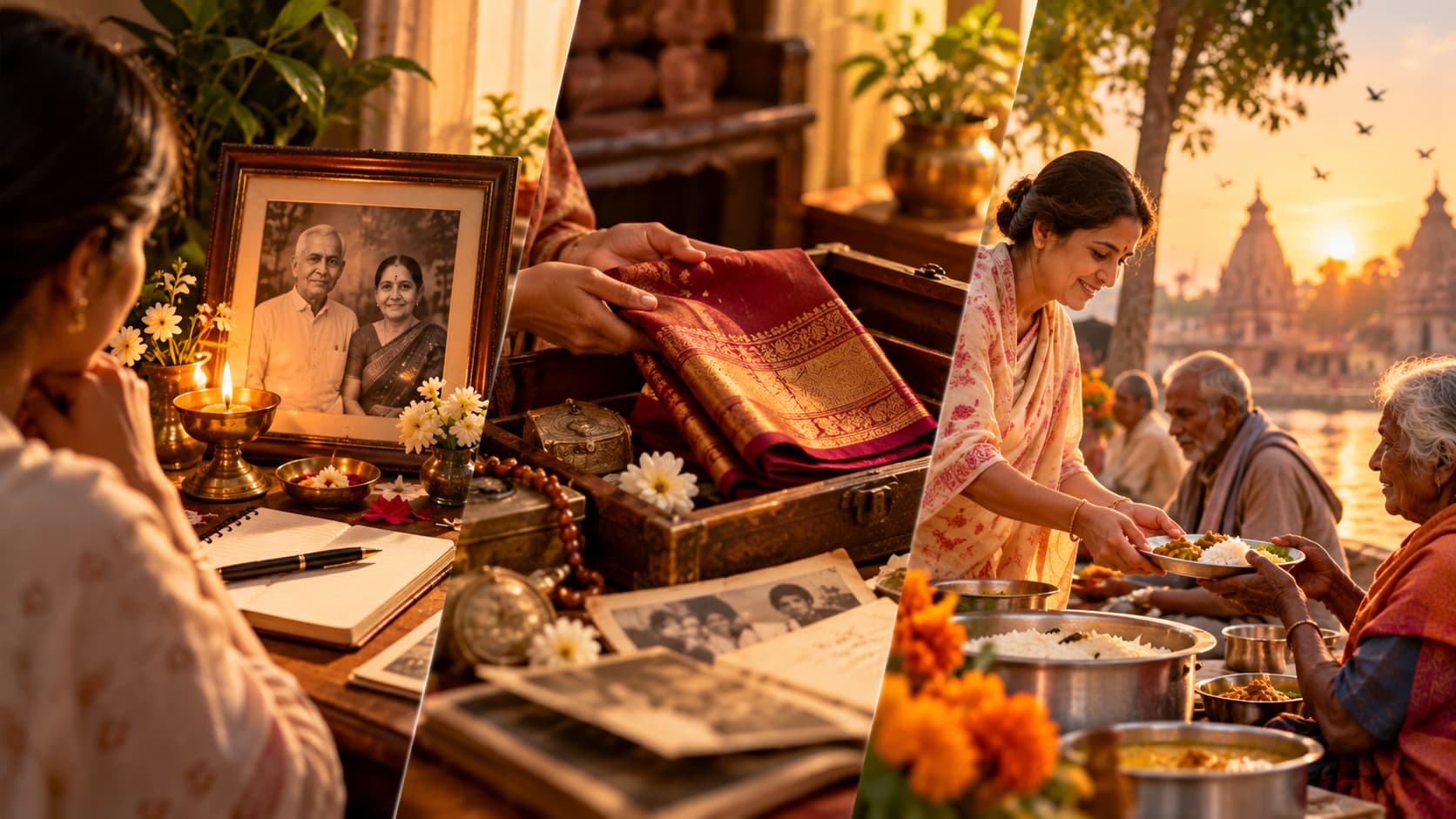
Once you understand the spirit behind Pitru Paksha, you can bring that intention into simple everyday actions. You do not need to make these practices elaborate. Choose whatever feels natural and meaningful to you.
1. Create a Moment of Personal Remembrance
If you have a photograph of your ancestor, take it out. You can revisit an old family album, keep their photograph beside you, or simply close your eyes and visualise them.
Spend a few quiet moments remembering them and thinking about what you are grateful for.
You can also write your thoughts down.
Try this journaling prompt:
“I am grateful to my ancestors for…”
You can continue with whatever comes naturally:
- Something they taught you
- A quality you received from them
- A memory you still treasure
- Something they made possible for your family
If you do not have a photograph, don’t worry. Your memory is enough.
2. Reconnect With Something That Carries Their Memory
Sometimes an ordinary object can hold an extraordinary memory.
Perhaps you still have a saree, piece of clothing, book, piece of jewellery, utensil, letter, photograph or another item that belonged to them or was gifted by them.
Take it out. Look at it. Use it if appropriate. Let it take you back to a memory.
You can ask yourself:
- What does this object remind me of?
- What memory of this person comes alive when I see it?
- What quality of theirs would I like to keep alive in my own life?
The object is not the important part. The memory and gratitude connected to it are.
3. Share Something in Their Memory
Food can carry some of our strongest family memories.
If you remember a dish your ancestor loved, you can prepare it and share it with your family. You can also share a meal with someone in need, donate food, or feed someone in their memory.
As you do it, simply hold the thought:
“I am doing this with gratitude and in loving remembrance of you.”
This allows remembrance to move beyond thought and become an act of kindness.
You Don’t Have to Do Everything
You can choose one of these practices, or combine all three. There is no need to make them elaborate.
What matters most is the intention behind them: remembering with love, expressing gratitude, and keeping meaningful values alive.
7 Common Mistakes People Make During Shradh
Now that we understand what Pitru Paksha is really about, let us come to the seven mistakes I see people making during Shradh, year after year.
Mistake 1: Observing Pitru Paksha Only Out of Fear
I have met so many people who follow every rule during this period purely out of fear that something bad will happen otherwise. In my experience, fear-based observance drains the meaning out of the practice. Pitru Paksha was never meant to frighten us into compliance. It was meant to bring us closer to gratitude and reflection. When fear becomes the main motivation, the deeper purpose gets lost entirely.
Mistake 2: Following Every Rule You See on Social Media
Every year, social media fills up with long lists of things you must never do during Pitru Paksha, many of them presented as universal law. What I personally believe is that a lot of these are regional or family-specific customs, not rules that apply identically to everyone. Before adopting a rule you saw online, it is worth checking what your own family tradition actually says.
Mistake 3: Ignoring the Relevant Tithi
Traditional Shraddha is meant to be performed according to the specific lunar tithi connected to the ancestor’s passing, not simply on any convenient day within the fortnight. Ignoring the tithi and treating the entire period casually takes away from the precision that this tradition was built around.
Mistake 4: Performing Rituals Without Understanding Their Meaning
I often see people going through the motions of a ritual mechanically, without any real sense of what it represents. Over the years, I have noticed that the intention and the reverence behind an act matter far more than performing it perfectly on the surface.
Mistake 5: Forgetting Charity, Food and Acts of Kindness
Somewhere along the way, many people have reduced Pitru Paksha to a list of restrictions, forgetting that generosity has always been at the heart of this tradition. Feeding someone, donating, or performing an act of kindness in your ancestor’s name is not a side detail. It is one of the central acts of remembrance.
Mistake 6: Thinking You Have Failed Spiritually If You Cannot Perform Elaborate Rituals
This one touches me personally, because I hear it so often. People living away from their hometown, settled abroad, unfamiliar with the exact procedure, or without access to a priest, often feel they have failed their ancestors. I would encourage you to release that guilt completely. A sincere prayer, a quiet moment of remembrance, or an act of kindness performed with genuine feeling holds real spiritual meaning, even without an elaborate ceremony.
Mistake 7: Remembering the Departed While Forgetting the Living
This is, for me, the most important mistake of all. If remembering our ancestors is meant to teach us gratitude, compassion, and family values, then those same qualities should show up in how we treat the people who are still with us today. I have seen families argue bitterly during Pitru Paksha over ritual details while the elders sitting right in front of them feel unseen and unheard. Honouring the departed should never come at the cost of neglecting the living.
What Should We Avoid During Pitru Paksha?
| Traditional Practice / Concern | How to Approach It |
| Food restrictions | Follow your own family or regional tradition rather than a generic rule |
| Major rituals | Understand what your family actually follows before adopting a rule from social media |
| Buying new things | Customs differ widely here, treat this as a family preference, not a universal prohibition |
| Arguments and negativity | Use this period for reflection and harmony within the family |
| Fear-based practices | Shift the focus from fear to gratitude and remembrance |
What If I Cannot Perform Shraddha Rituals?
I want to speak directly to those of you who feel a quiet sense of guilt around this question.
Perhaps you do not know your ancestor’s exact death tithi. Perhaps you live far from your hometown, or outside India altogether. & Perhaps you cannot travel to Gaya or another pilgrimage site, do not have access to a priest, or simply follow a different family tradition.
None of this makes your remembrance any less valid.
A sincere prayer said quietly at home, a donation made in your ancestor’s memory, a meal shared with someone in need, or simply setting aside ten minutes to remember them with love, these can hold real personal meaning.
I am not saying these replace every element of a traditional ritual performed with full ceremony. What I am saying is that remembrance, gratitude, and kindness are always within your reach, regardless of your circumstances.
Final Reflection
Pitru Paksha is not only about looking backward. It is also about deciding what kind of future we want to create.
We remember those who came before us. We understand what they gave us. & We acknowledge what may have been difficult. & We choose what to carry forward. And we consciously create a healthier legacy for those who will come after us.
When we honour where we came from, we become more conscious of where we are going.
If this reflection resonated with you, and you would like to go deeper into healing inherited family patterns and building conscious spiritual practices, I would invite you to explore the resources and courses available at drneetikaushik.com.
Frequently Asked Questions
Q1. What is Pitru Paksha?
Ans. Pitru Paksha is a fortnight in the Hindu lunar calendar dedicated to remembering and honouring one’s ancestors through Shraddha rituals.
Q2. When does the main Pitru Paksha observance start in 2026?”When does Pitru Paksha end in 2026?
Ans. Pitru Paksha 2026 ends on 10 October 2026 with Sarva Pitru Amavasya.
Q3. What is the difference between Pitru Paksha and Shradh?
Ans. Pitru Paksha is the entire fortnight, while Shraddha or Shradh refers to the specific act of remembrance performed for ancestors during this period.
Q4. What is Tarpan during Pitru Paksha?
Ans. Tarpan is a traditional water offering made as an act of remembrance and reverence toward one’s ancestors.
Q5. What is Pind Daan?
Ans. Pind Daan is a specific ancestral offering performed through prescribed rites, often at pilgrimage sites such as Gaya.
Q6. Why is Gaya important during Pitru Paksha?
Ans. Gaya in Bihar is traditionally considered one of the most significant pilgrimage centres for performing Pind Daan and ancestral rites.
Q7. What should we do during Pitru Paksha?
Ans. Remember your ancestors, express gratitude, perform charity, pray or meditate, and reflect on family patterns you wish to heal or continue.
Q8. What should we avoid during Pitru Paksha?
Ans. Follow your own family’s tradition around food and rituals, avoid conflict, and shift away from fear-based observance toward gratitude.
Q9. What is Sarva Pitru Amavasya?
Ans. It is the final day of Pitru Paksha, considered suitable for remembering all ancestors together, especially when the specific death tithi is unknown.
Q10. Can I observe Pitru Paksha if I cannot perform traditional Shradh rituals?
Ans. Yes. Sincere prayer, remembrance, charity, and acts of kindness performed with genuine feeling hold real personal and spiritual meaning, even without elaborate rituals.
Full Moon on 26 September 2026: The 9 Blessings Abundance Basket Ritual
The Full Moon falls on 26 September 2026. Aries is the first zodiac sign and stands for courage, action and fresh beginnings, while a Full Moon marks a point of fullness and completion. The 9 Blessings Abundance Basket Ritual uses this energy for gratitude instead of release. You place nine symbols in a basket, one for each area of your life (food, family, knowledge, health, work, home, money, spirituality and a personal blessing). You write a “I am blessed” sentence for each, celebrate, bless the basket, and leave it in the moonlight overnight. It needs a basket, a diya or candle, and a sheet of paper.
The Full Moon That Taught Me to Stop Asking
Namaskar, dear souls. I am Dr. Neeti Kaushik, and in my 7 years on this spiritual path I have led hundreds of Full Moon rituals. For most of those years I gave the same instruction: write down what you want to release and let it go. It is a beautiful practice, and I still believe in it.
But I have also noticed something over the decades. Many of us walk into a Full Moon carrying a long list of what is wrong, what is missing and what we still want. We release one thing and immediately reach for the next wish. We rarely stop to look at what is already sitting in our hands.
A woman once came to me during a difficult phase of her life. She told me, “Doctor, nothing is going right.” As we talked, she mentioned that her children were healthy, her mother had recently recovered from a long illness, and she had just been offered a new opportunity at work. She had listed three enormous blessings while insisting that nothing was going right. She was not ungrateful. & She had simply become so used to her blessings that they turned invisible.
That is the heart of this Full Moon ritual. On 26 September, we are not releasing anything. We are going to pause, look at our lives, and consciously recognise the abundance that is already here. I call it the 9 Blessings Abundance Basket, and I would love for you to try it with me.
What Does the Full Moon in Aries Mean?
A Full Moon is a moment of fullness. The Moon has travelled through its whole cycle and shines at her brightest, so it becomes a natural time to ask five questions:
- What has grown?
- What has reached completion?
- What have I learned?
- What have I received?
- How far have I come?
Yes, Full Moons are also associated with release. But they are just as much about recognising the harvest of your life. This one has a special quality, because it falls close to the September equinox and is often called the Harvest Moon. That name fits our ritual beautifully.
Aries is the first sign of the zodiac. It carries the energy of beginnings, courage, action, initiative, movement and the strength to step forward. It belongs to the Fire element, which is why we will start our ritual with a diya or candle.
Is this ritual only for Aries people?
Not at all. Whenever the Moon moves through a zodiac sign, all of us can connect with the themes of that sign. You do not need an Aries Sun sign or Aries Moon sign to feel this energy. Every one of us has a courageous, starting-fresh part inside, and this Full Moon gently wakes it up.
Why the two energies work so well together
The Full Moon says, “Pause and see what has reached fullness.” Aries says, “Every completed chapter prepares you for a new beginning.” Together they give us a lovely message: before you rush into the next chapter, before you ask life for more, stop and say, “Look at how much I already have.”
Release Ritual or Gratitude Ritual? Two Ways to Use a Full Moon

Both are valid. Here is how they differ so that you can choose what your heart needs this month.
| Release Ritual | 9 Blessings Abundance Basket | |
| Main question | What can I let go of? | What have I already received? |
| Focus | What is heavy or finished | What is present and growing |
| You will feel | Lighter, relieved | Full, thankful, secure |
| Best when | You feel stuck or weighed down | You feel restless, lacking or always chasing more |
| Tools | Paper, pen, flame | Basket, nine symbols, paper, diya |
If you ever feel that life is a long queue of things still to achieve, choose the basket. Gratitude changes the way we see abundance. The more consciously you recognise what is already present, the more deeply you learn to value it.
What You Need for This Full Moon Ritual
You do not need to buy anything special. This ritual works because it is simple.
- One basket. Small, decorative or just a plain one from your kitchen. It becomes your Full Moon Abundance Basket.
- Nine symbolic items. Each will represent one area of your life. I will guide you through all nine below.
- A sheet of paper (or nine small slips) and a pen.
- One diya or candle, to bring Fire, the element of Aries, into your space.
That is all. Simple things, but a very meaningful experience.
How to Perform the 9 Blessings Abundance Basket Ritual
Step 1: Cleanse Your Space and Yourself
Sit comfortably near the place where you will do the ritual. Light your diya or candle carefully. Watch the flame and take one slow, deep breath, then another. Let yourself become present.
Gently move your hands around yourself and your space, with the intention of clearing away distraction. Then say:
“I release distraction and negativity, and I open myself to recognise the abundance already present in my life.”
Step 2: Fill Your Basket With Nine Blessings
Place your basket in front of you. Every item you put inside will stand for something you already have and are grateful for. We use nine blessings because September is the ninth month, and the number nine carries a sense of completion and fullness.
Please remember that the object is only a symbol. You do not need the perfect item. What matters is the blessing behind it.
Blessing 1: Food and Nourishment
We eat every single day and rarely think about what a gift it is to have food on our table. Place a small pouch of rice, wheat or any grain, or a little homemade sweet such as halwa, in your basket. Say:
“I am blessed to have food that nourishes me and my family.”
Blessing 2: Family and Love
Think of the people who feel like home: your partner, children, parents, or anyone who loves you. Place a family photograph or a small object that reminds you of them. Say:
“I am blessed to have love and meaningful relationships in my life.”
Blessing 3: Education and Knowledge
Every chance to learn is a blessing. Place a book, a pen, a notebook, or something that represents your children’s education or your own learning journey. Say:
“I am blessed with the opportunity to learn, grow and gain knowledge.”
Blessing 4: Health and Well-Being
This does not mean your life must be perfect before you can be grateful. You can still honour your breath, your body and every way it supports you. Place a small water bottle, a fruit, a few dry fruits, or something linked to movement. If nothing suits, write “I am grateful for my body and for every way it supports me” on a slip of paper and place that inside. Then say:
“I am blessed with the gift of life, health and wellbeing.”
Blessing 5: Career and Work
Think of your profession, business, skills and opportunities. Choose something small, like an office ID card, a visiting card, a badge or a tiny tool of your trade. There is no need to put your laptop in a basket. Say:
“I am blessed with opportunities to work, grow and create in my life.”
Blessing 6: Home and Security
Think of the place you return to, the roof above your head and the comfort of shelter. Place your house key or another small symbol of home. Say:
“I am blessed with a home, shelter and a space of safety.”
Blessing 7: Financial Abundance
Think about your income, your ability to provide, and the resources that support your life. Place a coin or a currency note. Say:
“I am grateful for the financial resources and abundance that support my life.”
Blessing 8: Spirituality and Inner Growth
This is your relationship with yourself, your healing and your inner journey. Place a crystal, a mala, a journal or any object that feels sacred to you. Say:
“I am blessed with the opportunity to know myself, heal and grow.”
Blessing 9: Your Personal Blessing
This is the most personal one. What is the one thing in your life that makes you say, “I feel truly blessed to have this”? It might be a friend, a pet, a talent, a dream that came true, a special journey, your creativity or your inner strength. Choose a small symbol for it and say:
“I am truly blessed, and I gratefully celebrate this beautiful blessing in my life.”
Now pause and look at your basket. Nine objects, nine symbols, and behind them all the blessings that already exist in your life. Tell yourself, “This is my abundance.”
Step 3: Write Your Nine Blessings
Take your sheet of paper and look at each item one by one. For each, write one simple sentence beginning with “I am blessed…” & For example:
- I am blessed to have food that nourishes me and my family.
- I am blessed to have love and family in my life.
- I am blessed with opportunities to learn and grow.
- I am blessed with the gift of life and wellbeing.
- I am blessed with opportunities to work and create.
- I am blessed with a home and a place of safety.
- I am blessed with the financial resources that support my life.
- I am blessed with opportunities to heal, grow and connect with myself.
For the ninth, write your own sentence, straight from the heart.
The purpose is not to fill a page. It is to notice, and to say quietly, “Yes, this is already present in my life.” The things we see every day become so ordinary that we forget they are blessings. Writing them down makes them visible again.
Step 4: Celebrate What You Have
Hold your paper in your hands and look at your basket. You do not need to ask for anything right now. You do not need to wish for something else. For these few minutes, just celebrate the food that nourishes you, the people who love you, your home, your body, your work, your growth and your journey.
Then say aloud, and then say again:
“Today, I choose to see the abundance that already exists in my life.”
“Today, I celebrate every blessing that has brought me to this moment.”
Step 5: Bless Your Abundance Basket
Fold the paper gently and place it inside the basket, among your symbols. Rest both hands over the basket, close your eyes and take a deep breath. Slowly say:
“I recognise the blessings already present in my life.”
“I honour them, celebrate them and receive them with gratitude.”
“May every blessing in my life continue to grow for my highest good.”
Step 6: Place the Basket Under the Full Moon
If you can, leave the basket overnight where moonlight can reach it, such as a window, balcony or terrace. Choose a safe spot. If moonlight cannot reach it, that is perfectly fine. Keep it near your temple or prayer space instead. The intention and gratitude you brought matter far more than the location.
The Next Morning: Return Your Blessings to Your Life
Bring the basket back in the morning. These items were never meant to stay in the basket forever. They were symbols of blessings you recognised and celebrated, so now they go home.
- Grains: use them while cooking your regular meals.
- Homemade sweet or food: share it with your family and enjoy it together.
- Family photograph: put it back where it belongs.
- Coin or currency note: use it normally or keep it safe.
- Other items: return each one to its natural place.
Everything goes back into your life, but perhaps you will see it differently now, because you know what it stands for.
What should you do with your gratitude paper?
You have two lovely options. You can keep it in your journal as a reminder of the abundance you recognised on this Full Moon. Or, if it feels right, you can safely burn it as a symbolic gesture of trust and surrender. Whichever you choose, remember that the paper is not the point. The feeling of gratitude you created is.
What If You Are Going Through a Hard Time?
I want to speak to you gently for a moment, because I know some of you may be reading this in a difficult season. Perhaps money is tight, a relationship is strained or your health is troubling you. You may be thinking, “Ma’am, how can I feel blessed right now?”
I have walked through hard seasons myself, and I will tell you what I learned. Gratitude does not ask you to pretend that everything is fine. It only asks you to notice that something is still standing. A single breath, a person who called you today, a roof over your head and a cup of tea in your hand are small things, but they are real.
On such days, keep your basket small and honest. If you cannot find nine big blessings, find nine tiny ones. A warm blanket counts. So does the morning light and a friend’s voice on the phone. Tiny blessings, recognised with a full heart, can turn a heavy day around.
And notice what Aries offers you here. It is the sign of the first step. Even in a hard time, a small act of gratitude is a brave beginning. You are not pretending. You are beginning again.
The Message of This Full Moon in Aries
The Full Moon reminds us to pause, look back, recognise what has grown and celebrate what has reached fullness. Aries reminds us that a new beginning is always waiting.
So, this Full Moon, do not only look at what you need to release. Look at what you need to celebrate. Look at the abundance that already surrounds you. Fill your basket. Fill your heart. Then step into your next chapter with gratitude, with courage, and with the quiet knowledge that “I am already blessed.”
Want to explore more Moon rituals and sacred practices?
Discover Manifesting by the Moon, Dr. Neeti Kaushik’s step-by-step guide to lunar rituals, conscious manifestation, journaling and creating meaningful Moon practices.
Bring the wisdom of the Moon into your own journey. 🌙✨
👉 Order your copy here: Buy Now
Frequently Asked Questions
Q1. When is the Full Moon in Aries in September 2026?
The Full Moon in Aries falls on 26 September 2026. You can perform the ritual on the evening of the Full Moon, and it is fine to do it the evening before or after if that suits your schedule.
Q2. Do I need to be an Aries to do this ritual?
No. Every zodiac sign can connect with Aries themes such as courage, action and new beginnings whenever the Moon moves through this sign. This ritual is for everyone.
Q3. What if I do not have all nine items?
Use a symbol, a photo or a small slip of paper with the blessing written on it. The object is only a symbol, and what matters is the blessing behind it.
Q4. What if I cannot put the basket in moonlight?
That is absolutely fine. Keep it near your temple or prayer space overnight. The intention and gratitude count most.
Q5. Can I make wishes during this ritual?
This ritual is designed for recognising and celebrating what you already have, without asking for anything more. Once you have finished, if your heart wants to set new intentions, you are free to do so afterwards. Many people find that they feel differently about their wishes once they have felt gratitude first.
Q6. Why nine blessings?
September is the ninth month, and the number nine is linked with completion and fullness, which matches the energy of a Full Moon. Nine also gives you enough areas to cover the main parts of life: food, family, learning, health, work, home, money, spiritual growth and one personal blessing.
Q7. How often can I do the Abundance Basket ritual?
You can repeat it every Full Moon, at the turn of the year, on a birthday, or any time you feel you have forgotten what you already have.
A Closing Word From My Heart
I can tell you that some of the most powerful spiritual practices are also the simplest. A basket, a flame, a sheet of paper and a grateful heart are enough. Do this on 26 September, and let me know how it feels. I would love to hear which blessing surprised you the most.
If you would like to deepen your spiritual practice, you can explore more guidance at drneetikaushik.com and find crystals for your sacred space, such as a crystal for your Blessing 8, at shop.drneetikaushik.com.
With love and blessings,
Dr. Neeti Kaushik
Why You Keep Repeating the Same Life Pattern Even When You Know Better
There is a sentence I hear more often than almost any other, from students, from readers, from people who write to me after a workshop with tears still drying on their cheeks. It usually sounds something like this:
“Dr. Neeti, I know this isn’t good for me. I know it. So why do I keep doing it anyway?”
- Maybe you know a relationship isn’t right for you, and yet you find yourself choosing the same kind of person again.
- Maybe you know you are capable of so much more, and yet you keep holding yourself back at the edge of your own potential.
- Maybe you told yourself years ago, “I will never become like my parents,” and now, in a quiet unguarded moment, you catch yourself reacting exactly the way they did.
If any of this feels familiar, I want you to know something before we go any further.
You are not lacking intelligence. You are not lacking willpower. What you are experiencing is one of the most human, and most misunderstood, experiences there is: the gap between what we know and what we actually do.
Why does this gap exist? Why do we repeat something we consciously know is not serving us? The answer, as I have come to understand it through my own life and through years of guiding others, is both psychological and spiritual. And once you begin to understand it, something in you starts to loosen.
Knowing Something Is Not the Same as Believing It
Here is the first truth I want to offer you. Conscious knowledge and subconscious belief are two very different forces, and they do not always agree with each other.
You can consciously believe, “I deserve a healthy relationship.” But underneath that belief, quietly running in the background, there may be an older, deeper program that whispers-
- “Love has to be earned,” or
- “People eventually leave,” or
- “I have to keep everyone happy in order to be wanted.”
In the same way, you might consciously want success and growth, while somewhere underneath, success is subconsciously linked to pressure, judgment, or the fear of leaving your comfort zone.
The conscious mind wants one thing. The subconscious mind, shaped over years by experience and emotion, often chooses what feels familiar over what is actually healthy.
This is where repeating patterns begin. Not because you are weak, but because familiarity feels safer to the subconscious than the unknown, even when the unknown is better for you.
The Patterns We Keep Repeating
Over the years, I have noticed that repeating patterns tend to show up in a few recognisable forms.
Relationship patterns. Some of us keep finding ourselves in dynamics involving emotional unavailability, over-giving, fear of abandonment, or a difficulty saying no. This does not mean you consciously choose pain. It means certain emotional dynamics feel strangely, uncomfortably normal, because they echo something you learned to expect from love a long time ago.
Career patterns. This might look like staying in a job that drains you, underestimating your own worth, avoiding leadership, procrastinating the moment an opportunity appears, or starting things with enthusiasm and rarely finishing them. Sometimes it looks like self-sabotage right at the point of growth, as though something inside you pulls the brakes just when the road opens up.
Self-sabotage. This is one of the most confusing patterns to sit with, because it feels contradictory. You want something, you move toward it, and then, almost without noticing, you find a reason to stop. Fear, old beliefs, and a sense of identity that has not caught up with your growth can all quietly influence this.
None of this makes you broken. It makes you human, and it makes you someone whose subconscious mind learned certain rules long before you had the awareness to question them.
Where Do These Patterns Come From?

I like to think of patterns as having layers, much like the layers of the earth. To understand them, we usually need to look beneath the surface.
Subconscious Beliefs
Repeated messages, experiences, and emotional associations slowly harden into beliefs. Some common ones I have encountered in my years of working with people include:
- “Money is difficult.”
- “People cannot be trusted.”
- “Success changes people.”
- “I must struggle to deserve something good.”
- “This is just how our family is.”
These beliefs rarely arrive with a label attached. They simply become the lens through which we experience life, so quietly that we mistake them for facts.
Family Patterns
We learn far more from watching than from being told. We absorb how our parents handled conflict, how they spoke about money, how they responded to failure, how they expressed love, and what they believed was possible for people like us.
I want to be very clear about something here. This is not about blaming your family. Most parents pass on what was passed on to them, often without ever examining it. Understanding a pattern is not about assigning fault. It is about giving yourself the chance to consciously choose what you want to carry forward, and what you are finally ready to release.
Karma or Conditioning: Are You Repeating a Lesson, or a Learned Habit?
This is one of the questions I sit with often, both in my own life and alongside the people I work with.
From a spiritual lens, some of us understand recurring experiences as karmic lessons, as something the soul is still working through until the learning is complete.
From a psychological lens, the same recurring experience can be understood through conditioning: learned beliefs, emotional associations, and behaviours we repeat because they were once reinforced.
I do not believe we always need to choose one explanation over the other. In my experience, both lenses can illuminate the same experience from different angles, and both can be true at once.
So instead of only asking, “Why does this keep happening to me?” I invite you to also ask a gentler, more useful question:
“What is this pattern trying to help me understand about myself?”
That single shift, from why me to what now, is often where real transformation quietly begins.
Why Awareness Alone Doesn’t Break the Pattern

I want to be honest with you about something, because I think honesty serves you better than false promises. Awareness is essential, but awareness by itself rarely changes behaviour overnight.
You might read this article, nod along, recognise your pattern completely, and still find yourself repeating it next week. That does not mean the awareness failed. It means transformation follows a sequence:
Awareness → Understanding → Practice → New Response → Repetition → Change
Someone can clearly identify, “I know I have people-pleasing tendencies,” and still say yes when every part of them wants to say no. Knowing is the doorway. It is not the whole house.
Ask Yourself
Before we move into practice, sit with these questions honestly. There is no need to rush or judge your answers.
- What situation keeps repeating in my life?
- What emotion usually rises just before I repeat the pattern?
- What do I tell myself in that exact moment?
- What am I afraid might happen if I responded differently?
- What belief might be sitting underneath this reaction?
- Where might I have first learned this belief?
- Does this belief still serve the person I am becoming?
| Layer | What It Looks Like | What It Asks of You |
| Conscious knowledge | “I know I deserve better.” | Awareness and honesty |
| Subconscious belief | “Love has to be earned.” | Gentle questioning |
| Emotional trigger | Anxiety, fear of rejection, urge to please | Noticing without judgment |
| Old pattern | Repeating the familiar choice | Pausing before reacting |
| New response | Choosing differently, even imperfectly | Practice and repetition |
The Inner Work: How I Begin to Break a Pattern
Over time, I have come to rely on a simple, honest framework whenever I want to shift something in myself.
Step 1: Name the pattern. You cannot consciously change what you refuse to acknowledge. Naming it out loud or in writing takes away some of its hidden power.
Step 2: Find the belief beneath it. Ask yourself, “What would I have to believe about myself for this behaviour to make complete sense?” The answer is often surprisingly clear once you ask it directly.
Step 3: Notice the trigger. Which situations tend to switch on the old response? Awareness of the trigger gives you a few precious extra seconds before you react.
Step 4: Question the belief. Ask, “Is this actually my truth, or is this something I learned and never questioned?”
Step 5: Create a new belief. I want to be gentle but honest here. Affirmations are not magic sentences that erase years of conditioning overnight. What they do is repeatedly introduce a new internal conversation, one that slowly becomes as familiar as the old one once was.
Step 6: Take one different action. This is the step most people skip, and it is the one that matters most. A new belief only becomes real when your behaviour starts to support it, even in one small way.
Step 7: Repeat. Transformation is rarely one dramatic breakthrough. It is usually a quiet accumulation of small, conscious choices, made again and again, until they become who you are.
Journaling: The Conversation That Reveals What Your Mind Has Been Hiding
Journaling has been one of the most valuable tools I return to, both personally and in my work with students, because it slows down the automatic mind long enough to actually see what is happening beneath the surface.
Here is a short exercise you can try today. Complete each sentence honestly, without editing yourself.
- The pattern I keep repeating is…
- I usually feel…
- The thought I have in that moment is…
- The belief underneath that thought may be…
- I may have learned this belief from…
- A healthier belief I want to practise is…
- One different action I can take next time is…
If you feel that journaling like this could help you understand your own patterns more deeply, my course Unlock Your Inner Potential Through Journaling takes this practice much further. It is built around ten journaling methods designed to help you unlock mental blocks, build a sustainable journaling habit, and gain real clarity in the decisions you make. If this resonates, you can explore the course and begin your own journaling journey whenever you are ready.
A Personal Reflection
My own connection to inner work and manifestation goes back further than most people realise, all the way to childhood, when I would spend hours daydreaming and vividly imagining what I wanted my life to look like. I did not have a name for it then. I only knew that some part of me was always quietly working with intention, long before I understood the psychology or the spirituality behind it.
Over the years, working closely with so many students, I have noticed something interesting again and again. It is rarely a lack of desire that holds people back. It is not that they cannot want something enough. What holds them back is a quieter belief, one that rarely announces itself directly. Sometimes the real limitation is not “I cannot.” It is “people like me don’t do that.”
That sentence deserves to be questioned, gently and honestly, by every single one of us.
Some of these old, inherited beliefs are connected to emotional experiences from much earlier in life, moments that shaped what we believed was safe, acceptable, or possible. If you sense that some of your patterns are rooted in those older emotional layers, my course Shadow Journaling for Inner Child Healing was created to help you explore that inner landscape gently, through guided reflection and journaling, at a pace that allows you to process deeply rather than rush through it.
When the Pattern Is About What You Believe You Deserve
Many repeating patterns, especially around money, opportunity, and self-worth, are quietly shaped by our relationship with abundance itself. We can want more, plan for more, and still feel an invisible ceiling stopping us.
Manifestation, in my understanding, was never simply about asking the universe for something and waiting. It is about becoming deeply aware of the beliefs, emotions, and actions that are already shaping how you move toward, or away from, what you desire.
If this idea speaks to you, my Manifest Abundance Challenge is designed exactly for this: an eleven day structured practice to help you identify where scarcity thinking has taken root and consciously shift toward a mindset of genuine abundance.
Creating Space for the Shift
Sometimes the most important part of this work is not more thinking, but more stillness. Our minds are so full of noise, deadlines, and old chatter that we rarely give ourselves the quiet needed to actually feel what is happening inside us.
If you feel you need that kind of space, one of sound, silence, and gentle release, my audio course The Frequency Shift was created to support exactly that. It offers a guided way to slow down, release what you are holding onto, and create the inner alignment that makes real, lasting change possible.
The Final Shift: From “Why Me?” to “What Is This Teaching Me?”
I will not pretend this work is simple, or that it finishes in a week. You may not be able to change every circumstance around you. You may never fully understand every karmic thread running through your story. & You may not immediately trace every belief back to its origin.
But you can begin to notice. You can pause before reacting. You can question a thought instead of obeying it automatically. & You can choose, even once, to respond differently to an old trigger. And every time you do, you create quiet evidence that the old pattern does not get to define who you are becoming.
Awareness is the doorway. Conscious choice is the practice. Repetition of that new choice is what finally creates change.
One Companion for the Whole Journey
If everything I have shared with you today, the pattern, the belief beneath it, the release, the new choice, feels like a lot to hold onto, I want to tell you about something close to my heart.
I have poured years of my own journey with lunar energy into a book: Manifesting by the Moon. It is not a textbook you read once and shelve. It is a companion you return to, month after month, moon after moon.
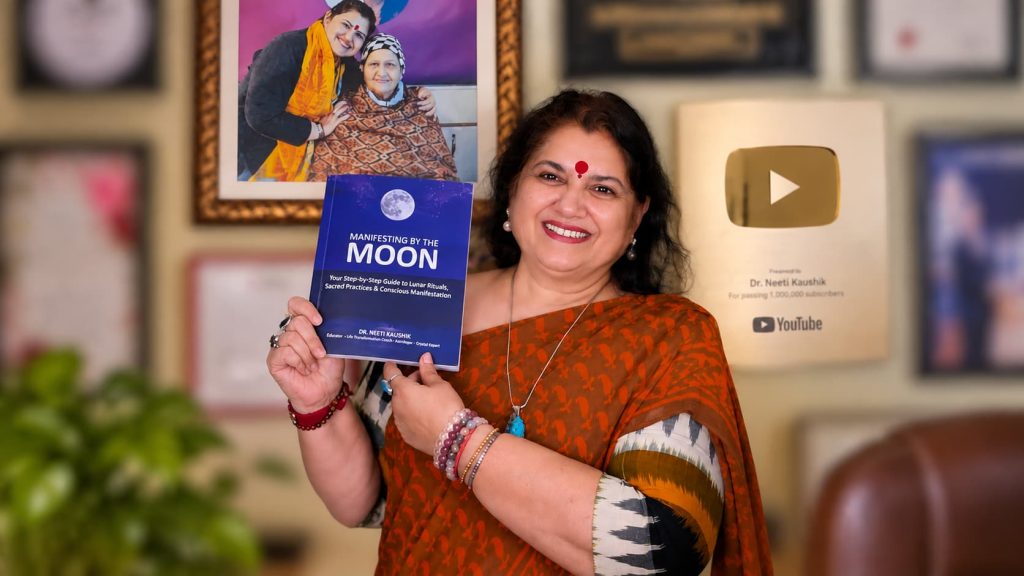
From New Moon intention setting to Full Moon release rituals, from making moon water to charging your crystals under moonlight, it walks you through every part of this work we have talked about today: letting go of what no longer belongs to you, working with your beliefs instead of against them, and slowly, gently, becoming the version of yourself you are meant to grow into.
If you feel ready to hold something in your hands that walks beside you through every phase of this transformation, you can pre-order your copy of Manifesting by the Moon here.
The Moon has been waiting for you. And so has this book.
How the Moon Changed My Life: My Journey Through Healing, Manifestation and Moon Rituals
The Moon Has a Lesson for Every Phase of Life
I still remember standing by my window at night as a little girl, looking up at the moon because I did not know where else to put my feelings. I would tell it about my fears, the things I was too young to explain to anyone else. It never answered in words, but I always felt lighter afterward. I did not know it then, but that quiet habit was the beginning of a relationship that would shape my whole life.
Sometimes we connect with something long before we understand why it matters to us. For me, the moon was that something. Over the decades that followed, through marriage, motherhood, and loss, I came to understand the moon was not just a source of comfort. It was a teacher. It showed me that life moves in cycles: a time to begin, a time to grow, a time to reflect, a time to release, a time to celebrate, and then, quietly, a time to begin again.
This is not the story of my life. It is the philosophy the moon taught me through my life, and I want to share it with you so it can help you recognize which phase you are standing in right now.
The New Moon: Learning to Begin Again

What Does the New Moon Symbolize?
The New Moon arrives as pure darkness in the sky, and that darkness is not empty. It is potential, a blank canvas with nothing written on it yet. In Vedic tradition, this phase is called Amavasya, long associated with introspection and new starts. The New Moon symbolizes:
- Fresh beginnings and clean slates
- Possibility, before anything has been decided
- Planting seeds of intention
- The conscious choice of what we want to create next, rather than drifting into it
When I first began working with the New Moon, I was not approaching it as a complicated practice. I simply saw it as a chance to pause and decide what I wanted to create next.
Over time, I realized this was one of the most important parts of manifestation: before we ask for something, we need to become clear about what we are actually asking for.
What My First New Moon Experience Taught Me About Manifestation
My very first real New Moon ritual was the 369 method: writing an intention three times in the morning, six times in the afternoon, and nine times at night, for 45 days without fail.
My intention was simple, to grow my YouTube channel to ten thousand subscribers. I did not fully understand why the method worked. I simply committed to it with faith, writing the same words with the same devotion, day after day.
What happened next surprised me. Within weeks I had not just reached ten thousand subscribers, I had gone far beyond it. But the real gift was not the number. It was what the experience taught me about how manifestation actually works.
It is the relationship between a clear intention, consistent repetition, genuine emotional connection, and steady belief, held together by real action.
Manifestation is not magic that replaces effort. It is a practice that aligns your effort with your intention so completely that the outcome stops feeling far away.
| A question worth sitting with If you wrote down what you wanted, every single day, for forty five days, would you still believe in it by day thirty? |
From Wish to Intention: The Shift That Changed My Practice
There is a real difference between a wish and an intention and understanding it changed the way I approached every New Moon after that.
- A wish is vague. It floats. “I want to be successful” is a wish.
- An intention has shape and feeling. “I am building work that serves people and creates abundance with purpose” is an intention, because it tells you what success looks like and how it feels to hold it.
This shift from vague hope to focused clarity is what makes the New Moon so powerful, when we use it with intention rather than treat it like a wish upon a star.
Why Journaling Became One of My Most Trusted Manifestation Tools
One of my most meaningful experiences with intention setting happened when I decided I wanted to earn a Golden Play Button from YouTube for reaching one million subscribers. Instead of simply hoping for it, I journaled about it as though it had already happened.
I did not write “I want a golden play button.” & I wrote about the weight of it in my hands, the joy of unboxing it, the pride of showing it to my family. & I even wrote the date I imagined receiving it, a date that held deep personal meaning for me.
I am not going to tell you that journaling alone produced that outcome. What I can tell you is that the practice made me emotionally connected to the goal in a way that vague hoping never could.
It kept me focused, and when the day actually came, receiving that award did not feel foreign. It felt familiar, as though I had already lived it a hundred times in my mind. That is the quiet power of writing your intention as though it has already arrived.
| Try this On your next New Moon, instead of listing what you want, write one paragraph describing a day after you already have it. What do you notice, feel, and do differently? |
But Life Is Not Only About Beginning
Sometimes We Need to Make Space Before We Can Receive More
Here is something I had to learn the hard way. We often think manifestation is only about asking, attracting, and receiving. But an equally important part of the work is releasing, healing, and making space. You cannot keep planting seeds in soil that is already crowded with old growth.
Over the years, I came to see that this releasing work usually meant letting go of things I had been quietly carrying:
- Old versions of myself that no longer fit who I was becoming
- Limiting beliefs absorbed so long ago I had mistaken them for facts
- Past hurts, guilt, and regret
- Habits and physical clutter that mirrored inner clutter
- Resentments that took up far more space than they deserved
This is where the Full Moon enters, because if the New Moon asks “what do I want to begin,” the Full Moon asks a very different question.
The Full Moon: When the Light Turns Inward
What Does the Full Moon Symbolize?
Where the New Moon whispers, the Full Moon illuminates. It is the point when the moon reflects the sun’s light fully, and seems to reflect everything back at us too, the things we are proud of and the things we have avoided. The Full Moon symbolizes:
- Illumination and awareness
- Reflection and honest self-assessment
- Completion of a chapter
- Release, forgiveness, and healing
- Gratitude and celebration
If the New Moon is about what I want to create, the Full Moon is about what I need to see, release, or celebrate.
I think of the New Moon as the moment you hand yourself a seed, and the Full Moon as the moment you look at what that seed has grown into and honestly ask whether it still belongs in your garden.
Even as a child, I would wait eagerly for the Full Moon, stepping outside just to sit in its glow. It made me feel lighter and whole, as though it were saying, “you are safe, you are guided, you are already complete.” I did not know then that this feeling would one day become the foundation of my spiritual practice.
The Limiting Beliefs I Had to Learn to Question
One of the most important things the Full Moon ever showed me had nothing to do with rituals. It had to do with a quiet, inherited belief I did not realize I was carrying.
I grew up in a family where stability and traditional careers were deeply valued, on both my father’s side and my husband’s side. Almost everyone around me held jobs, not businesses. I remember how casually we would say “we are not business minded,” as though it were a fact about our family rather than a story repeated so often that we forgot to question it.
A limiting belief is not always a truth. Sometimes it is simply an old story repeated for so long that we forget to question it. During one Full Moon, sitting with my journal, I finally wrote the opposite of that story: “I am successfully running my own business, reaching people and creating abundance with purpose.” I did not feel instantly transformed. But I had, for the first time, named the belief instead of obeying it, and that is where every real change begins.
| Reflection question Is there a sentence you have repeated about yourself so often that you stopped noticing it was a belief and not a fact? |
How Full Moon Affirmations Helped Me Change My Inner Dialogue
Naming a belief is only the first step. Changing it requires a new inner voice, and that voice does not arrive fully formed.
It has to be practiced, the same way the old belief was practiced for years without you noticing. This is where affirmations became essential to me, not as instant magic, but as a repeated, conscious choice to speak to myself differently.
Full Moon affirmations are not the same as general positive thinking. They are meant to help you become lighter, not simply more motivated. A few I return to often:
- “I release the belief that I am not capable, and I welcome the truth of who I am becoming.”
- “I forgive myself for the years I doubted my own strength.”
- “I am worthy of the success I am building.”
- “I let go of what was, and I trust what is coming.”
- “I am healing, and healing is not weakness, it is courage.”
If a belief took years to settle in, do not expect a new one to settle in overnight. Speak it anyway, and let repetition do what it always does.
The Full Moon and My Journey of Healing After Losing My Father
This is the part of my journey with the Full Moon that means the most to me, and I want to share it with the tenderness it deserves.
After I lost my father, the Full Moon took on a meaning I had never expected. Its silver light became something closer to a bridge. Whenever I looked up at it, I felt as though he was there, watching over me, and although it never answered in words, I always felt a quiet inner knowing that I was not alone.
One particular Full Moon night stays with me clearly. I stood outside and found myself thinking of him, and a wave of old guilt rose in me, memories of moments where I wondered if I had made him proud enough. I placed my hand on my heart and whispered, “I release all guilt. & “I forgive myself.“ & I know Daddy loved me, and I know he was proud of me, because I did my best.” The tears that came were not tears of pain. They were tears of release, as though something I had quietly carried for years had finally been allowed to set down.
Healing does not always mean forgetting the past. Sometimes it means honouring it, releasing the regret attached to it, forgiving where forgiveness is needed, and carrying the love forward without carrying the pain in the same way.
Learning to Let Go of What No Longer Serves Us
Full Moon Decluttering: Clearing the Outer and Inner World
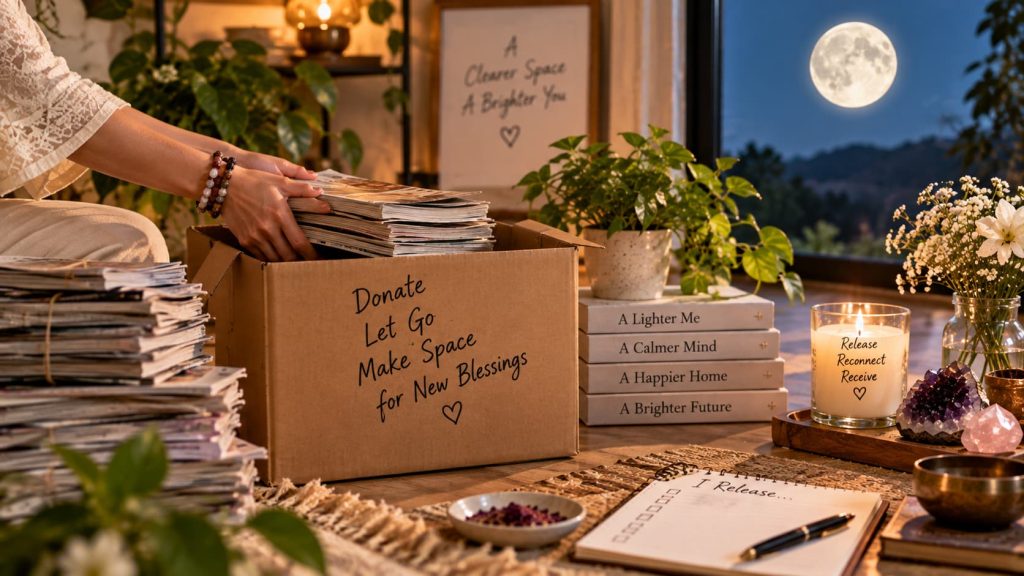
Once I understood how much lighter release could make me feel emotionally, I began to notice the same was true physically. When the outer world changes, the inner world tends to follow more easily.
For a long time, I collected old newspapers and magazines, telling myself I was being practical, that they would be worth something someday. But slowly those stacks began occupying not just physical space in my home, but mental space in my mind.
Letting them go taught me something larger: sometimes the space we need for something new is created only by releasing what we have been carrying, whether that is paper in a corner of a room or a story in the corner of the mind.
| Type of Clutter | What It Looks Like | What Releasing It Creates |
| Physical | Old papers, clothes, unused items | Room to breathe, clearer energy at home |
| Mental | Repetitive worries, overthinking | Space for clarity and focus |
| Emotional | Guilt, resentment, old regret | Room for peace and self-trust |
Decluttering is not meant to happen in a single day or a single Full Moon. Start with one drawer, one shelf, one old belief. That is enough.
Moon Water, Meditation and Other Full Moon Practices
The first time I prepared Moon Water, water charged with intention under the Full Moon sky, I did it with far more enthusiasm than wisdom, filling small bottles and drinking all of it the next day, believing more must mean faster results.
It took time to understand that Moon Water, like most spiritual practice, works best not through intensity but consistency. Small, steady sips over time created far more grounding than one dramatic dose ever did.
Alongside Moon Water, I have leaned on a handful of other Full Moon practices, each one a different doorway into the same larger theme of reflection, healing, release, and renewal:
- Meditation, to sit quietly with whatever the Full Moon brings to the surface
- Crystal charging, placing stones under the moonlight to refresh their energy
- Journaling, to name what needs to be seen
- Affirmations, to gently rewrite old inner stories
- Letting go rituals, writing down what no longer serves you and releasing it with intention
None of these needs to be done perfectly or all at once. Choose the one that calls to you this month, and trust that it is enough.
Celebration Is Also Part of Healing
It would be incomplete to speak of the Full Moon only as a time for releasing what is heavy. Just as the moon shines fully without apology, this is also the time to honour how far you have come, even the quiet growth nobody else notices.
Ask yourself honestly: what have you become that your earlier self could not have imagined? That question matters as much as any release ritual.
The Lesson the Moon Ultimately Taught Me
Looking back across everything the moon has shown me, from a child at a window to a woman who built her life around its rhythm, the lesson has always been the same. Every phase has a purpose, and none is meant to last forever.
There is a time to begin, when the New Moon invites us to plant a clear intention rather than a vague wish. There is a time to grow and act, nurturing what we have planted. & There is a time to see clearly, when the Full Moon holds up a mirror and asks us to celebrate what is working and release what is not. & There is a time to clear and surrender, letting the waning light remind us that rest is also progress. And then, quietly, there is a time to begin again.
I no longer see the moon as simply a beautiful object in the sky. I see it as a companion that has walked beside every version of me: the child at the window, the daughter learning to release guilt, the woman building something of her own against an old, inherited doubt. If any part of my journey feels familiar to you, I hope it reminds you that whichever phase you are standing in right now, it has a purpose, and it will not last forever.
If You Want to Walk This Journey More Deeply
Everything I have shared with you here is simply the philosophy. The deeper practices, the step by step rituals, the full set of Full Moon affirmations, the complete Moon Water process, the layered decluttering guide, the crystal charging methods, and the letting go rituals that walked me through my own healing all live in my book, Manifesting by the Moon: Your Step-by-Step Guide to Lunar Rituals, Sacred Practices and Conscious Manifestation.
I did not write it as a book you read once and place on a shelf. I wrote it as a companion you can return to with every New Moon, every Full Moon, and every new chapter of your life. If this way of working with the moon speaks to you, come deeper with me.
| MANIFESTING BY THE MOON Your Step-by-Step Guide to Lunar Rituals, Sacred Practices and Conscious Manifestation Buy Manifesting by the Moon and begin your lunar journey with me. shop.drneetikaushik.com |