

A few weeks before Diwali, almost every Indian home begins to move. Cupboards are opened, clothes are sorted, and old boxes come down from the top shelf. Someone finds a steel tiffin nobody remembers buying. Someone else is wiping shelves, and a tangle of fairy lights waits patiently in the corner.
Then the questions begin. “Keep this?” “Donate that?” “Arrey, it still works!” By evening, the doorway is ready for rangoli and the house smells of soap, agarbatti and a little bit of dust.
I smile every time I think about this season, because it is so completely ours. But there is a question I keep coming back to:
Every Diwali, we make an effort to clear the clutter from our homes. But when was the last time we made the same effort to clear the clutter in our minds and hearts?
Let us explore that together.
Why Do We Clean Our Homes Before Diwali?
Diwali is the festival of light, hope and fresh beginnings. In many homes, it is also the time when we prepare to welcome Goddess Lakshmi, who is associated with prosperity and well-being. Before an important guest arrives, we prepare the space with care. Cleaning, whitewashing, decorating the entrance and lighting diyas are all ways of saying, “We are ready.”
Customs differ across families, regions and communities. Some homes begin cleaning weeks ahead, and some follow specific rituals. What stays common is the feeling behind it: respect, care and readiness.
I do not believe an untidy home invites bad luck, and I do not believe cleaning guarantees prosperity. For me, the spiritual meaning of Diwali cleaning is gentler. We create space for something new by first making room for it.
Preparing our homes for Diwali can also remind us to prepare ourselves for the kind of life we wish to create.
Physical Clutter: What Happens When Our Space Becomes Overcrowded?
Let us start with what we can see. Clutter has a way of making ordinary days feel slightly more demanding.
You may recognise some of these:
- A wardrobe full of clothes, yet nothing that feels right to wear.
- A drawer of old receipts, tangled wires and forgotten objects.
- A desk where finding one important document becomes a task in itself.
- Things kept “just in case” that have not served us for years.
Researchers have started looking at this more closely. A 2021 study in the Journal of Environmental Psychology, titled Home and the Extended-Self: Exploring Associations Between Clutter and Wellbeing, examined how clutter, our sense of home and well-being relate among 1,111 adults. It found meaningful associations, particularly involving subjective clutter and psychological home. A later 2025 study in the same journal, Home Clutter and Mental Well-Being: Exploring Moderators and the Mediating Role of Home Beauty, surveyed 501 adults on clutter, perceived home beauty and mental well-being.
What most of us do feel is simple. When our surroundings are a little lighter, daily life often feels a little easier. That is among the quiet benefits of decluttering your home.
Decluttering is not about creating a perfect home. It is about making your surroundings more comfortable and useful.
Your Room-by-Room Diwali Decluttering Checklist
This Diwali, instead of trying to declutter your entire home in one day, I suggest taking it one area at a time. You can choose one area each day, complete the checklist at your own pace, and gradually create a home that feels lighter, more organised and more comfortable.
Day 1: The Kitchen
The kitchen is one of the easiest places to begin because we often accumulate food items, containers and utensils without realising it.
- Refrigerator: Check expiry dates and discard expired or spoiled food. Remove old leftovers and anything that is no longer safe to consume. Organise the remaining food and make a list before buying fresh supplies.
- Kitchen cabinets and pantry: Check packaged foods, spices, sauces, cereals and other stored ingredients. Remove expired items and organise what you still use.
- Utensils and cookware: Set aside chipped or damaged utensils, duplicate items and cookware you no longer use. Repair or dispose of items appropriately.
- Storage containers: Match containers with their lids. Recycle or discard damaged containers and those you no longer need.
- Appliances and gadgets: Identify appliances that have not been used in years. Keep what serves a purpose and consider passing on usable items you no longer need.
- Shopping bags and packaging: Sort through excess paper bags, boxes and packaging materials. Keep only a reasonable quantity for reuse and recycle the rest where possible.
Day 2: Wardrobe and Clothing

Our wardrobes often hold clothes from different phases of life. Some no longer fit, some no longer suit our needs, and others have remained untouched for years.
- Everyday clothes: Set aside garments you have not worn in several years, especially those that no longer fit or suit your lifestyle. Keep special-occasion outfits and sentimental pieces if they genuinely matter to you.
- Damaged clothing: Separate torn, stained or badly worn garments for repair, textile recycling or appropriate disposal.
- Footwear: Check shoes, sandals and slippers for damage, discomfort or pairs you no longer wear.
- Bags and accessories: Sort handbags, belts, scarves, jewellery and other accessories. Keep the items you use and love.
- Seasonal clothing: Store seasonal clothes neatly and remove items you no longer need.
- Give clothes a second life: Wash and dry wearable garments before donating them. Fold them neatly, and iron them where appropriate. Give them to a trusted donation centre, a relative or someone who can use them. Donate only clean, usable items.
Remember, decluttering your wardrobe does not mean getting rid of everything you have not worn recently. It means making thoughtful choices about what deserves space in your present life.
Day 3: Living Room and Common Areas
The living room is often where everyday clutter gathers because everyone in the household uses it.
- Showpieces and decorations: Review decorative items, artificial flowers, old festive décor and other objects. Keep those you enjoy and pass on usable items you no longer want.
- Tables and shelves: Clear unnecessary papers, empty boxes, unused accessories and objects that have simply been placed there temporarily.
- Cushions, throws and linens: Check for damaged or unused pieces. Wash and organise the ones you wish to keep.
- Old gifts and souvenirs: Keep meaningful gifts, but remember that you do not have to retain every object out of guilt.
- Festive decorations: Check fairy lights, diyas, lanterns and other decorations. Test electrical items safely, separate damaged pieces and organise the decorations you plan to use this Diwali.
- Storage baskets and drawers: Empty them, sort their contents and return only what belongs there.
Day 4: Electrical Devices, Chargers and Cables
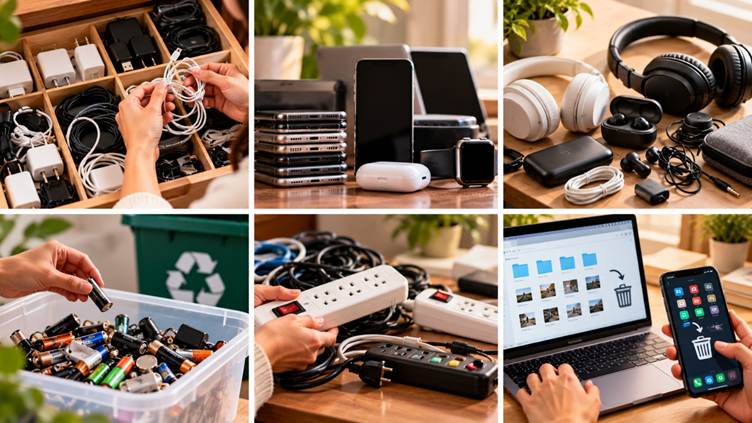
We often keep old electronic items because we might need them someday. Before long, a drawer becomes a collection of tangled cables, outdated devices and chargers we cannot identify.
- Chargers and cables: Match chargers to the devices you still own. Remove redundant cables and accessories you can confidently identify as unnecessary.
- Old phones and gadgets: Identify devices you no longer use. Check whether they can be repaired, reused, resold or responsibly recycled.
- Headphones and electronic accessories: Separate broken or obsolete items from those that still work.
- Batteries and electronic waste: Do not put batteries, electronics or other e-waste into ordinary household rubbish. Use an authorised collection or recycling facility.
- Extension boards and electrical accessories: Check for damaged plugs, frayed wires or unsafe equipment. Stop using damaged items and arrange appropriate replacement or disposal.
- Digital clutter: If you have time, remove duplicate files, unwanted screenshots and unused apps from your phone or computer.
Before passing on any electronic device, back up anything important and erase your personal data securely. Never keep using damaged electrical equipment simply because it might be useful one day.
Day 5: Books, Documents and Stationery
Books, notebooks, newspapers and paperwork can quietly occupy entire shelves. The goal is not to discard knowledge or memories, but to make room for what is useful and meaningful.
- Books: Sort books into those you want to reread, reference, keep for sentimental reasons or pass on. Donate books in good condition to libraries, community groups or readers who can use them.
- Newspapers and magazines: Recycle old newspapers and magazines you have finished reading instead of allowing them to pile up indefinitely.
- Notebooks and diaries: Keep journals and notebooks that hold meaningful memories or useful information. Recycle empty, damaged or unnecessary notebooks where possible.
- Stationery: Check pens, markers, pencils, old files and craft supplies. Test what can still be used and remove dried-out or damaged items.
- Bills and paperwork: Shred unnecessary documents containing personal or financial information. Retain important records for as long as they are needed.
- Study and work materials: Organise notes, folders and reference materials. Pass on usable supplies you no longer need.
If a book has completed its role in your life, it may be ready to begin a new chapter in someone else’s.
Day 6: Bathroom and Toiletries
Bathrooms often contain half-used products, old cosmetics and toiletries that we forget to check.
- Toiletries: Check the expiry dates and condition of shampoos, conditioners, body washes, lotions and other products. Dispose of expired or deteriorated products according to their packaging instructions.
- Skincare and cosmetics: Review creams, sunscreen, makeup and other personal-care products. Discard anything expired, contaminated or noticeably changed in smell, texture or appearance.
- Medicines and first-aid supplies: Check expiry dates and separate expired medicines for disposal through an appropriate pharmacy or authorised collection programme. Do not flush medicines down the drain unless the disposal instructions specifically advise it.
- Towels and bath linens: Separate worn-out towels, damaged bath mats and linens you no longer use. Wash and organise the pieces you wish to retain.
- Bathroom storage: Clear drawers and shelves of empty bottles, unnecessary packaging and duplicate products.
- Cleaning supplies: Check product condition and expiry information where provided. Keep cleaning products safely stored and never mix different cleaning chemicals.
The aim is to keep the bathroom clean, functional and stocked with products you actually use, rather than holding on to forgotten items.
Day 7: Bedroom, Bedside Tables and Miscellaneous Storage
Finish with the smaller spaces that often become catch-all areas for things we do not know where to put.
- Bedside tables: Remove old receipts, empty packaging, unused accessories and papers that no longer need to be there.
- Drawers and organisers: Empty one drawer at a time. Sort its contents into items to keep, donate, repair, recycle or discard.
- Bedding and linen cupboards: Check bedsheets, pillowcases, blankets and spare linens. Keep what you use and pass on clean, usable extras if appropriate.
- Old gifts and personal belongings: Revisit objects you have been keeping only because you feel obligated to keep them. Retain what is meaningful without feeling guilty about letting go of the rest.
- Storage boxes and suitcases: Open boxes you have not checked in years. Label useful stored items and responsibly clear out what is no longer needed.
- The final collection point: Review the items you have set aside for donation, repair, recycling and disposal. Arrange their next step rather than allowing them to become another pile of clutter.
Before You Finish: Give Every Item Its Next Step
As you declutter, create five simple categories:
- Keep: Items you use, need or genuinely value.
- Donate or pass on: Clean, functional items that someone else can use.
- Repair: Items worth fixing that you intend to use again.
- Recycle: Paper, packaging, textiles and electronics through suitable recycling channels.
- Dispose of safely: Items that cannot be reused or recycled, following the relevant disposal instructions.
You do not have to finish all seven areas in seven days. If one cupboard takes longer, give it the time it needs. The purpose is not to create pressure before Diwali; it is to make your home more useful and welcoming, one small decision at a time.
And one gentle reminder: decluttering is not about throwing away everything old. Some objects carry memories, family history and deep personal meaning. Keep those things with love. Let go of what is no longer useful, without turning the process into a test of how little you can own.
Mental Decluttering: Making Space for Clearer Thinking
Our minds get crowded too. Not with objects, but with recurring worries, unfinished tasks, comparison and endless planning.
It can look like this:
- Thinking about tomorrow’s responsibilities while trying to rest today.
- Replaying a conversation to work out what someone really meant.
- Comparing our progress with friends or relatives.
- Feeling responsible for solving everyone’s problems.
Mental decluttering does not mean forcing the mind to become empty. That never works. It means noticing what deserves attention and separating useful action from repetitive worry.
The Three-Column Thought List
Take a notebook and divide a page into three columns:
- What is occupying my mind?
- What can I take action on?
- What do I need to accept, postpone or stop repeatedly worrying about?
Here is a small example. Suppose you are worried about a pending conversation with a family member. In column one, you write, “How will they react?” In column two, you write, “Decide what I want to say and choose a calm time.” In column three, you write, “Stop rehearsing every possible reaction.”
Now choose one realistic next step, and do only that this week. Clearing the mind happens in small pieces, not in one big effort.
Emotional Decluttering: What Are We Still Carrying in Our Hearts?
This is the part I feel most strongly about. Physical clutter is visible and mental clutter is noisy, but emotional clutter often sits quietly for years.
Emotional decluttering is not about suppressing feelings or forgetting painful experiences. It is also not about forcing ourselves to forgive before we are ready. It is about recognising what we are carrying and deciding how to respond to it consciously.
Ask yourself gently whether you are holding on to any of these:
- Resentment after an unresolved disagreement.
- Guilt over a past decision.
- Disappointment when life did not unfold as expected.
- The need for constant approval.
- Hurt from repeatedly feeling unheard.
- The fear of saying no and disappointing others.
A careless remark from a relative may last two minutes, but we may replay it for two days. One moment ends up deciding our mood. That is emotional clutter at work.
Moving forward may involve journaling, honest communication, setting boundaries, seeking support, or accepting that some questions may never be answered. And letting go never means excusing harmful behaviour or allowing the same boundaries to be crossed again.
You do not have to carry every old hurt into every new beginning. You can honour what you have experienced while choosing how you want to move forward.
A Guided Practice for Reflection and Release
Some people like a structured spiritual practice for this inner work. My course, The Advanced Ho’oponopono Healing Journey, offers guided Ho’oponopono prayer practices across areas such as relationships, family harmony, inner-child healing, self-love and emotional release. The course page describes 11 sessions, guided prayer repetition and a printable PDF of prayers.
Looking for a guided practice to help you reflect on old hurts and cultivate more inner peace? Explore The Advanced Ho’oponopono Healing Journey with Dr. Neeti Kaushik.
The Invisible Clutter: Expectations, Comparisons and Old Beliefs
Some burdens cannot be placed in a donation box. They live quietly in the background:
- Believing we must have achieved certain milestones by a particular age.
- Comparing our relationships, careers or family lives with those of others.
- Feeling obligated to keep everyone happy.
- Holding on to an outdated idea of who we should be.
- Trying to prove our worth through constant achievement.
A young professional may feel behind because friends are getting promoted. A parent may feel inadequate because another family looks perfectly organised. Someone rebuilding their life may feel pressure to return to who they used to be.
Take a moment to reflect, and answer kindly:
- Which expectation am I following without questioning it?
- What am I trying to prove, and to whom?
- Which belief about myself am I ready to reconsider?
No one is grading you. This is simply a way to notice, without judgement, what you have been carrying.
A Simple Diwali Decluttering Plan: Physical, Mental and Emotional
You do not need to change everything before Diwali. Choose one small action from each category.
Physical decluttering
- Choose one drawer, shelf or cupboard.
- Sort belongings into keep, donate, repair, recycle or discard.
- Give usable items a second life where possible.
- Do not turn it into a competition for a perfect home.
Mental decluttering
- Write down your recurring worries.
- Identify one task you can complete.
- Choose your three most important priorities for the day.
- Take a short break from unnecessary notifications and comparison.
Emotional decluttering
- Name the feeling you have been avoiding.
- Write about one unresolved disappointment.
- Identify a boundary that needs attention.
- Have a necessary conversation when it is safe and appropriate.
- Seek support when a burden feels too heavy to manage alone.
One small, sincere step is enough.
My book, Manifesting by the Moon, has a dedicated section that includes decluttering for the mind, home and energy, along with reflection practices and release rituals. If you would like to explore this more deeply, it is there for you. You do not need any book to begin, though. A notebook and a sincere heart are enough.
Make a Diwali Sankalp: A Promise to Make Space Within
A sankalp is a conscious intention, a quiet resolve we make to ourselves. This Diwali, I invite you to make a small, realistic one. Here is an example you can adapt:
My Diwali Sankalp
- Physical: I will create space in one part of my home by letting go of things I no longer need.
- Mental: I will focus on what I can act upon instead of repeatedly worrying about everything.
- Emotional: I will acknowledge my feelings and respect my boundaries.
- Relationships: I will try to communicate with greater honesty and kindness.
- Personal well-being: I will make a little time for reflection, rest and gratitude.
Change the words so they sound like you. Write your sankalp in a diary, and come back to it after Diwali to see what has shifted.
A meaningful new beginning does not require perfection. It begins with a choice we are willing to practise consistently, one small day at a time.
Make Space for the Light You Want to Welcome
Picture your home on Diwali evening: shining floors, a bright rangoli, diyas glowing in a row. Now picture something just as lovely. A life with a little more room to breathe, think clearly and acknowledge what you feel.
You do not have to resolve every struggle before you celebrate. You can light a diya in a home that is still a bit messy and with a heart that is still healing. Diwali has never asked for perfection. It asks us to take part, with hope.
This Diwali, as we make space for the diyas in our homes, let us also make space within ourselves for peace, clarity, compassion and new possibilities.
With warmth and blessings,
Dr. Neeti Kaushik
Now I would love to hear from you. What would you like to declutter this Diwali: your physical space, recurring worries, old expectations or an emotional burden? Share it in the comments.