
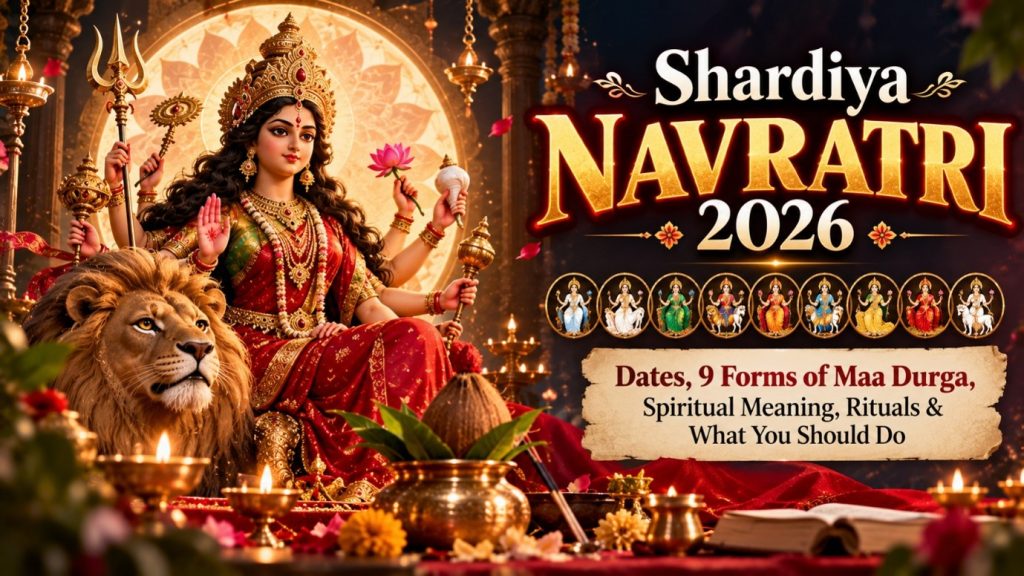
A complete guide to the nine sacred nights of Navratri, the nine forms of Maa Durga, important dates, traditional practices and the deeper spiritual meaning of Shakti.
Every year, Navratri arrives with colour, music, fasting, Garba, temple bells and the fragrance of incense in almost every home. And every year, beneath all of it, I find myself asking one quiet question: what are these nine nights actually inviting us to transform within ourselves?
For me, Navratri has always been more than a festival we watch from the outside. Over the years, I have understood that worshipping the Goddess is also a way of recognising the Shakti, the divine feminine strength, that already lives within us.
Navratri can be seen as a journey from inner weakness to inner strength, from fear to courage, and from confusion to clarity.
In this guide I will share the Navratri 2026 dates and rituals, but I also want to walk you through the deeper meaning, because that is where the real change begins.
What Is Shardiya Navratri?
“Navratri” simply means nine nights. “Shardiya” comes from Sharad Ritu, the autumn season. The festival is observed in the bright fortnight of the month of Ashwin, which usually falls in September or October. Of all the Navratris in a year, this is the most widely celebrated, which is why it is also called Maha Navratri.
The nine nights are followed by the tenth day, Vijayadashami, also known as Dussehra. What I find beautiful is that it arrives just as the season turns. Nature is changing, and we are invited to change with it.
Shardiya Navratri 2026 Dates
Shardiya Navratri 2026 begins on Sunday, 11 October and the nine days run till Monday, 19 October. Vijayadashami follows on Tuesday, 20 October.
| Date | Day | Observance |
| 11 October | Sunday | Day 1, Pratipada: Shailputri, Ghatasthapana |
| 12 October | Monday | Day 2, Dwitiya: Brahmacharini |
| 13 October | Tuesday | Day 3, Tritiya: Chandraghanta |
| 14 October | Wednesday | Day 4, Chaturthi: Kushmanda |
| 15 October | Thursday | Day 5, Panchami: Skandamata |
| 16 October | Friday | Day 6, Shashthi: Katyayani |
| 17 October | Saturday | Day 7, Saptami: Kalaratri |
| 18 October | Sunday | Day 8, Ashtami: Mahagauri |
| 19 October | Monday | Day 9, Navami: Siddhidatri |
| 20 October | Tuesday | Vijayadashami / Dussehra |
The Story of Maa Durga and Mahishasura
According to the traditional account, the demon Mahishasura received a boon that made him nearly invincible, and his arrogance grew until he defeated the gods and drove them from heaven. Unable to overcome him, the gods combined their energies, and from that radiance the Goddess Durga appeared. Each god gave her a weapon. Riding a lion, she fought Mahishasura through nine days and nights and defeated him on the tenth.
That is the traditional story, and I honour it as faith. But I also read it as a mirror. Mahishasura can symbolise the forces within that overpower us: ego, anger, fear, greed, attachment, arrogance and self-doubt. Maa Durga is the awakened strength that allows us to face them.
What Does Shakti Really Mean?
Shakti is the divine feminine power. It is creative energy, strength and consciousness in action. But it is not only something we worship in a temple. I see it in:
- A mother’s quiet endurance
- The courage to speak the truth
- The ability to begin again
- The strength to leave an unhealthy situation
- Compassion, creativity, discipline and resilience
For me, worshipping Shakti is also a reminder that strength is already within us. The Goddess is not only someone we bow to. She is also a quality we are invited to awaken within ourselves.
The Nine Forms of Maa Durga: A Nine-Day Inner Journey
Here is a quick view of the nine forms of Maa Durga, followed by what each one can teach us. These are spiritual interpretations, offered with full respect for the traditional meaning.
| Day | Goddess | Spiritual Quality |
| 1 | Shailputri | Grounding and new beginnings |
| 2 | Brahmacharini | Discipline and devotion |
| 3 | Chandraghanta | Courage and balance |
| 4 | Kushmanda | Creativity and life force |
| 5 | Skandamata | Nurturing and compassion |
| 6 | Katyayani | Courage and decisive action |
| 7 | Kalaratri | Transformation and fearlessness |
| 8 | Mahagauri | Purification and peace |
| 9 | Siddhidatri | Wisdom and spiritual fulfilment |
Day 1: Shailputri, Ground Yourself
She is the daughter of the Himalayas, often shown riding a bull with a trident and lotus. She teaches us to begin from a steady base, like a mountain.
Ask yourself: what do I need to feel stable?
Day 2: Brahmacharini, Build Discipline
She represents tapasya, patient devotion through sincere effort, and is shown with a rosary and a water pot. Discipline is a promise we keep to ourselves.
Ask yourself: what promise do I need to keep to myself?
Day 3: Chandraghanta, Find Courage
She wears a crescent moon shaped like a bell on her forehead and rides a tiger. She is calm yet ready, courage with balance.
Ask yourself: what am I afraid to face?
Day 4: Kushmanda, Create
She is believed to have created the universe with her gentle smile. Her energy is the spark of life and creativity.
Ask yourself: what wants to come alive through me?
Day 5: Skandamata, Nurture
She is the mother of Skanda (Kartikeya) and holds him in her lap. Strength can be soft, and nurturing is a form of power.
Ask yourself: who or what needs my care, and do I include myself?
Day 6: Katyayani, Act Decisively
Born to Sage Katyayana, she is the warrior form who destroyed Mahishasura. She asks us to stop postponing what we already know is right.
Ask yourself: what decision have I been avoiding?
Day 7: Kalaratri, Face the Darkness
Her fierce, dark form destroys ignorance and fear, yet she is deeply protective. She reminds us that transformation often begins in the dark.
Ask yourself: what must I let go of to become free?
Day 8: Mahagauri, Purify and Find Peace
Radiant and white, she is the Goddess after her long penance. She invites us to clear our hearts and choose peace.
Ask yourself: what do I need to forgive, including in myself?
Day 9: Siddhidatri, Receive Wisdom
Seated on a lotus, she is the giver of siddhis, spiritual accomplishments. She represents completion and fulfilment.
Ask yourself: what have I learned, and what am I grateful for?
Explore the Complete Navratri Journey
If you want to go beyond the surface and feel each Goddess’s energy with clarity, I have created A Complete Navratri Transformation Journey. It covers the spiritual meaning of all nine forms, day-wise practices, chakra, crystal, colour and mantra guidance, and a bonus chapter on Gupt Navratri. Explore the Navratri Transformation Journey
What Should You Do During Navratri?
People observe Navratri differently depending on family tradition, region, age, health and circumstances. There is no single right way. Here are meaningful options:
- Pray, meditate and chant Devi mantras
- Read or listen to Devi scriptures such as the Durga Saptashati
- Keep your home and puja space clean and calm
- Give to charity and help someone in need
- Practise gratitude and spend a few quiet minutes in self-reflection each day
- Fast, if it suits your tradition and health
A Simple Daily Practice
Every morning: light a diya if it is part of your practice, sit quietly for five minutes, take three deep breaths, think of the day’s form of Shakti, and set one intention.
Every evening, ask yourself:
- What did I learn about myself today?
- Where did I show strength?
- Where do I need more courage?
What Should You Avoid During Navratri?
I do not see this as a list of fears. I see it as a list of things to be mindful of: unnecessary anger, gossip, deliberately hurting others, dishonesty, overindulgence, treating fasting as a competition, doing rituals only for show, and fear-based superstition.
The purpose of a spiritual practice is not to make us more fearful. It is to make us more conscious.
Fasting During Navratri
Devotees fast to build discipline, simplify food and turn attention inward. Traditions vary widely. Some eat once a day, some take fruits and milk, and some use special Navratri foods such as kuttu or sabudana.
Fasting is a personal choice, not a requirement. If you are pregnant, diabetic, on medication, have an eating disorder or any other health condition, please follow your doctor’s advice rather than fasting blindly. A prayerful heart matters more than an empty stomach.
Durga Ashtami, Maha Navami, Kanya Pujan and Vijayadashami
- Durga Ashtami is considered one of the most powerful days, observed with special puja, and in many homes with fasting and havan.
- Maha Navami is the culmination of the nine-day worship, often marked by Siddhidatri puja and, in some traditions, worship of tools and weapons.
- Kanya Pujan (Kanjak) is the tradition of honouring young girls as manifestations of the Divine Feminine. They are welcomed, their feet are washed, and they are offered prasad such as puri, halwa and chana. It is done on Ashtami or Navami according to family custom, and in 2026 many families may do it on 19 October.
- Vijayadashami on 20 October marks victory. In some traditions it celebrates Durga’s victory over Mahishasura, and in North India, Lord Rama’s victory over Ravana.
Shardiya Navratri Across India
These are only examples, and every region has its own beautiful variations.
- Gujarat: Garba and Dandiya nights
- West Bengal: Durga Puja with pandals, dhak drums and artistry
- Uttar Pradesh, Delhi, Bihar and Rajasthan: fasting, Devi worship, Kanya Pujan and Ramlila
- Maharashtra: Ghatasthapana and Devi worship at home and in temples
- Karnataka: the royal Mysuru Dasara
- Himachal Pradesh: local Devi traditions and the famous Kullu Dussehra, which begins on Vijayadashami
Shardiya Navratri vs Durga Puja
Shardiya Navratri is the nine-night worship of the Goddess in many regions. Durga Puja is a major regional expression, especially in Bengal and eastern India, with its own customs and artistry. The two overlap in the lunar calendar but have different cultural forms.
My Reflection on Navratri
Over time, I have realised that we stop seeing strength only as achievement. Sometimes strength is starting again, saying no, forgiving yourself, walking away, staying patient, choosing peace, speaking your truth, or continuing when nobody is watching. All of these are Shakti.
So, the nine nights are not only about asking the Goddess to remove our problems. They are also an invitation to ask, what do I need to awaken within myself? It could be courage, discipline, compassion, creativity, boundaries, peace or wisdom. True spiritual practice changes the person performing it.
Navratri reminds us that darkness does not have the final word. Within every difficult phase, there is a form of Shakti waiting to awaken.
You do not need to wait for Navratri to become courageous. You do not need to wait for a temple to reconnect with your strength. The deeper celebration begins when you start living the qualities you worship.
Walk Through These Nine Days With Guidance
If you want a structured, heartfelt way to experience this Navratri, my course A Complete Navratri Transformation Journey is available in two options. It has 26 chapters, day-wise practices for all nine Goddesses, chakra, crystal and colour guidance, meditation and mantra practices, and a bonus Gupt Navratri chapter. It comes with one year of access.
Enroll in the Navratri Transformation Journey
Frequently Asked Questions
1. When does Shardiya Navratri start and end in 2026?
It begins on Sunday, 11 October 2026 and the nine days end on Monday, 19 October. Vijayadashami is on Tuesday, 20 October.
2. What are the nine forms of Maa Durga?
Shailputri, Brahmacharini, Chandraghanta, Kushmanda, Skandamata, Katyayani, Kalaratri, Mahagauri and Siddhidatri.
3. What is the spiritual significance of Shardiya Navratri?
It celebrates the victory of Shakti over negativity and invites us to awaken courage, discipline, compassion and wisdom within.
4. What should we do during Navratri?
Pray, meditate, chant mantras, keep your space clean, help others, practise gratitude and reflect daily.
5. Can everyone fast during Navratri?
No. Fasting is optional. People with health conditions, pregnancy or medication needs should take medical advice.
6. What is the significance of Durga Ashtami?
It is one of the most powerful days of worship, often observed with special puja and Kanya Pujan. In 2026 it is on 19 October.
7. What is Kanya Pujan?
The tradition of honouring young girls as forms of the Divine Feminine on Ashtami or Navami.
8. What is the difference between Shardiya Navratri and Durga Puja?
Navratri is the nine-night Goddess worship across regions. Durga Puja is its major Bengali and eastern Indian expression with distinct customs.