
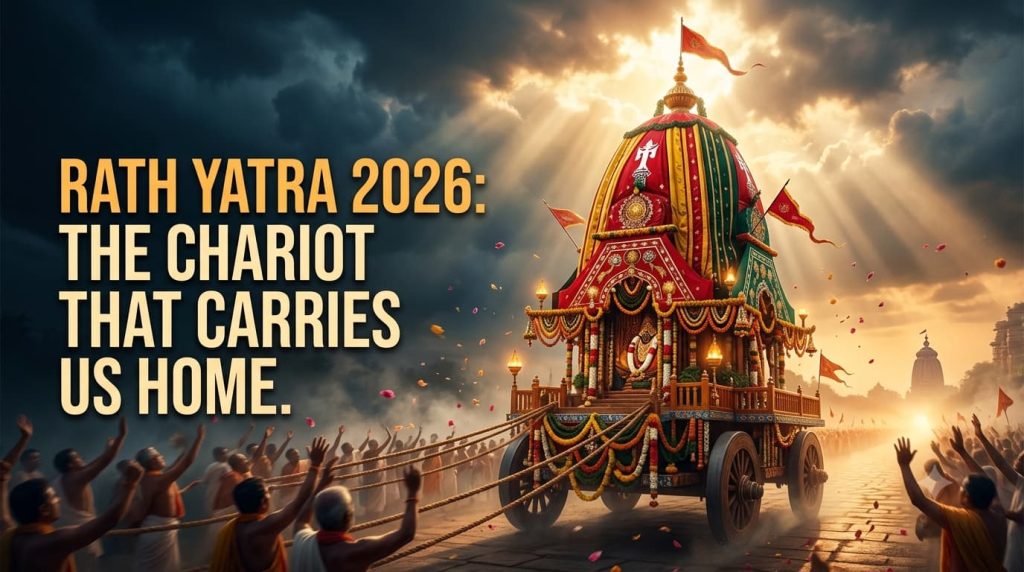
I still remember the first time I stood on the Grand Road in Puri and felt the ground actually tremble under my feet as the chariot of Lord Jagannath began to move. I was not prepared for it. The chanting, the conch shells, the sheer wall of people around me, all of it was overwhelming in the most beautiful way. But what stayed with me long after I came home was something much quieter. It was a feeling that the Lord was not sitting far away in some untouchable heaven. He was right there, rolling through the dust, close enough to touch.
That feeling has never left me. And every year, when Ashadha arrives and Puri begins preparing for Rath Yatra, I find myself returning to that same moment in my heart.
So, this year, I wanted to write to you differently. Not just the dates and the rituals, though I will give you every single one of them, accurate and complete. I want to share the parts of this festival that quietly changed something in me, the stories that most people never get to hear, and why I believe this festival has something urgent to say to us in 2026.
Now, if this is the first time you are reading me on this festival, I want to gently point you towards the piece I wrote last year, where I walked you through the full story of how Rath Yatra began, the tale of Queen Gundicha, the tender legend of Krishna fainting in divine memory, and everything about how each ritual unfolds in Puri. I covered all of that in detail there, so I will not repeat it here. This year, I want to take you somewhere I have not taken you before. I want to share the parts of this festival that most people never hear about, the ones that quietly changed something in me, and I want to walk through 2026 with you, date by date, so you have everything you need.
Click here to Read: Rath Yatra: The Sacred Chariot Festival of Lord Jagannath

When Is Rath Yatra 2026?
Let us begin with what you actually need to know for your planning.
Rath Yatra 2026 falls on Thursday, 16th July 2026. This is the day the chariots of Lord Jagannath, Lord Balabhadra, and Devi Subhadra begin their journey from the Jagannath Temple to the Gundicha Temple in Puri, Odisha, a distance of about 3 kilometres along the sacred Bada Danda, the Grand Road.
The festival is calculated according to the Dwitiya Tithi of Shukla Paksha in the Hindu month of Ashadha. For those who like precision, the Dwitiya Tithi begins on 15th July at 11:50 AM and ends on 16th July at 8:52 AM.
Some of you may have heard of Nabakalebar, the rare occasion when the wooden idols themselves are completely replaced with new ones, carved from sacred neem trees. That only happens once every several years, when the lunar calendar produces an extra month of Ashadha. 2026 is not that year. The chariots will be brand new, as they are every single year, but the beloved forms of Jagannath, Balabhadra, and Subhadra that we know and love will remain the same.
The Complete Festival Calendar for 2026
I know many of you like to keep a simple reference for the whole festival, so here is the full sequence of events this year.
| Date (2026) | Day | Ritual | What It Means |
| 29th June | Monday | Snana Purnima | Deities are bathed with 108 pitchers of sacred water |
| 29th June – 14th July | — | Anavasara | 15 days of seclusion, the deities rest and are repainted |
| 15th July | Wednesday | Netrotsava (Nabajouban Darshan) | First public darshan of the freshly adorned deities |
| 16th July | Thursday | Rath Yatra | The grand chariot procession to Gundicha Temple |
| 20th July | Monday | Hera Panchami | Goddess Lakshmi visits Gundicha in search of Jagannath |
| 24th July | Friday | Bahuda Yatra | The return journey to the main temple |
| 25th July | Saturday | Suna Besha | Deities adorned in gold ornaments on the chariots |
| 26th July | Sunday | Adhara Pana | A sweet drink is offered to the deities on the chariot |
| 27th July | Monday | Niladri Bije | The deities re-enter the sanctum of the main temple |
I always tell my students to keep this table close if they are planning to visit or even to observe from home, because each of these days carries its own energy and its own blessing.
A Story I Had Never Shared: The Chariot Inside You
Now let me tell you something I did not write about last year, something that changed the way I personally understand this festival.
There is a beautiful teaching in the ancient Katha Upanishad that compares the human being to a chariot. In this timeless image,
- The body is the chariot itself.
- The senses are the horses pulling it in different directions.
- The mind is the reins, and the intellect is the charioteer who must hold those reins with a steady hand.
- And the soul, quiet and eternal, sits within as the traveller.
When I first came across this teaching many years ago, I remember sitting with it for a long time, because I suddenly understood why Rath Yatra moves people the way it does. We are not just watching a wooden chariot roll down a road. We are watching a mirror of our own inner journey.
Every one of us is being pulled in many directions every single day, by our desires, our fears, our old wounds, our ambitions. The question Rath Yatra quietly asks us is this: who is holding your reins? Is it your highest intellect, aligned with something sacred? Or have you let the horses run wild, pulling you wherever your senses demand?
I share this with my community often when we work on manifestation and self-discipline, because I have seen it change how they approach their own lives. You do not need to wait for the chariot in Puri to move. Your own inner chariot is moving every single day. Rath Yatra simply reminds us to notice who is driving.
The Secret of the Chariots: Built Without a Single Nail
Here is something that genuinely surprised me when I first learned it, and I do not think enough people know this.
Every year, three enormous new chariots are constructed from scratch for this festival, and not a single iron nail is used anywhere in their structure. The entire chariot, sometimes reaching over 45 feet in height, is built purely through traditional wood joinery, a craft passed down for generations within specific hereditary carpenter families of Puri.
The wood itself is not chosen randomly. Specific trees, mainly phassi and dhausa, are identified through ritual selection from the forests of Odisha, and the felling of these trees is itself accompanied by prayer and ceremony. Construction traditionally begins on Akshaya Tritiya, months before the festival, so that by the time Rath Yatra arrives, three towering, hand carved wooden temples on wheels are ready to carry the Lord through the streets.
I find this detail deeply moving. Think about it. An entire community comes together every year to build something magnificent that will only be used once and then dismantled, its wood distributed as sacred relics to devotees. There is no ego of permanence in it. It is pure, humble devotion, offered again and again without asking for anything lasting in return. That, to me, is one of the truest definitions of selfless service.
The Three Chariots at a Glance
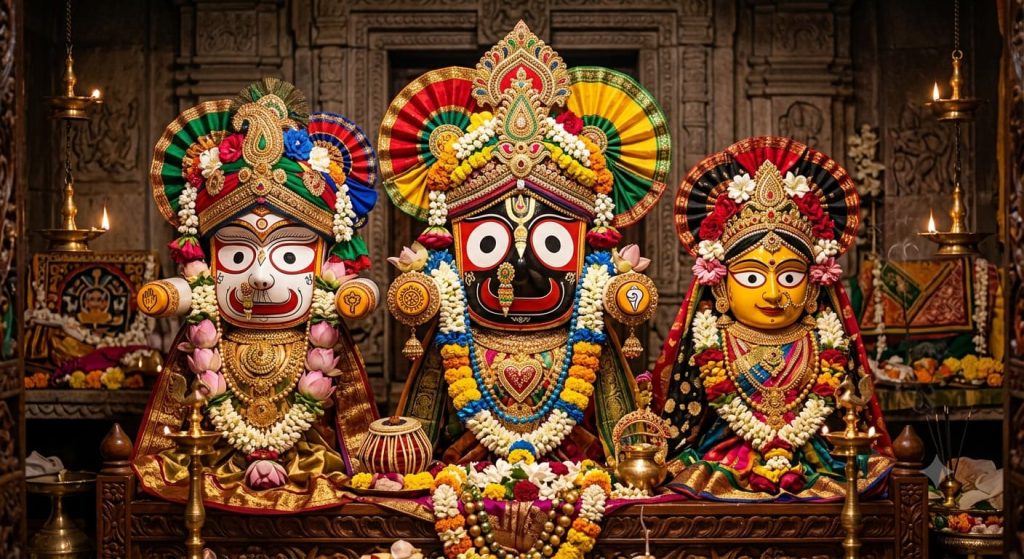
- Nandighosh – Lord Jagannath’s chariot, about 45 feet tall, 16 wheels, wrapped in red and yellow cloth
- Taladhwaja – Lord Balabhadra’s chariot, about 45 feet tall, 14 wheels, wrapped in red and green cloth
- Darpadalana – Devi Subhadra’s chariot, about 44 feet tall, 12 wheels, wrapped in red and black cloth
Hera Panchami: The Day the Goddess Comes Looking for Her Husband
This is one of my favourite parts of the whole festival, and one I have never written about before.
Four days after the main Rath Yatra, on Hera Panchami, a very human and rather tender little drama unfolds. According to tradition, Goddess Lakshmi, the consort of Lord Jagannath, becomes upset that her husband left for Gundicha without informing her. So, she sets out from the main temple to find him.
When she arrives at Gundicha and does not receive the welcome she feels she deserves, she is said to express her displeasure quite openly, and in some retellings, even damages part of Balabhadra’s chariot in her frustration before returning home.
I love this story because it reminds us that even in the grandest, most cosmic festivals, there is room for warmth, humour, and the ordinary textures of relationship. The divine is not always solemn and distant. Sometimes the divine looks a lot like a spouse who simply wants to be told before you leave the house. It teaches us that devotion does not require us to erase our humanity. We can be deeply spiritual and still feel, still expect love and consideration, still be human in our devotion.
Suna Besha: When the Lord Wears Gold
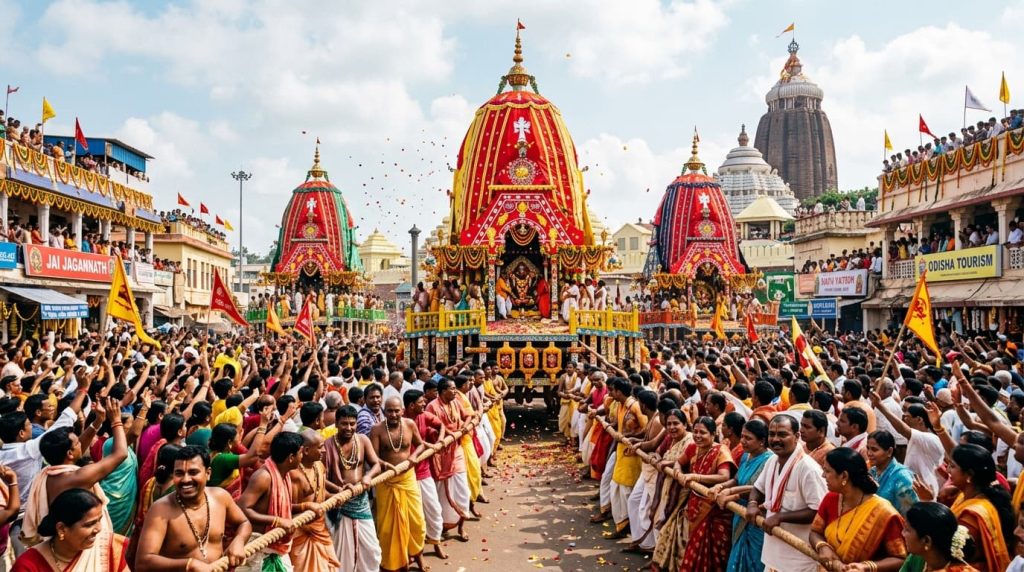
On the day after the deities return to the main temple, they are dressed in an extraordinary array of gold ornaments while still seated on their chariots. This is called Suna Besha, and it is said to be one of the most visually magnificent moments of the entire festival, when the deities appear in their fullest, most regal glory before the crowds.
Historically, this tradition is believed to date back centuries, and it is one of the rare occasions when devotees can witness Jagannath, Balabhadra, and Subhadra adorned in this manner in the open, rather than within the sanctum. If Rath Yatra teaches us humility through the Lord stepping out into the dust of the street, Suna Besha reminds us that after every act of surrender and service, there is also a season of glory that follows.
What This Festival Is Really Teaching Us
Every year I come back to the same realisation. Rath Yatra is not really about a festival in Puri. It is about permission.
Permission to leave the places where we feel safe and step into the open, even when it is uncomfortable. Permission to be seen exactly as we are, without needing to hide behind walls of perfection. & Permission to let go of the reins for a moment and trust that we are being pulled somewhere good.
I think of the Gajapati King of Puri, who every single year, no matter how much power or wealth he holds, picks up a golden broom and personally sweeps the chariot platform clean before the deities are seated. Kings, in that moment, become servants. It is one of the most powerful pictures of humility I have ever encountered, and I return to it whenever my own ego starts whispering that I am too important for small, humble acts of service.
Celebrating from Home, Wherever You Are
Not everyone can be in Puri this July, and that is perfectly alright. Divine connection has never needed a passport.
- Set up a small altar with an image of Jagannath, Balabhadra, and Subhadra, decorated simply with fresh flowers and a diya.
- Chant with sincerity, even if only for five quiet minutes. The Mahamantra, Hare Krishna Hare Krishna, Krishna Krishna Hare Hare, Hare Rama Hare Rama, Rama Rama Hare Hare, carries its own gentle power.
- Offer simple bhog, kheer or fruit or anything made with love, and sit with it in gratitude before you eat.
- Write a few honest lines to the Lord about what you are ready to release this year and what you are asking Him to carry for you.
- Sit quietly and visualise the chariot moving, the crowd, the chanting, and imagine yourself letting go of the rope you have been gripping too tightly all year.
Before I Close
Every year, this festival asks me the same gentle question, and I want to leave it with you too. What are you still holding on to that you were meant to release long ago?
The chariot does not wait. It moves forward, carrying the Lord towards His people, regardless of who is ready and who is not. Perhaps that is the final lesson. Life keeps moving. Grace keeps arriving. The only real choice we have is whether we walk towards it with open hands, or stand still, holding on to what no longer serves us.
This Rath Yatra 2026, I hope you find the courage to loosen your grip a little. I hope you let something old be carried away, and something new roll gently into your life instead.
Jai Jagannath.
With love and light,