
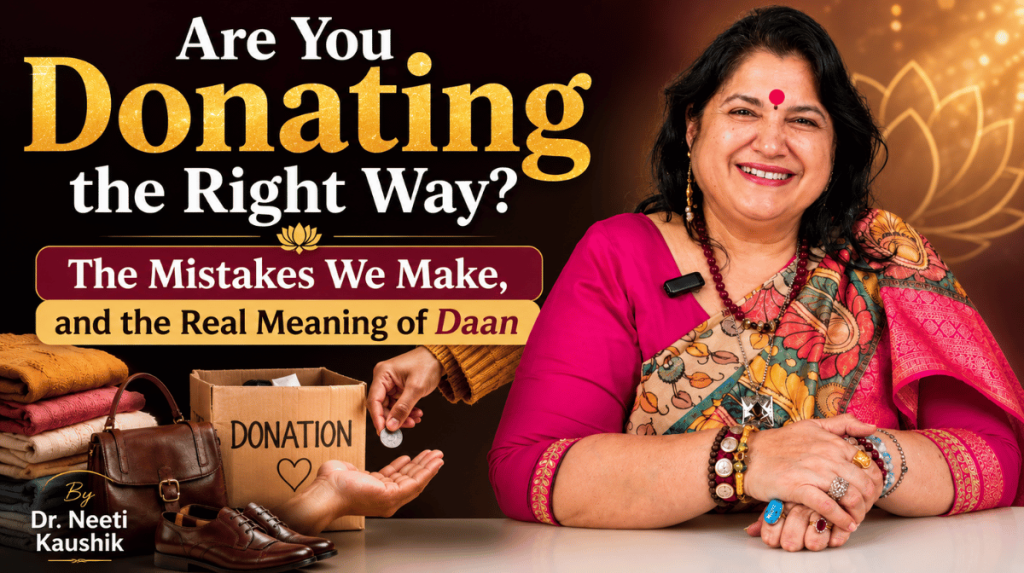
I want to ask you something honestly. When was the last time you donated something? Not the last time you clicked ‘donate’ on a website or dropped some coins into a box, but truly gave something of yourself to another person with full heart?
This question used to make me uncomfortable too. Because I thought donation meant big gestures. Big money. Grand gestures at temples. Truckloads of food for hundreds of people. And if I could not do that, well, I was simply not in a position to donate.
I was so wrong. And it took me years to understand that.
Today, I want to share everything I have learned about Daan, about giving, about what our ancient scriptures actually say, and most importantly, about the very common mistakes most of us make without even realizing it. Whether you are reading this in your lunch break or your morning chai time, I promise this will stay with you.
| A Truth That Changed My Perspective Our scriptures do not measure the value of a donation by its size. They measure it by the purity of the intention behind it. A small act of giving with a full heart is worth infinitely more than a large donation done for show. |
What Is Daan? More Than Just Money
The Sanskrit word ‘Daan’ comes from the root ‘da’, which means ‘to give.’ But it is so much deeper than the act of handing something over.
In our Vedic tradition, Daan is described as one of the highest virtues. It appears in the Bhagavad Gita, the Mahabharata, the Manusmriti, and countless Puranas, always as a pillar of dharmic living. Lord Krishna specifically says in the Gita that Daan given without expectation of return, at the right time, in the right place, to a worthy person, is Sattvic Daan, the purest form of giving.
But here is what strikes me most. Our scriptures list over a dozen forms of Daan. Food, yes. Clothes, yes. Money, yes. But also knowledge. Time. Encouragement. Medicine. Safety. A smile. A kind word to someone who is struggling.
Daan, in its truest sense, is anything you give that reduces someone else’s burden or lights up their world, even for a moment.
What the Scriptures Say About the Types of Daan
Here is a simple breakdown of the types of Daan our tradition recognizes. As you read this, I want you to notice how many of these you are already doing without even calling it ‘donation’:
| Type of Daan | What You Give | Who Benefits |
| Anna Daan | Food | The hungry, laborers, pilgrims |
| Vidya Daan | Knowledge, education, skills | Students, struggling youth |
| Vastra Daan | Clean, ironed clothes | The poor, disaster-affected |
| Abhaya Daan | Safety, protection, support | The fearful, the vulnerable |
| Aushadh Daan | Medicine, health guidance | The sick, the elderly |
| Samay Daan | Your time and presence | The lonely, children, the aged |
| Shrama Daan | Your effort, physical help | Anyone in need of hands |
| Prerana Daan | Encouragement, a smile, a kind word | Everyone around you |
Look at that list again. You are already giving in so many ways, aren’t you? The friend you encouraged when she was about to give up. The colleague whose lunch you shared when they forgot theirs. The elderly uncle you helped cross the road. That is all Daan. That is all sacred.
The 5 Common Mistakes People Make While Donating
Now I want to talk about something that I see again and again, and something I myself was guilty of for many years. We give, but we give carelessly. And when we give carelessly, we not only miss the full benefit of giving, we sometimes pass on our own stagnant energy to someone else.
Let me explain.
Mistake #1: Giving Used Items Without Cleaning Them
This is perhaps the most common mistake, and it is one I feel very strongly about.
Giving your old clothes, shoes, bags, or other belongings to someone in need is a beautiful thing. But your things carry your energy. Every object you have used and lived with holds a vibrational imprint of you, your emotions, your stress, your good days and your bad days.
When you give something away, you are not just giving a physical object. You are transferring energy.
| The Right Way to Donate Used Items Before donating any used item, clean it properly. Wash the clothes, iron them neatly, polish the shoes, and clean the bags or purses before giving them away. Donation should always be done with respect and dignity. One beautiful spiritual practice many people follow is asking the person receiving the item to give a very small amount in return – even ₹1 or ₹2 is enough. This is not about taking money from them. It is only a symbolic exchange of energy. Spiritually, this small exchange creates balance and ensures that the item is not passed with the energy of burden, pity, or helplessness. Instead, it becomes an exchange done with respect, positivity, and dignity for both sides. |
Please remember: whatever you give, give it with the same respect you would want to receive something with.
Mistake #2: Donating for Show, Not for the Soul
We live in the age of social media. We take pictures at donation drives. We post about how many blankets we distributed. We share videos of food being served.
Now, there is nothing wrong with spreading awareness. But when the real motivation behind giving becomes likes, comments, and being seen as a good person, the purity of the act changes.
My mother always told me something I have never forgotten. She said, ‘Beta, the best donation is the one where your left hand does not know what your right hand gave.’
Daan done in silence, without seeking recognition, multiplies in its impact. Our scriptures call this ‘Gupti Daan’, the hidden donation, and consider it the highest form of giving.
Mistake #3: Giving What You No Longer Want, Not What You Can Truly Give
Let me be honest here. Most of the time, we donate things we were going to throw away anyway. Clothes that no longer fit. Food that is about to go bad. Objects that are broken or faded.
Giving someone your unwanted leftovers is not the same as giving from your heart.
True giving sometimes requires a little sacrifice. Not so much that it harms you, but enough that you feel it. Even if it is just giving 30 minutes of your time to sit with a lonely elderly person. Even if it is giving a book you love to a child who could benefit from it. Even if it is giving up the front seat in a queue for someone who needs it more.
When giving costs you something, even a little something, it means something.
Mistake #4: Giving Without Intention or Awareness
Have you ever dropped coins in a donation box at a temple while scrolling on your phone? Or quickly clicked ‘donate’ on an appeal while half-watching a show?
Our tradition teaches us that Daan should be given with full awareness. You should know who you are giving to, why you are giving, and hold a clear, loving intention as you give. Even if it is just 10 rupees, pause for one breath and think: ‘I give this for the benefit of whoever needs it most.’
That one conscious breath changes everything about the quality of your giving.
Mistake #5: Believing You Have Nothing to Give
This breaks my heart the most. So many people tell me: ‘Dr. Neeti, I wish I could donate more but I don’t have enough money.’
Friend, if this is you, I want you to hear me clearly.
You do not need money to donate. You need only a willing heart.
| You Can Give More Than You Think Your smile to a stranger is Prerana Daan. Listening patiently to a grieving friend is Samay Daan. Teaching a child in your neighbourhood to read is Vidya Daan. Helping an elderly neighbour carry their groceries is Shrama Daan. These are not small things. These are everything. |
The Benefits of Giving: What Our Scriptures Promise
Now, let me tell you something that might surprise you. Daan is not just good for the person receiving it. It is profoundly good for you.
Our scriptures and our modern science both agree on this, which I find deeply comforting.
What the Vedic Texts Say
The Padma Purana states that Daan purifies the giver’s mind and removes past karma. The Mahabharata, in the Anushasana Parva, dedicates an entire section to the glory of Daan, saying that giving food is like offering the sun itself to the universe.
Chanakya wrote that one who gives to the deserving, at the right time and place, without pride, that person is never in want. Not because of some magical reward system, but because the mindset of generosity naturally attracts abundance.
What Modern Science Agrees
- Studies show that people who regularly volunteer or give to others experience lower levels of stress hormones.
- Acts of giving release oxytocin, the same bonding hormone that makes us feel love and connection.
- People with a habit of generosity report higher life satisfaction and stronger sense of purpose.
- Children raised in giving households develop higher emotional intelligence and empathy.
| When you give, you are not depleting yourself. You are opening a channel. Energy flows in where energy flows out. This is not a metaphor. This is how the universe actually works. |
Simple Ways to Begin: You Don’t Need to Wait
I want to make this practical for you. Because I know how life is. We are all busy. We are all dealing with our own things. So let me give you small, real, doable ways to begin a practice of giving, starting today.
In Your Home
- Once a Year, go through your clothes and select 5 pieces that are clean, washed, and ironed. Drop them at a local gurdwara, temple, or charity.
- Cook one extra serving at dinner and give it to the watchman, the delivery person, or whoever is nearby.
- Sit with your elderly parents or grandparents for 20 minutes and just listen to them without your phone.
In Your Workplace
- If a junior colleague is struggling, offer to explain something without being asked.
- Say thank you out loud to the office housekeeping staff. Make eye contact. Mean it.
- Share your knowledge. That report template you spent hours perfecting? Share it freely.
In Your Community
- If you see an elderly person waiting in a long queue, offer them your spot.
- Teach a child in your neighbourhood something useful, a skill, a poem, a game.
- Pray genuinely for someone who is sick or struggling, even if you do not know them personally. This is Prerana Daan and it is incredibly powerful.
| Start With One Commitment You do not need to change everything at once. Just pick one thing from this list. Do it once this week. Notice how it feels. That feeling is the beginning of a giving practice that will transform your life from the inside out. |
The One Thing I Want You to Remember
If you take only one thing from this entire article, let it be this:
| Daan Is Not About What You Have. It Is About Who You Choose to Be. Every time you give, even the smallest thing, from a genuine place of love and care, you are participating in the oldest, most sacred practice of humanity. You are saying: I see you. You matter. And I am here. |
You do not need to be wealthy to be generous. You do not need to run a charitable trust to make a difference. You just need to be present, intentional, and willing to give a little of yourself.
Start where you are. Give what you can. Do it with love. Do it with dignity.
That is the whole teaching. That is Daan.
| Want to go deeper into abundance, manifestation, and spiritual living? Explore my courses and resources at drneetikaushik.com |
With love and light, Dr. Neeti Kaushik
Excellent
Superb article
Loved it
Thank you so much
[…] Also read: Are You Donating the Right Way? […]