
Why Do We Overthink? Understanding the Brain Behind Overthinking
When Your Mind Simply Refuses to Switch Off
Have you ever lain in bed at night, body exhausted, and yet your mind is wide awake?
You begin with a small thing, a conversation from the morning. Then you wonder whether you said something wrong. You imagine what the other person must have thought, and before you realise it, you are replaying the whole conversation like a film you never wanted to watch.
Or perhaps there is a decision waiting for you. Instead of choosing, you keep analysing every option and imagining everything that could go wrong.
I often meet people who tell me, “I know I am thinking too much, but I cannot stop.” If that is you, please hear this first: you are not weak and you are not broken. Your mind is working hard to protect you. It just does not know when to rest.
So here is the question we will explore together: why does the mind keep thinking about something even when we desperately want it to stop?
What Is Overthinking? Thinking vs Overthinking
Thinking is not the enemy. It helps us plan, learn and solve problems. Overthinking begins when thinking stops moving us forward.
Imagine you made a mistake at work. Asking “What can I do differently next time?” helps you grow. But repeating “Why am I so careless?” for days only keeps you stuck.
| Productive Thinking | Overthinking |
| Helps you understand a situation | Repeats the same questions |
| Looks at possible solutions | Focuses on what could go wrong |
| Leads to a decision or action | Replays old conversations |
| Has a clear purpose | Imagines endless future scenarios |
Psychologists use two words here. Worry is repetitive thinking about the future. Rumination is repetitive thinking about the past or our own distress. Both keep us circling without arriving anywhere.
What Happens in Your Brain When You Overthink?
There is no single “overthinking switch” in the brain. Several regions and systems work together, and scientists are still learning how.
The Brain’s Threat Detection System
The amygdala, a small almond-shaped region, helps process the emotional importance of what is happening, especially anything that feels threatening. Uncertainty, criticism or conflict can activate these threat-related responses, and the mind starts scanning and preparing. That is why one casual remark can send you spiralling.
The amygdala does not cause overthinking on its own. It is one part of a larger network.
The Prefrontal Cortex and Decision-Making
The prefrontal cortex, behind your forehead, supports planning, reasoning and decision-making. Think of it as the wise adult in the room. Research shows that stress can weaken its functioning. This is why decisions feel heavy when you are tired, and why a problem that looks huge at midnight often looks smaller after sleep.
The Default Mode Network and the Wandering Mind
The Default Mode Network (DMN) is a group of connected brain regions linked with mind-wandering, autobiographical memory and thinking about ourselves. It is active when we remember the past or imagine the future.
It is not an “overthinking centre,” and its activity is not harmful. & It is why we can reflect and dream. Trouble may start when this natural wandering gets stuck on unsolved or negative concerns. A well-known study by Killingsworth and Gilbert found that people reported feeling less happy when their minds were wandering.
Why Repeated Thoughts Become Familiar
The more we return to a worry, the easier it becomes to return to it again. The brain learns through repetition, and thinking habits can grow stronger. This connects with neuroplasticity, the brain’s ability to adapt with experience, though not every repeated thought creates a permanent change.
The hopeful part is this: if the brain can learn a habit, it can learn a new one too.
Why Do We Overthink? 7 Common Reasons
1. Fear of making the wrong decision. We want the perfect choice, so we keep comparing and doubting. This is analysis paralysis.
2. Fear of judgement. “Did I sound silly?” We replay conversations because we care what others think.
3. Uncertainty about the future. While waiting for a result or a reply, the mind fills the gap with imagined scenarios, usually the worst ones.
4. Past experiences and emotional baggage. If trust was broken once, the mind may stay on high alert, trying to protect you even when it is no longer needed.
5. Perfectionism and the need for control. When everything must be just right, the mind never gets to rest.
6. Low confidence and self-doubt. You decide carefully, then ask, “But what if I was wrong?”
7. Stress, mental overload and lack of rest. Busy schedules, constant notifications and too little sleep leave no space for the mind to settle.
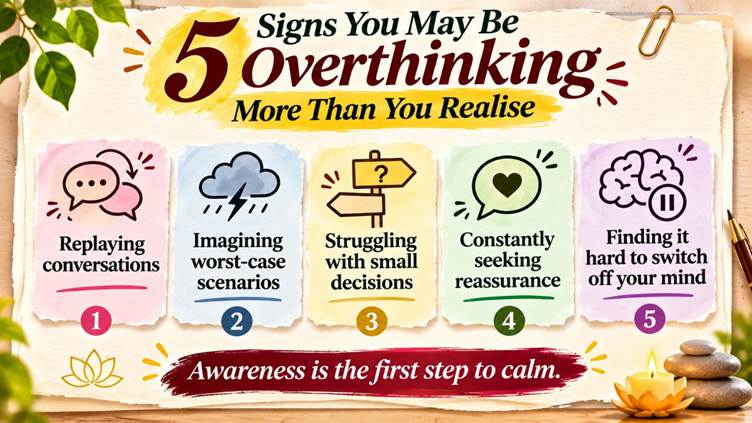
5 Signs You May Be Overthinking More Than You Realise
- You replay conversations in your head, long after they are over.
- You imagine negative outcomes before anything has happened.
- You struggle with even small decisions, like what to eat or wear.
- You keep seeking reassurance from other people.
- You find it hard to relax because your mind is always occupied.
An occasional overthinking night is a very human experience. These signs alone do not indicate a mental health diagnosis.
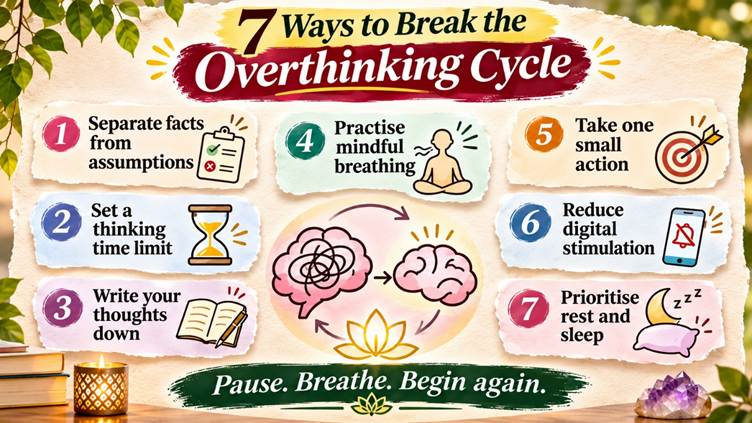
How to Stop Overthinking: 7 Practical Techniques
You cannot always control which thoughts arrive, but you can learn how to respond. None of these is a magic cure, so be patient with yourself.
1. Separate facts from imagined scenarios. Ask: What do I actually know? What am I assuming? What evidence do I have? Am I worrying about something that has not happened?
2. Give your thoughts a time limit. Set aside 15 to 20 minutes a day as thinking time. When a worry appears outside it, tell yourself, “I will think about this later.”
3. Write your thoughts down. Ask: What am I thinking about? What am I feeling? What is within my control? & What is one action I can take?
4. Practise mindful breathing. Breathe in slowly through your nose and out gently through your mouth. When the mind wanders, bring it back without scolding yourself. Even two minutes is a start. It will not erase overthinking, but it trains attention.
5. Take one small action. Instead of “I need to fix my career,” ask, “What is one step I can take today?” Maybe it is one email or one phone call.
6. Reduce mental stimulation. Take short digital breaks from notifications and scrolling, especially in the first and last half hour of your day.
7. Prioritise sleep, movement and rest. Research links sleep and physical activity with better emotional balance and clearer thinking. These are kind foundations, not guaranteed treatments.
Try This: The “What Is the Worst That Can Happen?” Exercise
When a “what if” thought keeps looping, the mind usually jumps to the worst story and then runs away from it. This exercise does the opposite. You look at the worst case calmly, once, and then you close the file.
Sit with a pen and paper and give yourself 10 minutes.
Step 1: Write the “what if.”
Write the exact fear. For example: “What if I fail this interview?”
Step 2: Name the worst that can happen.
Be honest and specific. “I do not get the job.” Then ask yourself, “And then what?” Keep going until you reach the real end of the story. You will often notice that the worst case is far smaller and more bearable than the vague fear that was spinning in your head.
Step 3: Ask how likely it really is.
Write a rough number from 0 to 100. Our minds treat a possible thing as a certain thing, so this step brings you back to reality.
Step 4: Write the best case and the most likely case.
The truth usually sits somewhere in the middle.
Step 5: Plan your “if it happens.”
Write two short lines:
- What can I do to make the worst less likely?
- If it does happen, what will I do next, and who can support me?
Step 6: Ask one last question.
“Will I be okay in a year?” Most of the time, the honest answer is yes.
Now stop. Close the notebook, take three slow breaths, and tell yourself, “I have looked at it. I have a plan. I do not need to think about it again right now.” If the thought returns, you can say, “I already answered this.”
A gentle note: this exercise is for everyday worries. If the worst case feels overwhelming or the fear will not settle, please speak with a qualified mental health professional.
Can Meditation Help You Manage Overthinking?
Many people believe meditation means stopping all thoughts. It does not. It changes the way we relate to them.
Through meditation we learn to:
- Observe thoughts instead of fighting them.
- Return attention to the present moment.
- Notice our emotional reactions.
- Build a steady routine over time.
Think of thoughts as clouds crossing the sky. You do not chase them. You simply notice them and let them pass.
Give Your Mind a Little Space to Breathe
If you would like a structured way to begin, I created 7 Days of Chakra Healing Meditation. It includes seven guided chakra meditations, healing frequencies and affirmations, and it aims to help you release overthinking and mental clutter. It is a reflective practice, not a medical treatment. Explore it whenever you feel ready.
Why Journaling Can Help You Understand Your Thoughts
Thoughts that stay inside tend to spin. On paper, they slow down. Journaling helps you recognise recurring patterns, identify emotional triggers, separate facts from assumptions and reflect on alternative responses.
Try these four prompts for five quiet minutes:
- What thought keeps returning to my mind?
- What emotion is connected to this thought?
- What am I afraid might happen?
- What is one healthier or more constructive way to respond?
Do not try to write beautifully. Just be honest.
Go Beyond Your Thoughts. Understand the Patterns Behind Them.
If the same worries keep returning in different forms, you may like my course Shadow Journaling for Inner Child Healing. It uses guided journaling, reflective prompts and chakra-based exploration to understand emotional patterns, childhood experiences, hidden beliefs and unspoken fears. Not every instance of overthinking comes from childhood, but for some people, gentle self-exploration brings real insight.
Crystals Traditionally Associated With Calmness and Mental Clarity
Some people keep a crystal near them during meditation or journaling as a symbolic reminder of an intention. The properties below are traditional and spiritual associations, not scientific treatments, and crystals are never a substitute for professional support.
Amethyst: Traditionally Associated With Calmness and Meditation
Amethyst is associated with calmness, intuition, spiritual awareness and restful sleep.
- Keep it near your meditation space.
- Hold it during quiet reflection.
- Place it by your bedside as a reminder to slow down.
Lepidolite: Traditionally Associated With Emotional Balance
Lepidolite is associated with emotional calm, life transitions and letting go of old patterns.
- Hold it during journaling.
- Keep it near your meditation space.
- Use it as a reminder to pause when overwhelmed.
Sodalite: Traditionally Associated With Clarity and Thoughtful Communication
Sodalite is associated with mental clarity, rational thinking, inner understanding and communication.
- Keep it on your work desk.
- Hold it during reflection.
- Include it in meditation or journaling.
If you feel called to bring one into your routine, you are welcome to explore these at my official shop.
When Should You Seek Professional Support?
Occasional overthinking is normal. But please consider speaking with a qualified mental health professional if repetitive thoughts:
- Significantly disturb your sleep.
- Interfere with work, studies or relationships.
- Create persistent distress.
- Feel difficult to manage on your own.
Asking for help is not weakness. It is one of the wisest things a person can do.
Your Mind Needs Guidance, Not Constant Criticism
Having too many thoughts does not mean something is wrong with you. It means you have a mind that cares and wants to protect you. You would not scold a frightened child for being scared, so give your mind the same kindness.
As you move through your days:
- Notice your thinking patterns.
- Stop treating every thought as a fact.
- Allow yourself to pause.
- Focus on what you can control.
- Practise meditation and reflection.
- Seek support when needed.
You cannot always control which thoughts enter your mind, but you can learn to change how you respond to them.
You do not have to solve every problem in your mind today. Sometimes, the first step towards peace is simply learning to pause.
Tell me in the comments: what do you tend to overthink the most? The past, the future, relationships or decisions?
With love and light,
Dr. Neeti Kaushik
FAQs
Q1. Why do we overthink everything?
Ans. The brain tries to protect us from uncertainty, mistakes and judgement. Fear of wrong decisions, past experiences, perfectionism, self-doubt, stress and lack of rest can all push the mind into repetitive thinking. It is a common human pattern, not a personal flaw.
Q2. What happens in the brain when we overthink?
Ans. No single area causes it. Threat-related regions like the amygdala may react to uncertainty, stress can reduce the prefrontal cortex’s ability to reason calmly, and the Default Mode Network, linked with mind-wandering, can get stuck on past or future concerns.
Q3. How can I stop overthinking at night?
Ans. Write your thoughts down before bed, set a daytime thinking window, practise slow breathing and avoid screens for 30 minutes before sleep. If sleepless worry is frequent, speak with a healthcare professional.
Q4. Can meditation help with overthinking?
Ans. It can help you notice thoughts without reacting to each one, and it trains attention and emotional awareness. It does not stop thoughts, and it is not a replacement for professional care.
Q5. What are some practical ways to calm an overactive mind?
Ans. Separate facts from assumptions, limit worry to a daily thinking window, journal, breathe mindfully, take one small action, reduce digital stimulation and prioritise sleep and movement.
Research References
- Nolen-Hoeksema, Wisco & Lyubomirsky (2008). Rethinking rumination. Perspectives on Psychological Science.
- Ehring & Watkins (2008). Repetitive negative thinking as a transdiagnostic process. International Journal of Cognitive Therapy.
- Raichle et al. (2001). A default mode of brain function.
- Buckner, Andrews-Hanna & Schacter (2008). The brain’s default network. Annals of the New York Academy of Sciences.
- Killingsworth & Gilbert (2010). A wandering mind is an unhappy mind. Science.
- Arnsten (2009). Stress signalling pathways that impair prefrontal cortex structure and function. Nature Reviews Neuroscience.
- Hölzel et al. (2011). How does mindfulness meditation work? Perspectives on Psychological Science.
Your Relationship With Money: 7 Hidden Patterns That May Be Controlling Your Financial Life
Imagine two people who earn exactly the same salary.
One checks the bank balance calmly, spends with thought, and sleeps peacefully. The other feels a knot in the stomach even on salary day, worries about running out, cannot buy a small thing for themselves, or feels they must rescue everyone around them.
Same income. Completely different experience. Why?
I have thought about this question for years, and my answer is simple. Your relationship with money is not decided by your income alone. It is shaped by what you believe, what you feel, what you saw as a child, and what money has come to mean to you.
Let me ask you a few gentle questions. Please answer honestly, only for yourself.
- Do you feel anxious when you check your bank balance?
- Do you shop when you are stressed, bored or sad?
- Do you feel guilty buying something for yourself?
- Do you find it hard to say no when someone asks for money?
- Do you earn regularly but still feel you never have enough?
If even one of these touched something inside you, please stay with me. Nothing is wrong with you. You may simply be noticing a pattern, and noticing is where every real change begins.
What Does Your Relationship With Money Really Mean?
We usually think of money as numbers in an account. But for most of us, money quietly carries other meanings: safety, freedom, respect, independence, responsibility, or even self-worth.
Your relationship with money has four layers:
- Thoughts: What do you believe about money, wealth, security and success?
- Emotions: What do you feel when you earn, spend, save, give or receive?
- Habits: How do you behave in everyday financial decisions?
- Experiences: What has happened in your life that taught you how to handle money?
I want to be clear about one thing. This is different from learning budgeting or investing. Those skills matter, and I will come back to them. But this article is about the emotional side, the part that decides whether you actually follow what you already know.
7 Hidden Money Patterns That May Be Controlling Your Financial Life
Before we begin, a gentle note. These seven patterns are examples I am using to help you reflect. They are not medical labels or fixed personality types. You may see yourself in more than one, and patterns can change over time.
1. The Avoider: When Looking at Money Feels Uncomfortable

This person delays paying bills, avoids checking the balance, and leaves bank statements unopened. Often the reason is not laziness. It is fear of what they might find, or embarrassment about a past choice.
Think of someone who feels their chest tighten every time a message from the bank arrives, so they simply do not open it. The problem does not disappear. It quietly grows.
Researchers have a name for a similar behaviour in investors, the “ostrich effect”: people look at their finances less when they expect bad news (Karlsson, Loewenstein and Seppi, 2009).
Try this: Set aside ten calm minutes this week to look at your finances, with a cup of tea and no self-criticism. Awareness is always kinder than avoidance.
2. The Emotional Spender: When Shopping Becomes an Escape
A hard day at work, a lonely evening, a small disappointment, and suddenly the phone is full of shopping carts. There is nothing wrong with enjoying a purchase. The question is whether you are buying something you need or buying a feeling.
Research has found that sadness can make people more willing to spend, even when they do not realise it (Cryder, Lerner, Gross and Dahl, 2008).
Try this: Before an unplanned purchase, pause for a minute and ask, “What am I really feeling right now?” Often the answer is not “I need this.”
3. The Over-Giver: When Saying No Feels Selfish
This is the person everyone calls in an emergency. They lend again and again, pay for others, and carry the financial weight of the family, even when their own stability suffers.
Behind this often sits love, but also guilt, duty, or a fear of disappointing someone. Generosity is a beautiful quality. But true generosity should not require you to abandon yourself.
Try this: Practise one respectful boundary, such as “I cannot help with this amount, but I can help with this much.” A boundary is not rejection. It is honesty.
4. The Fearful Saver: When Saving Never Feels Like Enough
Saving is wise. But some people save and save and still cannot relax or use what they have built. Often this comes from a time of insecurity, when money was scarce and the fear of losing it became deeply rooted.
Here is the difference I want you to notice. Healthy saving gives you peace. Fear-driven saving gives you only more fear. Psychologists have also shown that losses feel more painful than equal gains feel good, a idea known as loss aversion (Kahneman and Tversky, 1979). It helps explain why holding on can feel safer than living.
Try this: Decide a fixed amount each month for security and a fixed amount for joy. Both deserve a place in your plan.
5. The Guilt-Driven Spender: When Spending on Yourself Feels Wrong

You buy gifts for everyone, fix everyone’s needs, and yet delay your own medicine, your own clothes, your own rest. Many of us, especially women, learned quietly that our needs come last.
That belief may have looked like sacrifice, but over time it can turn into the feeling that we are not worth the spend.
Try this: Write down three reasonable personal needs that you have been postponing. Then choose one and honour it this month.
6. The Approval Seeker: When Money Becomes a Way to Prove Your Worth
A bigger car, a grander celebration, a lifestyle that looks successful, even when it strains the budget. Comparison is a very human habit. Psychologist Leon Festinger described it long ago as our natural tendency to judge ourselves by looking at others (1954), and social media has multiplied it.
Try this: Before a major purchase, ask, “Is this for my needs, or for someone else’s opinion?”
7. The Anxious Earner: When You Work Hard but Never Feel Secure
This person works constantly, fears losing income, and cannot enjoy achievements. Their worth feels tied to their earnings, so rest feels risky.
Here is something important: earning more does not automatically calm every fear about money. If the worry is emotional, a bigger number alone may not settle it.
Try this: Make a small list of progress that is not measured in rupees, such as skills gained, trust earned and problems solved.
Quick view
| Pattern | What it looks like | Gentle question to ask |
| Avoider | Avoids bills and balance | What am I afraid to see? |
| Emotional Spender | Spends to feel better | What am I feeling right now? |
| Over-Giver | Cannot say no | Whose approval am I seeking? |
| Fearful Saver | Saves but cannot enjoy | Is this peace or fear? |
| Guilt-Driven Spender | Puts self last | Do I deserve my own care? |
| Approval Seeker | Spends to impress | Who am I buying this for? |
| Anxious Earner | Works but never feels safe | Is my worth my income? |
Which Money Pattern Do You Recognise in Yourself?
Recognising a behaviour is only the first step. The deeper question is why it happens. If you would like to explore this more gently and in an organised way, I have created a course called Master Your Relationship With Money. It includes a 21-question money-pattern self-assessment that helps you identify your dominant pattern, along with its strengths, blind spots and direction for growth. It is simply there for you if you wish to go deeper.
Where Do Our Money Beliefs Come From?
Nobody is born anxious about money or guilty about spending. These feelings are learned, sometimes without a single word being said.
Childhood and Family Conversations
Think about what you heard growing up:
- “Money does not grow on trees.”
- “We cannot afford that.”
- “Rich people are greedy.”
- “Always save for a difficult day.”
- “Money is very hard to earn.”
Repeated again and again, such sentences quietly become beliefs. Research on family financial socialisation shows that parents and home environments shape how children later think about and handle money (Gudmunson and Danes, 2011). Psychologists Brad Klontz and colleagues have called such deep beliefs “money scripts” (Klontz and Britt, 2011).
Please note, our parents usually said these things out of love and their own experience. The aim is not to blame them. It is to understand ourselves.
Social Conditioning and Comparison
Advertisements, weddings, social media and neighbours all tell us what “success” should look like. Slowly we begin to measure our own financial life against a picture that may not even be real.
Personal Financial Experiences
Not every habit comes from childhood. A job loss, a debt, a sudden medical expense, or an unexpected act of kindness at a hard time can also change how we feel about money at any age. That is why I always say, your story is yours, and it is still being written.
Are You Following Money Rules You Never Questioned?
Many of us carry financial rules for years without asking where they came from. In Master Your Relationship With Money, there are reflective exercises and a belief-rewriting practice that help you explore the influence of family, childhood and society, recognise the beliefs behind your behaviour, question old money rules, and practise healthier responses.
How Emotions Influence Your Financial Decisions
Money decisions are rarely cold and logical. Our emotions walk into every one of them.
- Fear: avoiding decisions, or holding on too tightly.
- Guilt: feeling uncomfortable spending on personal needs.
- Shame: hiding difficulties or avoiding money conversations.
- Stress: impulsive purchases, or postponing responsibilities.
- Comparison: spending to match another person’s lifestyle.
- Pride: protecting an image or proving success.
Here is the simple sequence behind it all:
Trigger → Emotion → Thought → Behaviour → Repeated Pattern
Let me give you an example. An unexpected expense arrives (trigger). You feel fear (emotion). You think, “I am never going to be secure” (thought). So you avoid looking at your accounts, or you make a hasty decision (behaviour). Next time, the same thing happens, and a pattern is born.
The good news is that once you can see this chain, you get a small gap between the trigger and the reaction. In that gap lies your freedom.
A Small Pause Can Change the Way You Respond to Money
The course includes a simple pause practice. You learn to recognise the trigger, notice the emotion, and then choose your response instead of reacting automatically. The aim is never to remove emotions, only to become aware of how they steer you. You can learn this practice in Master Your Relationship With Money. It does not replace financial planning or professional financial advice. It sits beside them.
Money IQ vs Money Mindset: Why You Need Both

These two are often confused, so let me separate them.
Money IQ is your knowledge: budgeting, saving, managing expenses, understanding debt, investing and planning for the future.
Money Mindset is your inner world: the beliefs, attitudes and emotions that decide how you behave with that knowledge.
Consider these two examples:
- A person knows saving is important, yet spends impulsively whenever stressed.
- Another person knows they can afford something, yet feels guilty buying it for themselves.
7 Practical Ways to Build a Healthier Relationship With Money
1. Observe your habits without judgement.
For one week, simply notice how you spend, save, give and receive. Try: a small notebook, with no scolding allowed.
2. Identify the emotion behind each decision.
Ask whether the choice comes from need, fear, guilt, stress or social pressure. Try: write one word for the feeling before any non-essential purchase.
3. Question old money beliefs.
Ask whether a rule you inherited still suits your life today. Try: complete the line, “I learned that money is…” and then ask, “Is this still true for me?”
4. Create healthy financial boundaries.
You can care for someone and still say no. Try: prepare one kind sentence in advance, such as “I wish I could, but I am not able to this time.”
5. Learn to receive without guilt.
Accept fair payment, a gift or help with a simple “thank you,” without apologising. Try: the next time someone offers, say only “Thank you.”
6. Make conscious choices.
Pause before impulsive purchases and plan for both saving and spending. Try: a 24-hour wait rule for non-essential buying.
7. Separate self-worth from net worth.
You are valuable because of who you are, not because of your salary or possessions. Try: each evening, write one thing you did that has nothing to do with money.
Ready to Understand and Transform Your Relationship With Money?
If something in this article has stirred you, I would love to walk with you further. Master Your Relationship With Money is the course I created for exactly this purpose.
Inside you will find:
- 10 chapters organised across four parts
- A 21-question money-pattern self-assessment
- Reflections and journaling prompts
- A simple pause practice
- A belief-rewriting exercise
- Guidance on childhood and family money beliefs
- Exercises on self-worth, receiving and abundance
- A bonus Money Relationship Workbook
Please remember, this is not a budgeting or investment course, and I make no promise of financial results. It focuses on the emotional and behavioural side of money, and it can sit comfortably beside any financial planning you already do. If you are ready, I welcome you.
Your Relationship With Money Can Change
Here is what I most want you to take from this article. Your money habits are not a label stuck on you forever. They are patterns, and patterns can be understood.
So please be gentle with yourself. Whatever you did with money in the past, you did with the awareness, the fears and the circumstances you had at that time. Today you know a little more.
Remember these five things:
- Awareness comes before change.
- Understanding comes before judgement.
- Conscious choices are better than automatic reactions.
- Financial knowledge and emotional awareness belong together.
- Small, steady steps are enough.
You do not have to judge your money patterns. You have to understand them before you can consciously change them.
Which of these seven money patterns did you recognise in yourself? I would love to read your reflections in the comments.
FAQs
1. What does a healthy relationship with money mean?
It means you can earn, spend, save, give and receive without constant fear, guilt or shame. Your decisions come from awareness and your values, not from automatic emotional reactions.
2. What are the most common unhealthy money patterns?
Common examples include avoiding finances, emotional spending, over-giving, fear-driven saving, guilt about spending on yourself, spending for approval, and anxious overworking. These are illustrative tendencies, not clinical diagnoses.
3. How does childhood influence your relationship with money?
Repeated messages and examples at home can shape beliefs about security, spending and wealth. Research on financial socialisation supports this, though later life experiences also play a role.
4. What is the difference between money mindset and money IQ?
Money IQ is your financial knowledge and skill, such as budgeting and investing. Money mindset is your beliefs and emotions about money. Healthy finances usually need both.
5. How can I change my relationship with money?
Start by observing your habits without judgement, notice the emotions behind decisions, question inherited beliefs, set boundaries, and pause before reacting. Change comes through small, consistent steps.
References
- Cryder, C. E., Lerner, J. S., Gross, J. J., & Dahl, R. E. (2008). Misery is not miserly: Sad and self-focused individuals spend more. Psychological Science, 19(6).
- Festinger, L. (1954). A theory of social comparison processes. Human Relations, 7(2).
- Gudmunson, C. G., & Danes, S. M. (2011). Family financial socialization: Theory and critical review. Journal of Family and Economic Issues, 32.
- Kahneman, D., & Tversky, A. (1979). Prospect theory: An analysis of decision under risk. Econometrica, 47(2).
- Karlsson, N., Loewenstein, G., & Seppi, D. (2009). The ostrich effect: Selective attention to information. Journal of Risk and Uncertainty, 38.
- Klontz, B., & Britt, S. L. (2011). Money behaviors and money scripts. Journal of Financial Therapy, 2(1).
- Lown, J. M. (2011). Development and validation of a financial self-efficacy scale. Journal of Financial Counseling and Planning, 22(2).
- Lusardi, A., & Mitchell, O. S. (2014). The economic importance of financial literacy. Journal of Economic Literature, 52(1).
Chant Mantras as Per Your Birth Number
Almost every week, someone sends me a message that goes something like this: “Ma’am, this is my birth number, this is my destiny number, this is my date of birth. Please help me. Which planet should I take help from? Which God should I worship? What can I do daily that will always support me, especially when I feel low, confused or overwhelmed?”
I read these messages with so much love, because I know that feeling. When life gets heavy, we want someone to hand us a clear direction. And so many of us end up running from one person to another, spending a lot of money on readings and remedies, when we are already carrying everything we need.
That is what I always say: do not run behind small things. The universe, the divine and your planetary energies are not outside you. You were born with them. In this article, I want to show you how simple it can be to connect with them through your birth number, one gentle practice at a time.
Understand Your Birth Number Before Choosing Your Mantra
When we are born, we receive a few important numbers: the birth number (from the date you were born), the birth month, the birth year, and the destiny number (from your complete date of birth).
In this article, we focus on the Birth Number, because it is the easiest place to begin.
How to calculate it: Add the digits of the date you were born. If you get a two-digit number, add again until you reach a single digit.
- Born on the 14th: 1 + 4 = 5
- Born on the 27th: 2 + 7 = 9, so your Birth Number is 9
- Born on the 3rd: your Birth Number is simply 3
The Destiny Number is different. You get it by adding every digit of your full date of birth (day, month and year) and reducing it to a single digit. Please do not mix up the two. Today we are talking only about the birth number.
A small note from me: these associations come from numerology and Hindu tradition, and what I share here is my own understanding and recommendation. They are not hard rules. Think of them as loving suggestions you can try.
Mantras and Deities for Birth Numbers 1 to 9
Here is a quick overview first, and then we will go through each number with a little more heart.
| Birth Number | Planet | Deity | Day | Simple Practice |
| 1 | Sun | Lord Rama | Sunday | Aditya Hridaya Stotra, water to the Sun |
| 2 | Moon | Lord Shiva | Monday | Om Namah Shivaya, full moon meditation |
| 3 | Jupiter | Lord Vishnu | Thursday | Om Namo Bhagavate Vasudevaya |
| 4 | Rahu | Goddess Saraswati | Wednesday | Saraswati mantras, durva offering |
| 5 | Mercury | Lord Ganesha and Goddess Durga | Wednesday | Durga Saptashati or Durga stotra |
| 6 | Venus | Goddess Lakshmi | Friday | Kanakadhara Stotra |
| 7 | Ketu | Lord Ganesha | Tuesday | Om Gan Ganapataye Namah, 11 times |
| 8 | Saturn | Shani Dev and Batuk Bhairav | Saturday | Shani Chalisa, Batuk Bhairav mantra |
| 9 | Mars | Lord Hanuman | Tuesday | Hanuman Chalisa |
Birth Number 1

Ruling Planet: Sun
Associated Deity: Lord Rama
Favourable Day: Sunday
Mantra or Prayer: Aditya Hridaya Stotra
Simple Practices: Offer water to the Sun, write “Ram Ram” in a small notebook
If your birth number is 1, Sunday is your special day. Wake up, offer water to the rising Sun, and read or simply listen to the Aditya Hridaya Stotra. You do not need to be perfect at it. Listening with attention is a beautiful beginning.
Another very simple practice is to write “Ram Ram” in a small notebook. These little notebooks are easily available online and cost only ten to fifteen rupees. If you do not have one, any plain diary or notebook works just as well. You can start by writing it once, and slowly increase the count as it feels right.
For food, you can include jaggery (gud) and bajra in your diet.
Birth Number 2
Ruling Planet: Moon
Associated Deity: Lord Shiva
Favourable Day: Monday
Mantra or Prayer: Om Namah Shivaya
Simple Practices: Full moon meditation
The Moon is the planet of water and emotions, and Monday belongs to Lord Shiva. If you are a number 2, you carry a lot of feeling inside you, and Shiva’s energy can help you feel steady.
On full moon nights, sit quietly and meditate. In my experience, this can help you grow your inner strength and your willpower, and it helps you become a calmer, happier person within. You can also chant Om Namah Shivaya whenever you like. It is the simplest mantra, and nothing about it is difficult.
For food, rice kheer (rice cooked in milk) is a good addition to the diet for the Moon (but not during night).
Birth Number 3
Ruling Planet: Jupiter
Associated Deity: Lord Vishnu (Lord Brahma is also connected)
Favourable Day: Thursday
Mantra or Prayer: Om Namo Bhagavate Vasudevaya
Simple Practices: Yellow foods, a pinch of turmeric, saffron tilak
Thursday is your day. A few gentle things you can do:
- Eat besan chilla or have chana dal.
- Add a pinch of turmeric to your bath water.
- Apply a saffron tilak.
- Chant Om Namo Bhagavate Vasudevaya.
If you can only do one thing, make it the mantra. It is so easy to recite, and you do not have to decide anything complicated. You can also read or listen to the Vishnu Sahasranama on Thursdays.
Birth Number 4

Ruling Planet: Rahu
Associated Deity: Goddess Saraswati
Favourable Day: Wednesday
Mantra or Prayer: Saraswati mantras and stotras
Simple Practices: Durva grass, coconut
Number 4 is connected with Rahu, and the goddess associated with it is Maa Saraswati. She is the goddess of knowledge, wisdom and clarity, which is exactly what a restless Rahu energy often needs.
You can offer durva (green grass) in your prayers, and include coconut in your diet. Listen to Saraswati mantras or stotras whenever you feel scattered. Even a few minutes of listening can bring a little calm.
To get better results of Rahu, donation of the Rahu should be done on Wednesday, during Rahu’s Nakshatra (Ardra, Swati, Shatabhisha) either in evening or night.
Birth Number 5
Ruling Planet: Mercury
Associated Deity: Lord Ganesha and Goddess Durga
Favourable Day: Wednesday
Mantra or Prayer: Durga Saptashati or Durga stotra
Simple Practices: Whole green moong dal
Mercury is the planet of intellect, communication and learning. Wednesday is a lovely day to pray to Lord Ganesha. Whole green moong dal is traditionally offered or eaten for Mercury.
For Maa Durga, you can recite the Durga Saptashati, or simply listen to a Durga stotra. This is especially good for students, because it can support focus and confidence during stressful study days.
Birth Number 6
Ruling Planet: Venus
Associated Deity: Goddess Lakshmi
Favourable Day: Friday (the traditional day of Venus)
Mantra or Prayer: Kanakadhara Stotra
Simple Practices: Listen to the stotra regularly
Number 6 belongs to Venus, and Venus is Maa Lakshmi. The Kanakadhara Stotra is a beautiful, powerful hymn dedicated to her. You can simply sit and listen to it, and if you understand its meaning, even better, because understanding makes the prayer feel closer to the heart.
Birth Number 7
Ruling Planet: Ketu
Associated Deity: Lord Ganesha
Favourable Day: Tuesday
Mantra or Prayer: Om Gan Ganapataye Namah (11 times)
Simple Practices: A small havan on Saturday, a Ganesh Chaturthi puja
For number 7, the best and most beautiful practice is to worship Lord Ganesha. If you feel you cannot do something long or elaborate, or cannot go to a temple to have a puja done, that is perfectly fine. Chant Om Gan Ganapataye Namah 11 times. That is enough.
If you would like to do a little more, you can perform a small havan on a Saturday. I also like to remind people that Ganesha is not only the remover of obstacles. He is the energy of peace, wisdom and new beginnings. Whatever your birth number is, taking his blessings regularly is a lovely habit.
Birth Number 8
Ruling Planet: Saturn
Associated Deity: Shani Dev (Batuk Bhairav is also worshipped)
Favourable Day: Saturday
Mantra or Prayer: Shani Chalisa, Batuk Bhairav mantra
Simple Practices: Dates as an offering
Number 8 carries Saturn energy, and Saturn rewards patience and consistency. You can read or listen to the Shani Chalisa. You can also worship Batuk Bhairav, with the mantra:
ॐ ह्रीं बटुकाय आपदुद्धारणाय कुरु कुरु बटुकाय ह्रीं
Om Hreem Batukaya Aapaduddharanaya Kuru Kuru Batukaya Hreem
You can choose either of these, or both, whenever it feels right. Dates (khajoor) are considered dear to this energy and can be offered as prasad.
Birth Number 9

Ruling Planet: Mars
Associated Deity: Lord Hanuman
Favourable Day: Tuesday
Mantra or Prayer: Hanuman Chalisa
Simple Practices: Neem leaves, jaggery, Ram Naam writing
Number 9 is Mars, and Mars means Hanuman ji. The simplest practice here is the Hanuman Chalisa. Read it, or just listen to it.
This is the one I can speak about from my own experience, because I have tried it on myself. When I read or listen to the Hanuman Chalisa before sleeping, I feel very calm and peaceful, and I sleep well. That is what has worked for me.
Hanuman ji spends his whole day in the service of Lord Rama, and he feels very happy when you write “Ram Ram.” On Tuesdays, you can also include neem leaves and jaggery.
What If You Have More Than One Important Number?
You might be thinking: “But my destiny number is different from my birth number. Which one do I follow?”
This is a very natural question, and the answer is not to panic. A numerology chart has several numbers, and each one brings its own planetary energy. In my videos on numerology and astrology, I explain each of these in detail.
But please hear this clearly: you do not have to do everything. If you try to follow ten remedies at once, you will only feel tired and confused. Pick one number you feel most connected to, choose one mantra or one practice from it, and begin there. You can add more later, when your heart says it is time.
How to Make Mantra Chanting a Daily Habit
Here is a simple routine I recommend for beginners:
- Choose one mantra that matches the number you are focusing on.
- Pick a quiet time that suits your day. Morning or just before sleep works for most people.
- Start small. Even 11 repetitions, or a few minutes of listening, is a good start.
- Be present. Chant or listen with attention and a little devotion, not in a hurry.
- Stay consistent. One small practice done every day is worth more than a big ritual done once.
- Keep it comfortable. If it feels like a burden, make it lighter.
If you also want a gentle way to build stillness into your day, you can pair your prayer with my Guided Meditation for Abundance. Many people find that a few quiet minutes of meditation makes the mantra feel deeper.
You Do Not Need Complicated Remedies to Connect with the Divine
Let me tell you what I truly believe. The divine does not look at how grand your puja is. It looks at how sincere you are.
Think about it this way. We ask our father for help with the smallest things. We ask our children, our loved ones, our close ones. Our planets and deities are no different. The universe made you with them in mind. So why not give them a little respect, a little attention, and a simple thank you?
Writing “Ram Ram” in a small notebook costs a few rupees. Chanting a mantra 11 times costs nothing. Saying thank you takes five seconds. And yet these small acts can change how your day feels, how you sleep, and how you face the world.
If life feels heavy right now, please do not wait for the perfect moment, the perfect guru or the perfect ritual. Begin with whatever is in front of you, even if it is only a few lines in a notebook. A small beginning is still a beginning, and the universe notices it.
Want to Deepen Your Connection Through Prayer?
If this article made you want to understand prayer more deeply and build a personal practice that feels like your own, you can explore my course, The Power of Prayer. It is a gentle next step for anyone who wants to go beyond chanting and truly connect.
A Warm Goodbye
Thank you for being part of this beautiful family. I hope this article has made things simpler and a little lighter for you.
Now I would love to hear from you. What is your Birth Number, and which mantra will you begin with? Share it in the comments. And if you already have a favourite mantra, tell me that too. We can all learn from each other.
May God keep you happy, healthy and at peace, in your heart and in your health.
FAQs
- How do I find my birth number? Add the digits of the date you were born and reduce them to a single digit. For the 14th, 1 + 4 = 5.
- Is the birth number the same as the destiny number? No. The destiny number comes from your full date of birth, including month and year.
- Which God should I worship according to my birth number? In this guide: 1 Rama, 2 Shiva, 3 Vishnu, 4 Saraswati, 5 Ganesha and Durga, 6 Lakshmi, 7 Ganesha, 8 Shani and Bhairav, 9 Hanuman.
- Do I need to do complicated rituals? No. A short mantra, a few minutes of listening, or a few lines in a notebook, done regularly, is enough.
- What if my destiny number is different? Choose one practice from the number you feel closest to, and add others slowly.
Neuroplasticity: How to Rewire Your Brain and Change Your Life
Your Brain Is Not Fixed. It Can Change.
Years ago, I met a woman who told me, “Dr Neeti, I have always been like this. I am not good enough, things never work out for me, and I cannot learn anything new.” She said it so calmly, as if she were reading out her name and address.
That calm is what stayed with me. When we repeat a thought for years, it stops feeling like a thought and starts feeling like a fact. We respond to every situation through the same old beliefs, and we begin to think, “This is just who I am.”
I want you to understand something important. Much of what we call “who I am” is really “what I have practised the most.”
That is where neuroplasticity comes in. It is the brain’s ability to adapt and reorganise itself in response to learning, experience and repeated activity. We cannot control everything life sends our way, and I will not tell you that thinking positively fixes every difficulty. But we can take intentional steps to influence what we practise, learn and reinforce. That is a hopeful place to begin, and it is also a realistic one.
What Is Neuroplasticity? Understanding the Brain’s Ability to Change
In simple words, neuroplasticity (also called brain plasticity) means that your brain is not a finished, frozen structure. Your brain is made of billions of nerve cells that connect and communicate with each other. These connections can strengthen, weaken or reorganise depending on how they are used.
Whenever you learn something, practise something or live through a meaningful experience, your brain is involved in adjusting itself. This is how you remember a friend’s face, learn a new route to work or pick up a new skill.
Let me give you a simple analogy. Imagine walking across a grassy field. The first time, there is no visible path. But if you keep walking along the same route every day, the grass wears down and a clear pathway appears. Walking that path becomes easier, almost automatic.
Repeated thoughts, behaviours and responses work somewhat like that. The more often we follow a pattern, the more familiar and efficient it becomes. Please remember that this is only an analogy. It is a picture to help us understand, not a literal description of how every neural connection changes.
Is This Only for Children?
Not at all. Children’s brains are certainly very adaptable, but scientists now understand that the brain continues to adapt throughout adulthood. The learning may feel slower at times, and it may need more patience, but the ability to change does not simply switch off. I will return to this beautiful truth at the end of this article.
How Does Your Brain Rewire Itself?
The science of how the brain changes is deep, but the everyday principles are simple. Here are four that I find most useful.
Repetition Strengthens Learning

Think of learning to ride a bicycle. In the beginning you wobble, you grip the handlebar too tightly and you are sure you will fall. With practice, one day you are simply riding. Research on skill learning suggests that repeated practice strengthens the brain circuits involved in that skill.
The same is true when you learn a new language, build a daily reading habit or practise meditation. Each repetition makes the next one a little easier.
New Experiences Create Opportunities for Change
When you learn a new skill, visit an unfamiliar place or try something you have never done, your brain has to work differently. Studies on learning and environmental enrichment suggest that novelty and challenge are part of what keeps the brain adaptable. Comfort is lovely, but growth usually lives a little outside it.
I have seen this in my own team as well. One of our team members is an engineering graduate who now works in digital content and social media. Her education was in an entirely different field, but her current role requires creativity, writing, understanding audience behaviour and developing communication strategies.
Initially, many of these responsibilities were unfamiliar. But through regular practice, learning from feedback and working on different projects, she gradually developed these skills.
What once seemed outside her area of expertise became a part of her everyday work. This shows how our abilities can grow when we give ourselves the opportunity to learn and practise something new.
Attention and Consistent Practice Matter
There is a big difference between practising and just going through the motions. If you repeat a new habit while your mind is somewhere else, you gain much less than when you are present and engaged. Quality of attention matters, and so does regularity. Ten focused minutes often serve you better than an hour of distracted effort.
Rest and Sleep Support Learning

This one surprises many people. Learning does not happen only while we are practising. The brain also processes and consolidates what we have learned while we rest. An NIH-supported study found that very short breaks during practice of a new skill were linked to the brain replaying and strengthening what had just been practised. And sleep plays an important role in memory and learning too.
So, the next time you feel guilty about resting, remember that rest is part of learning, not the opposite of it.
How Your Everyday Thoughts and Habits Influence Your Brain
Here is where this science touches our daily life. Neuroplasticity is neutral. It can support helpful patterns and unhelpful patterns, depending on what we repeat.
Let me show you how this looks in real life.
| Repeated Pattern | How It Can Become Familiar | A Gentler Alternative to Practise |
| Harsh self-talk (“I always mess up”) | Mistakes feel like proof of a fixed flaw | “I can learn from this mistake” |
| Constant worrying and overthinking | The mind jumps to the worst case quickly | Writing worries down, then choosing one small action |
| Avoiding uncomfortable situations | The discomfort stays big because it is never tested | Facing the situation in small, manageable steps |
| Consistent routines | Good habits begin to feel natural | Keeping routines small enough to repeat daily |
Take public speaking. A person who keeps avoiding it often continues to feel uneasy about it, because they never get a chance to learn that they can survive it. Someone who starts by speaking to two friends, then a small group, then a team meeting, slowly becomes familiar with the experience and more confident.
Notice what happened there. Nobody forced a transformation. They practised a different response, in small doses, again and again.
I must add one honest note. Repetition helps with many habits and responses, but not every emotional difficulty can be solved through practice alone. Anxiety, depression, trauma and other conditions deserve proper care, and there is no shame in seeking help from a mental health professional. Self-development is a companion to that support, never a replacement.
Can You Rewire Your Brain by Changing Your Thoughts?
In my experience, our words to ourselves shape more than we realise. Repeated self-talk can influence what we pay attention to, what we expect, how motivated we feel and which actions we take. If I keep telling myself “I will fail,” I will probably avoid trying. If I tell myself “I can learn this,” I am more likely to take the first step.
This is where affirmations become a useful tool. An affirmation is a deliberate, constructive statement that you practise consciously. Here are a few swaps I often share:
- Instead of “I cannot do this,” try “I can learn this one step at a time.”
- Instead of “I always make mistakes,” try “I can learn from my mistakes.”
- Instead of “I am not capable,” try “I am developing my abilities through practice.”
- Instead of “Nothing ever changes,” try “I can begin with one small change today.”
Let me be very clear about something. Repeating a sentence does not, by itself, physically rewire your brain, and it does not guarantee any outcome. An affirmation works best when it feels meaningful and believable to you right now. If a sentence feels like a lie, soften it. “I am learning to trust myself” is far better than a grand claim you cannot yet accept.
Think of affirmations as a doorway. They support awareness, reflection and, most importantly, action. The words open the door, and your small daily steps walk you through it.
Breaking a limiting belief about business
Let me share something from my own journey. I grew up in a family where most people were in service-oriented professions. Becoming a businesswoman was something I had rarely seen around me. Somewhere along the way, I began believing that business was simply not something people like us did. This belief created an invisible resistance within me. But when I started consciously working on my thoughts through affirmations, challenging my old beliefs and taking small steps towards entrepreneurship, my perspective began to change. I slowly realised that my family background did not have to decide what I could become.
7 Practical Ways to Encourage Positive Neuroplasticity

These are the habits I come back to again and again, for myself and for the people I guide.
1. Learn Something New
Learning a language, a musical instrument or a craft gives your brain a fresh challenge. Research on learning and enrichment links such activities with brain adaptability.
Try today: Spend 10 minutes on a language app or learn one new word.
2. Repeat Small, Positive Habits
Tiny habits repeated daily beat dramatic changes attempted for three days. Small routines are easier to keep and easier to restart if you slip.
Try today: Pick one habit, such as a glass of water on waking, and attach it to something you already do.
3. Practise Constructive Self-Talk
Begin by simply noticing your inner voice. You cannot change what you have not noticed.
Try today: Catch one harsh thought and rewrite it in a kinder, honest way.
4. Make Meditation a Part of Your Routine
Studies suggest that regular meditation can help build attention and awareness, and may support emotional regulation. Research is still developing, so I see it as a helpful practice, not a miracle.
Try today: Sit quietly for three minutes and simply follow your breath.
5. Move Your Body Regularly
Regular physical activity is linked with better brain health and cognitive functioning in the research on plasticity. Movement is also wonderful for mood and energy.
Try today: Take a brisk 15-minute walk without your phone.
6. Prioritise Sleep and Rest
Sleep helps the brain consolidate memory and learning. A tired brain struggles to hold on to new lessons.
Try today: Choose a fixed bedtime and keep screens away for the last 30 minutes before it.
7. Challenge Your Comfort Zone
Do something slightly unfamiliar, learn from the awkward moments and try again. This is how new responses are built.
Try today: Do one small thing you usually avoid, such as asking one question in a meeting.
A Simple 10-Minute Daily Brain Rewiring Routine
Here is a gentle routine you can start tomorrow. Please note that this is a suggested self-development routine, not a medically established brain-rewiring protocol.
Morning (3 minutes)
- Choose one constructive affirmation.
- Repeat it slowly and consciously.
- Set one small intention for the day.
During the Day (4 minutes)
- Take one small action connected to the change you want.
- Learn something new, or approach a familiar situation differently.
Evening (3 minutes)
- Reflect on one thing you did differently today.
- Write down one positive learning.
- Choose one small improvement for tomorrow.
Take Your Self-Reflection Practice Deeper
Writing down your thoughts is one of the most powerful ways to see your own patterns. Journaling helps you observe your thoughts, notice what keeps repeating, reflect on your experiences and become more intentional about the habits you want to build. If you would like guidance, my journaling course, Unlock Your Inner Potential Through Journaling, is a gentle way to explore your thoughts, emotions, clarity and personal intentions. You can find it at drneetikaushik.com/video-courses.
How Long Does It Take to Rewire Your Brain?
I get this question in almost every session, and I understand why. When we are in pain, we want relief quickly.
The honest answer is that there is no single fixed timeline. It depends on what you are learning, who you are, how often you practise and how well you practise. You may have heard that “21 days will rewire your brain.” That is a popular claim, not an established scientific fact, and I do not want you to feel like a failure if change takes longer.
Instead of counting days, look at direction. Are you a little more aware than last month? Do you recover from setbacks a little faster? That is progress. Be patient with yourself, the same way you would be with a child learning to walk.
Your Brain Can Learn New Patterns at Any Age
Neuroplasticity does not end with childhood. Adults can keep learning, adapting and building new skills, whether at 25, 45 or 70.
Another example from my own life is my journey from education into spirituality and personal transformation. I spent several decades as an educator, first as a teacher and later as a school Principal. Education was the professional world I knew so well. But as I began exploring spirituality, psychology, healing and personal development, I entered an entirely new field.
I had to learn new subjects, develop different skills and adapt to a completely different way of working. It reminded me that our past experiences may shape us, but they do not have to limit our future. We can continue learning, evolving and creating new possibilities at any stage of life.
So please do not define yourself permanently by old habits, past mistakes or limiting beliefs. They are patterns you practised, and patterns can be practised differently.
I will not promise you that change is instant or easy. It needs time, effort, suitable practice and a lot of patience. But it is possible. We cannot control every experience in life, yet we can keep learning, keep practising and keep developing healthier patterns, one small step at a time.
Start today, with one small step.
Ready to Transform the Way You Speak to Yourself?
The words we repeatedly use with ourselves can influence our mindset, expectations and daily choices. That is why I created 200 Powerful Affirmations for Complete Life Transformation, a practical resource for anyone who wants a more intentional daily affirmation practice.
Inside, you will find 200 affirmations across 10 important areas of life:
- Money and abundance
- Love and relationships
- Career and success
- Health and healing
- Self-confidence and self-worth
- Mental peace and well-being
- Restful sleep and relaxation
- Daily motivation and productivity
- A guided daily practice to help you use them
Choose the affirmations that resonate with your current goals, and practise them consistently with attention and honesty. I would be so happy to walk this journey with you.
Frequently Asked Questions
Q1. What is neuroplasticity in simple words?
Ans. Neuroplasticity is the brain’s ability to change and adapt. Its connections can strengthen, weaken or reorganise in response to learning, experience and repeated practice.
Q2. Can you rewire your brain at any age?
Ans. Yes. Research shows the brain continues to adapt throughout adulthood. Learning may take more time and patience as we age, but the ability to change does not disappear.
Q3. How do you rewire your brain from negative thinking?
Ans. Start by noticing your repeated thoughts, then practise more balanced alternatives, take small actions that support the change and build consistent habits. Practices like meditation and journaling can help. For persistent distress, please consult a mental health professional.
Q4. How long does it take to develop new brain patterns?
Ans. There is no fixed timeline. It depends on the skill or habit, the person, and the frequency and quality of practice. The popular “21 days” claim is not an established scientific rule.
Q5. Do affirmations help with neuroplasticity?
Ans. Affirmations alone do not physically rewire the brain or guarantee results. They can support constructive self-talk, awareness and motivation, and they work best when combined with reflection and real action.
References
- National Institutes of Health. How Short Breaks Help the Brain Learn New Skills
- NCBI Bookshelf. Information About the Brain, Plasticity and Learning
- Brain Plasticity. Maintaining a Dynamic Brain: A Review of Empirical Findings Describing the Roles of Exercise, Learning, and Environmental Enrichment in Neuroplasticity from 2017 to 2023
- National Institutes of Health. Brain Circuit Rewiring During Motor Learning
The Spiritual Meaning of Repeated Dreams: What Is Your Subconscious Trying to Tell You?
A few months ago, a student from my course wrote to me late at night. She said, “Ma’am, I keep seeing the same dream. I am standing at a railway platform with my bag in my hand, and the train is already pulling away. I run, but I never catch it. & I wake up with my heart racing and a strange heaviness in my chest.”
She had been having this dream for almost three months. At first she brushed it off. “It is just a dream,” she told herself. But the dream did not care what she told herself. It kept coming back, patiently, like a friend knocking on a door.
As I read her message, I realised how many of us carry a dream like this.
- Maybe you are being chased by someone you cannot see.
- Maybe you are falling from a great height, or standing in the rooms of a childhood home that no longer exists.
- Maybe the same face keeps appearing, or the ocean keeps rising around you.
So, you ask the question millions of people type into search bars every month: why do I keep having the same dream?
Let me share what I told her, and what I have learned through years of sitting with people and their stories, and through the wisdom of traditions much older than all of us. The spiritual meaning of repeated dreams is rarely a prediction or a warning. In my experience, it is an invitation.
What Are Recurring Dreams?
A recurring dream is a dream, or a dream theme, that returns again and again over days, months or even years. The setting may change. The people may change. But the feeling, the situation or the symbol stays the same.
This is different from having a similar dream once or twice. Everyone dreams about exams or lost wallets occasionally. A recurring dream is the one that stays with you after you wake up, the one you can describe in detail because you have visited it so many times.
Here is what I have noticed about recurring dreams meaning:
- The dream returns until we pay attention to what it is pointing towards.
- The emotion matters more than the object. A snake that fills you with fear and a snake that fills you with curiosity are two different dreams.
- The same symbol can mean very different things to different people.
I always tell people: do not ask only “What does this symbol mean?” Ask “What did I feel, and where in my life do I feel that right now?”
What Do Different Traditions Say About Dreams?
Long before dream journals and apps, people everywhere treated dreams with deep respect. Let us understand this a little more deeply, tradition by tradition. They do not all say the same thing, and I will not pretend they do.
The Indian Perspective: Swapna and the Four States of Consciousness
In the Indian tradition, dreaming is not a side effect of sleep. It is one of the great states of existence. The Mandukya Upanishad describes four states of consciousness:
| State | Name | Simple meaning |
| 1 | Jagrata | The waking state, where we engage with the outer world |
| 2 | Swapna | The dreaming state, where our awareness turns inward |
| 3 | Sushupti | Deep, dreamless sleep |
| 4 | Turiya | The fourth, the pure awareness that witnesses all the other three |
I find this beautiful. It tells us that Swapna in the Upanishads is not “unreal nonsense.” It is a state where the mind works with its own inner material, its impressions and memories, without the outer world in front of it.
The Brihadaranyaka Upanishad goes further. In its discussion of the dream state, it says that in dreaming the self creates its own world out of its own light and its own impressions. The chariots, the roads and the people in a dream are not out there. They are made from within. It also speaks of the dream state as a meeting place between this world and what lies beyond it.
Now, I want to be careful here. These texts explain what the dream state is. They do not hand us a dictionary of dream symbols. When people ask about the meaning of dreams in Hinduism, they often receive fixed lists of “if you see this, then that happens.” Those lists come from later folk and popular traditions, not from the Upanishads themselves. The Upanishadic gift is something deeper: dreams are a doorway into the inner world, and the one who watches the dream is greater than the dream.
The Jungian Perspective: The Language of the Unconscious
Carl Gustav Jung, the Swiss psychiatrist, spent a lifetime studying dreams. In Man and His Symbols (1964), he describes dreams as the way the unconscious speaks to us, not in plain words but in images and symbols. He also wrote extensively on this in his Collected Works on dreams.
What touches me most in Jung’s approach is his respect for the individual. He cautioned against reading dream symbols from a fixed dictionary. The same image, he felt, can carry a personal meaning for one dreamer and a shared, archetypal meaning for another. So, a recurring image may be an invitation to meet a part of ourselves we have been ignoring.
The Cross-Cultural Perspective: Dreams as Guidance and Reflection
The scholar Kelly Bulkeley, in Dreaming in the World’s Religions: A Comparative History (2008) and Spiritual Dreaming: A Cross-Cultural and Historical Journey (1995), shows how widely dreams have been honoured across religions. In many traditions, dreams have been treated as moments of guidance, reflection, sacred imagery and personal meaning.
Even in ancient Greece, Artemidorus wrote his Oneirocritica (a dream interpretation work from around the 2nd century CE). What I find remarkable is that even this ancient interpreter paid attention to the dreamer’s own circumstances, since the same dream could mean different things for different people.
Different paths, one common thread: dreams are worth listening to.
What Could Your Repeated Dreams Symbolise?
Before we begin, one important promise. Nothing below is a fixed meaning or a prediction. These are possibilities to explore. You are the final authority on your own dream.
Dreaming of Being Chased

This is among the most common recurring dreams. It often points to something we are avoiding, a conversation, a decision, a feeling, a responsibility, or a pressure we do not want to face.
Reflect: What am I running away from in my waking life? What might happen if I turned around and faced it, even gently?
Dreaming of Falling
Falling dreams often arise when we feel unsupported or uncertain, or when life is changing and we fear losing control. It may be an invitation to build inner trust and stability.
Reflect: Where in my life do I feel the ground is not steady? What would help me feel held?
Dreaming of Water, Oceans or Floods
Across many traditions, water is linked with emotion, cleansing and renewal. Calm water may suggest peace and healing. A flood may reflect feeling emotionally overwhelmed, or a deep transformation underway.
Reflect: How did the water feel, calm or frightening? Which emotion in my life feels too big to hold right now?
Dreaming of the Same Person Repeatedly

When someone appears again and again, they may represent an unfinished conversation, a memory, an emotional attachment, or a quality we associate with them, such as safety, love, hurt or approval.
If the person has passed away, I want to speak very gently. I do not believe we should automatically call such dreams visits, warnings or messages. Many people find comfort in feeling connected to a loved one through a dream, and that comfort is real and valid. At the same time, a dream may also be our own heart processing love and grief. Let it comfort you. You do not need to force it to mean more than you feel.
Reflect: What does this person represent for me? Is there something I wish I had said or heard?
Create a Peaceful Space for Your Dreams with Amethyst
Dreams can sometimes leave us with lingering emotions, unanswered questions or a restless mind. In crystal traditions, Amethyst is associated with peace, intuition, spiritual awareness and restful sleep. Keeping an Amethyst crystal beside your bed or incorporating it into your meditation practice can serve as a gentle reminder to slow down, quiet your thoughts and reconnect with yourself.
If you feel drawn to this beautiful crystal, explore the Amethyst Crystal Collection at Dr. Neeti Kaushik’s Shop.
Dreaming of Your Childhood Home or Old Places
These dreams often take us back to earlier phases of life. They may reflect a longing for familiarity and security, or invite us to ask how far we have grown, and who we are now.
Reflect: What did I need in that home that I may still be searching for today? What part of that younger self wants my attention?
Dreaming of Missing a Train, Flight or Important Event
Remember the platform dream? For her, it was about the fear of missing out on a life she had imagined for herself. Such dreams often reflect pressure around deadlines, feeling unprepared, or a sense that life is moving faster than we are.
Reflect: What opportunity am I afraid of missing? Is that fear based on truth, or on pressure from others?
Dreaming of Snakes
Here I am especially careful, because snakes carry very different meanings across traditions. In Indian thought, the serpent is connected with Shiva, with the coiled life energy of kundalini, and with renewal as it sheds its skin. In other settings, snakes may stand for hidden fears or something that frightens us. & In Jungian thinking, such images may relate to transformation and instinctive energy.
So, no single meaning is correct. Notice how you feel about snakes.
Reflect: Was the snake threatening or fascinating? What in my life is shedding its old skin, or feels hidden and dangerous?
Dreaming of Flying

Flying dreams are often associated with freedom, independence, personal growth and the desire to rise above limitations.
Reflect: Where am I longing to be free? What would I do if I believed I could rise?
A Quick Summary Table
| Recurring dream | Possible themes to explore |
| Being chased | Avoidance, pressure, unresolved situations |
| Falling | Uncertainty, loss of control, transition |
| Water or floods | Emotions, cleansing, transformation |
| Same person | Attachment, unfinished conversations, memories |
| Childhood home | Security, memories, identity and growth |
| Missing a train or flight | Fear of lost opportunity, unpreparedness |
| Snakes | Transformation, hidden fears, life energy (varies by tradition) |
| Flying | Freedom, growth, independence |
Why Do Some Dreams Keep Repeating?
Let me say this gently first: a recurring dream does not mean something is wrong with you. In my experience, dreams return for reasons like these:
- An emotion needs attention. We pushed a feeling aside during the day, and it finds a way to be heard at night.
- A situation feels unresolved. A relationship, decision or chapter of life has not found closure.
- A pattern keeps repeating. The same relationship dynamic or habit shows up in daily life, and in dreams too.
- A transition is underway. New city, new job, a loss, a marriage, a birth. Big changes often stir the inner world.
- A fear or expectation keeps occupying the mind. What we worry about by day often visits by night.
- A symbol has personal meaning. Something from your own story, a place, a song, a face, that only you can decode.
Explore Your Inner World Through Shadow Journaling
Sometimes, understanding ourselves requires looking beyond what is immediately visible. Our recurring emotions, memories and patterns can offer valuable opportunities for self-reflection.
This is where journaling can become a meaningful practice. Through my Shadow Journaling for Inner Child Healing Course, I guide you through reflective exercises and prompts designed to help you explore hidden emotions, understand childhood patterns and develop a deeper connection with yourself.
Because sometimes, the answers we are looking for begin with the questions we are willing to ask ourselves.
How to Understand Your Own Recurring Dreams: A Step-by-Step Guide
You do not need a teacher or a dictionary. You need honesty and a notebook.
Step 1: Write the dream immediately. Keep a notebook beside your bed. As soon as you wake, write down the people, places, objects and events, even if the details seem small.
Step 2: Identify the repeated symbol. What keeps appearing? A person, an animal, a place, a situation?
Step 3: Notice the emotion. Were you afraid, peaceful, confused, happy, anxious or relieved? The feeling is often the key that opens the door.
Step 4: Connect it to your present life. Is something happening now that carries the same feeling?
Step 5: Explore your personal symbolism. A house may mean safety to one person and suffocation to another. Ask what this symbol means to you.
Step 6: Write a reflection. Try these prompts:
- What was the strongest emotion I experienced?
- Which part of the dream stayed with me after waking?
- Does this dream remind me of something in my life?
- What might I need to acknowledge or understand?
- If this dream were inviting me to reflect on one thing, what would it be?
Step 7: Observe patterns over time. Revisit older entries. You may notice the dream changing as you change. That change is a quiet sign of growth.
A Simple Dream Journaling Practice
Dream journaling takes five minutes. Use this simple format each morning:
- Date of the dream
- Main people or symbols
- What happened in the dream
- Emotions I experienced
- What this reminds me of
- My reflection or intention for today
The aim is not to force an interpretation. The aim is to become aware of your inner world, to notice recurring themes and personal associations. Over time, your journal becomes a mirror, and many people tell me it is the most honest conversation they have ever had with themselves.
Take Your Journaling Practice a Little Deeper
A journal can become more than a place to record your dreams. It can become a space where you understand your emotions, recognise recurring patterns, express your thoughts and discover what truly matters to you.
If you wish to develop a more meaningful journaling practice, explore my Unlock Your Inner Potential Through Journaling Course. It will guide you in using focused journaling to gain clarity, explore your emotions and connect with your inner self.
When Should You Pay Special Attention to a Recurring Dream?
I invite you to pause and reflect a little longer when:
- The same dream keeps returning.
- It leaves a strong emotional impression.
- A particular symbol appears again and again.
- It appears during a major life transition.
- It makes you think about an unresolved relationship or decision.
Please remember, none of this means your dream predicts the future or warns of danger. Dreams are not here to scare you.
And one gentle note from my heart: if repeated nightmares are disturbing your sleep or affecting your daily life, please do not carry that alone. Speaking with a counsellor or a qualified professional is an act of self-care, and there is no shame in it.
Conclusion: Listen to What Your Dreams Invite You to Explore
When I look back at my railway platform dream, I no longer feel the heaviness. I feel gratitude. That dream was never trying to frighten me. It was my own inner self, saying, “Neeti, you already know what you need to do. I will wait, but please listen.”
That is what I believe about all our recurring dreams. They are invitations to pause, to reflect and to know ourselves a little more deeply. Instead of searching for one fixed meaning, let us pay attention to the emotions, symbols and experiences that keep returning. Every returning dream is proof that a part of you is still hoping to be heard.
So begin tonight. Keep a notebook by your bed. Be curious, not afraid. You are not a prisoner of your dreams. You are their listener, and in that listening, you may find healing, courage and direction.
Now I would love to hear from you. What is the one dream that keeps returning to you, and what do you think it is trying to say? Share it in the comments below.
The 11:11 Portal: How I Use This Special Time to Set Intentions
Have you ever looked at your phone at exactly 11:11 and felt a small pause inside you? Maybe it happened once and you smiled. Maybe it keeps happening, on the clock, on a bill, on a car number plate, and now you are wondering whether it means something.
I want to tell you something I have learned over the years. That small pause is not random for me. I see it as a gentle nudge, an invitation to stop rushing and ask myself one honest question: “What do I really want my life to look like?”
Most of us are so busy running behind deadlines, family needs and daily stress that we forget to ask this. The 11:11 Portal gives us a reason to ask it, and gives us a full month to answer it with care.
In this article, I am sharing what 11:11 means in spiritual traditions, how I use the 11:11 Portal for manifestation, the ten practices that guide me, and the three intentions I wrote during my own journey. Please read it slowly, with a cup of chai and an open heart.
What Does 11:11 Mean Spiritually?
In spiritual and numerology traditions, repeating numbers like 111 and 11:11 are called angel numbers. People believe they are gentle signals that we are paying attention to our inner world and that we are moving in the right direction.
Here is how I understand the symbolism in simple words:
- The number 1 stands for new beginnings, individuality and the power of a single, clear thought.
- The number 11 is considered a master number in numerology. It is linked with intuition, insight and spiritual awakening.
- Two 1s standing side by side (11:11) are seen as a doorway between our everyday mind and our deeper inner voice.
Please remember that this is a spiritual belief and a way of looking at life, not a guarantee. For me, the real power of 11:11 is not the number itself. It is what the number makes me do. It makes me pause, breathe and notice my thoughts.
So, the next time you see 11:11, try this tiny practice:
- Stop whatever you are doing for a few seconds.
- Take one slow, deep breath.
- Ask yourself, “What am I creating right now with my thoughts?”
- Silently state one clear wish.
That is it. It takes less than a minute, but it trains you to live with more awareness.
The 11:11 Portal: Why November 11 to December 12 Feels So Special

Every year, November 11 is known in the spiritual community as the day the 11:11 Portal opens. Many people see the period from November 11 to December 12 (the 11:11 to 12:12 Portal) as a bridge, a month where we slow down, set meaningful intentions and take steady steps towards them.
I look at it like this. Think of the whole year as a long journey. Somewhere around November, we are close to the end of the road, and we tend to either feel tired or start thinking about next year. The 11:11 Portal gives us a better option. It gives us a sacred window to reflect on the year, decide what we truly want, and begin working on it right away, without waiting for 1 January.
I have been using this portal for manifestation for years now. I do not see it as magic that does everything for me. & I see it as a month of focus, a time when my intentions, my actions and my belief walk together.
And that is what I want for you too.
My Journey Through the 11:11 Portal
One of my proudest moments was receiving the YouTube Golden Play Button. When I started, it felt like a very distant dream. Today I look back and feel deep gratitude, because that dream became real through consistent effort, my community’s love and my practice of setting clear intentions during the 11:11 Portal.
Let me share how I approached it in one particular year.
I sat down with my journal and started scripting. I wrote page after page about what I wanted to create, experience and learn. I did not edit myself. I just let my heart speak, and I visualized each dream as if it was already part of my life.
When I finished, I read everything slowly and highlighted the phrases that made my heart feel warm. Those were my real desires. From them, I created three simple intentions:
“My intention moving forward is to give myself permission to play, feel happy, and be energetic.”
“My intention is to simplify life lessons and make them easier to understand, helping millions worldwide.”
“My intention is to cultivate beautiful memories with my loved ones.”
Notice something. These are not only about work or fame. One is about joy, one is about service, and one is about family. That balance matters to me.
When I looked back at the year, I felt emotional. I had grown from a few thousand subscribers to over 12 lakh. Every workshop I conducted, every video I made and every lesson I shared became a thread in a bigger tapestry. I am not saying the portal did this alone. My work, my team, my community and my practice all played a part. But I do believe that clear intentions kept me moving in the right direction.
The most important lesson was this: celebrate your small wins. Every small step I took, even on days I felt tired or doubtful, was proof of my commitment to growth. If you are reading this and feel your dream is too big or too far, please remember that I also started small.
Before You Begin: Set a Clear 11:11 Intention
Many people write wishes like “I want to be happy” or “I want more money.” These are beautiful, but they are too vague to guide your daily actions. A clear intention gives your mind a direction.
Here is a simple way to turn a vague wish into a clear intention:
| Vague Wish | Clear Intention |
| I want to be healthy | I walk for 30 minutes every morning and eat home-cooked meals |
| I want more money | I am building a steady income and I save a fixed amount every month |
| I want a better career | I am learning one new skill this month and applying for roles that suit my strengths |
| I want peaceful relationships | I give my family 30 minutes of undistracted time every day |
| I want to feel happy | I give myself permission to play and rest without guilt |
My simple 4-step intention exercise
- Write freely for 15 minutes about what you want. Do not judge or edit.
- Highlight the lines that make you feel warm, excited or emotional.
- Choose 3 intentions (like I did), one for your inner self, one for your work or purpose, and one for your relationships.
- Write each one in the present tense, starting with “My intention is…” or “I am…”
Then ask yourself, “What is one small action I can take for each intention this week?”
10 Powerful Practices to Manifest During the 11:11 Portal
Here are the ten practices I follow and recommend. You do not have to do all of them every day. Pick what feels right and begin.
Meditation: The Gateway to Inner Peace

When my mind is noisy, I cannot hear my own intentions. Meditation clears that noise. Set aside 10 to 15 minutes daily. Sit comfortably, breathe deeply and let your thoughts settle. Then gently bring your intention to mind and visualize it clearly, as if it is already happening. You can also repeat an affirmation that feels true to you.
If you are new to meditation, guided sessions or my audio course inspired by my seven-day meditation workshop can help you begin.
Small action: Meditate at the same time each day, so it becomes a habit.
2. Dare to Dream Big
This is your time to dream without limits. Ask yourself, “If I knew I could not fail, what would I try?” Write your answers in a dedicated notebook. Every big tree begins as a tiny seed, so plant yours now.
Go into detail. How does it look? How does it feel? Who is with you? The more clearly you can see it, the easier it is to move towards it.
Journaling prompt: “If my life a year from now was exactly how I wanted it, what would an ordinary day look like?”
3. Tune into Your Heart’s Whisper
Our logical mind is loud. Our heart is quiet, and it speaks in small feelings. Spend a few quiet moments daily asking, “What does my heart truly desire? What brings me joy?”
Make a list of activities that make you feel alive and make time for at least one of them during this month. Yoga, a quiet walk or simply sitting in silence can help you reconnect with your inner self.
Small action: Before making any decision this month, place a hand on your heart and ask how it feels.
4. Craft Your Path of Progress
Imagine your life as a road trip. You would never start without knowing your destination. So ask, “Where do I want to be one year from now?”
Break your goals into small, manageable steps with deadlines and milestones. A dream without a plan stays a wish. A dream with small daily steps becomes a journey.
Small action: Write down just three actions you will take in the next seven days.
- Journaling: A Canvas for Your Thoughts

Journaling is where I became clear about my own intentions. It helps you understand yourself and shifts your focus from lack to abundance.
Here is a simple structure you can follow:
- Morning: Write your intention for the day and how you want to feel.
- Night: Write at least five things you are grateful for.
- Reflection: Answer, “What step did I take today towards my dream?” and “What did I learn today?”
Small action: Keep your journal beside your bed so it is the first and last thing you touch each day.
6. Nature: Your Source of Grounding Energy
When I feel scattered, nature brings me back to myself. Take a walk in the park, breathe fresh air and feel the earth beneath your feet. Try walking barefoot on grass or hugging a tree. These simple acts bring stability and calm.
Small action: Spend 15 minutes outdoors daily without your phone.
7. Open Your Heart Chakra
Many of us carry old hurts that dim our light. The heart chakra is the centre of love, compassion and forgiveness. When we work on it, we make space for new, joyful experiences.
Try gentle heart-opening yoga poses like Cobra Pose or Bridge Pose, and pair them with deep breathing that expands your chest. Practice forgiveness, even if it is just forgiving yourself first.
Journaling prompt: “What am I ready to let go of so that something new can come in?”
8. Create Your Vision Board: Manifest Your Dreams
A vision board turns your dreams into something you can see every day. Gather magazines, scissors and glue. Choose images, quotes and affirmations that make your heart feel something. Divide your board into areas like health, career, relationships, joy and spiritual growth, so your life stays balanced.
Hang it where you will see it daily. Every glance becomes a small reminder of the life you are building.
If you want step-by-step guidance, you can join my Vision Board Mastery Course.
9. Connect with Your Spiritual Guides
Many spiritual traditions believe that during this period, the veil between realms feels thinner. Whatever your belief, stay open to signs such as repeating numbers, meaningful coincidences or messages in dreams. Keep a small journal to note them down.
You can also create a simple ritual. Light a candle, state your intention and quietly invite your guides to support you.
Small action: Write down every sign you notice, even if it feels small.
10. Reflect and Review
As December 12 approaches, pause and look back. What did I intend on November 11? What progress have I made? & What needs more attention?
Honour your journey with a small personal ceremony. Light a candle, speak your reflections aloud and celebrate every win, even the tiny ones.
A Simple Daily 11:11 Routine You Can Follow
If you want to keep things easy, here is a routine you can complete in about 30 minutes a day.
Morning (10 minutes)
- Meditate and visualize your intention
- Read your three intentions aloud
- Write one action you will take today
During the day
- Whenever you see 11:11, pause, breathe and restate your intention
- Take that one action
Evening (10 minutes)
- Write five things you are grateful for
- Note one small win
- Spend a few minutes with your vision board
Consistency matters more than perfection. If you miss a day, simply begin again.
Walk This Journey With Me: The 11:11 Portal Workshop
I know how powerful it feels when you are not doing this alone. That is why I created my 11:11 Portal Workshop.
In this workshop, I guide you step by step on how to set your intentions, work with the energy of this period and move towards your dreams and desires. You also get to connect with like-minded people, many of whom have been on this journey with me for years, in a warm and supportive community.
If you feel ready to go deeper and want clear guidance, I would love to have you with me.
👉 Join the 11:11 Portal Workshop here: https://drneetikaushik.com/11-11-portal-workshop/
If there is one thing I want you to take from this article, it is this: you do not need the perfect moment to begin. You only need a sincere intention and one small step.
Every dream I have seen come true in my life started quietly, with a notebook, a pen and a little courage. Yours can too. Be kind to yourself on this journey. Celebrate every small win. Keep going even on the days it feels slow.
The portal opens on November 11, but the real door opens inside you, the moment you decide to begin.
So, tell me, what do you wish to manifest between 11:11 and 12:12? Share it in the comments below. I would love to read it and cheer for you.
With love and light,
Dr. Neeti Kaushik
Frequently Asked Questions
Q1. What is the 11:11 Portal?
It is a spiritual concept that sees November 11 as a day of heightened energy for intention setting, and the period until December 12 as a time of reflection, intention and focused action.
Q2. What does seeing 11:11 mean spiritually?
In spiritual and numerology traditions, it is seen as a sign of awareness, intuition and new beginnings, and a reminder to pay attention to your thoughts.
Q3. How do I manifest with 11:11?
Pause when you see the number, write clear intentions, visualize them, take small daily actions and review your progress regularly.
Q4. When does the 11:11 Portal start?
It opens on November 11 and runs until December 12.
Q5. Do I have to do all ten practices?
No. Choose the ones that feel right and be consistent with them.
Why Do We Clean Our Homes Before Diwali? The Spiritual Symbolism of Clearing Space
A few weeks before Diwali, almost every Indian home begins to move. Cupboards are opened, clothes are sorted, and old boxes come down from the top shelf. Someone finds a steel tiffin nobody remembers buying. Someone else is wiping shelves, and a tangle of fairy lights waits patiently in the corner.
Then the questions begin. “Keep this?” “Donate that?” “Arrey, it still works!” By evening, the doorway is ready for rangoli and the house smells of soap, agarbatti and a little bit of dust.
I smile every time I think about this season, because it is so completely ours. But there is a question I keep coming back to:
Every Diwali, we make an effort to clear the clutter from our homes. But when was the last time we made the same effort to clear the clutter in our minds and hearts?
Let us explore that together.
Why Do We Clean Our Homes Before Diwali?
Diwali is the festival of light, hope and fresh beginnings. In many homes, it is also the time when we prepare to welcome Goddess Lakshmi, who is associated with prosperity and well-being. Before an important guest arrives, we prepare the space with care. Cleaning, whitewashing, decorating the entrance and lighting diyas are all ways of saying, “We are ready.”
Customs differ across families, regions and communities. Some homes begin cleaning weeks ahead, and some follow specific rituals. What stays common is the feeling behind it: respect, care and readiness.
I do not believe an untidy home invites bad luck, and I do not believe cleaning guarantees prosperity. For me, the spiritual meaning of Diwali cleaning is gentler. We create space for something new by first making room for it.
Preparing our homes for Diwali can also remind us to prepare ourselves for the kind of life we wish to create.
Physical Clutter: What Happens When Our Space Becomes Overcrowded?
Let us start with what we can see. Clutter has a way of making ordinary days feel slightly more demanding.
You may recognise some of these:
- A wardrobe full of clothes, yet nothing that feels right to wear.
- A drawer of old receipts, tangled wires and forgotten objects.
- A desk where finding one important document becomes a task in itself.
- Things kept “just in case” that have not served us for years.
Researchers have started looking at this more closely. A 2021 study in the Journal of Environmental Psychology, titled Home and the Extended-Self: Exploring Associations Between Clutter and Wellbeing, examined how clutter, our sense of home and well-being relate among 1,111 adults. It found meaningful associations, particularly involving subjective clutter and psychological home. A later 2025 study in the same journal, Home Clutter and Mental Well-Being: Exploring Moderators and the Mediating Role of Home Beauty, surveyed 501 adults on clutter, perceived home beauty and mental well-being.
What most of us do feel is simple. When our surroundings are a little lighter, daily life often feels a little easier. That is among the quiet benefits of decluttering your home.
Decluttering is not about creating a perfect home. It is about making your surroundings more comfortable and useful.
Your Room-by-Room Diwali Decluttering Checklist
This Diwali, instead of trying to declutter your entire home in one day, I suggest taking it one area at a time. You can choose one area each day, complete the checklist at your own pace, and gradually create a home that feels lighter, more organised and more comfortable.
Day 1: The Kitchen
The kitchen is one of the easiest places to begin because we often accumulate food items, containers and utensils without realising it.
- Refrigerator: Check expiry dates and discard expired or spoiled food. Remove old leftovers and anything that is no longer safe to consume. Organise the remaining food and make a list before buying fresh supplies.
- Kitchen cabinets and pantry: Check packaged foods, spices, sauces, cereals and other stored ingredients. Remove expired items and organise what you still use.
- Utensils and cookware: Set aside chipped or damaged utensils, duplicate items and cookware you no longer use. Repair or dispose of items appropriately.
- Storage containers: Match containers with their lids. Recycle or discard damaged containers and those you no longer need.
- Appliances and gadgets: Identify appliances that have not been used in years. Keep what serves a purpose and consider passing on usable items you no longer need.
- Shopping bags and packaging: Sort through excess paper bags, boxes and packaging materials. Keep only a reasonable quantity for reuse and recycle the rest where possible.
Day 2: Wardrobe and Clothing

Our wardrobes often hold clothes from different phases of life. Some no longer fit, some no longer suit our needs, and others have remained untouched for years.
- Everyday clothes: Set aside garments you have not worn in several years, especially those that no longer fit or suit your lifestyle. Keep special-occasion outfits and sentimental pieces if they genuinely matter to you.
- Damaged clothing: Separate torn, stained or badly worn garments for repair, textile recycling or appropriate disposal.
- Footwear: Check shoes, sandals and slippers for damage, discomfort or pairs you no longer wear.
- Bags and accessories: Sort handbags, belts, scarves, jewellery and other accessories. Keep the items you use and love.
- Seasonal clothing: Store seasonal clothes neatly and remove items you no longer need.
- Give clothes a second life: Wash and dry wearable garments before donating them. Fold them neatly, and iron them where appropriate. Give them to a trusted donation centre, a relative or someone who can use them. Donate only clean, usable items.
Remember, decluttering your wardrobe does not mean getting rid of everything you have not worn recently. It means making thoughtful choices about what deserves space in your present life.
Day 3: Living Room and Common Areas
The living room is often where everyday clutter gathers because everyone in the household uses it.
- Showpieces and decorations: Review decorative items, artificial flowers, old festive décor and other objects. Keep those you enjoy and pass on usable items you no longer want.
- Tables and shelves: Clear unnecessary papers, empty boxes, unused accessories and objects that have simply been placed there temporarily.
- Cushions, throws and linens: Check for damaged or unused pieces. Wash and organise the ones you wish to keep.
- Old gifts and souvenirs: Keep meaningful gifts, but remember that you do not have to retain every object out of guilt.
- Festive decorations: Check fairy lights, diyas, lanterns and other decorations. Test electrical items safely, separate damaged pieces and organise the decorations you plan to use this Diwali.
- Storage baskets and drawers: Empty them, sort their contents and return only what belongs there.
Day 4: Electrical Devices, Chargers and Cables

We often keep old electronic items because we might need them someday. Before long, a drawer becomes a collection of tangled cables, outdated devices and chargers we cannot identify.
- Chargers and cables: Match chargers to the devices you still own. Remove redundant cables and accessories you can confidently identify as unnecessary.
- Old phones and gadgets: Identify devices you no longer use. Check whether they can be repaired, reused, resold or responsibly recycled.
- Headphones and electronic accessories: Separate broken or obsolete items from those that still work.
- Batteries and electronic waste: Do not put batteries, electronics or other e-waste into ordinary household rubbish. Use an authorised collection or recycling facility.
- Extension boards and electrical accessories: Check for damaged plugs, frayed wires or unsafe equipment. Stop using damaged items and arrange appropriate replacement or disposal.
- Digital clutter: If you have time, remove duplicate files, unwanted screenshots and unused apps from your phone or computer.
Before passing on any electronic device, back up anything important and erase your personal data securely. Never keep using damaged electrical equipment simply because it might be useful one day.
Day 5: Books, Documents and Stationery
Books, notebooks, newspapers and paperwork can quietly occupy entire shelves. The goal is not to discard knowledge or memories, but to make room for what is useful and meaningful.
- Books: Sort books into those you want to reread, reference, keep for sentimental reasons or pass on. Donate books in good condition to libraries, community groups or readers who can use them.
- Newspapers and magazines: Recycle old newspapers and magazines you have finished reading instead of allowing them to pile up indefinitely.
- Notebooks and diaries: Keep journals and notebooks that hold meaningful memories or useful information. Recycle empty, damaged or unnecessary notebooks where possible.
- Stationery: Check pens, markers, pencils, old files and craft supplies. Test what can still be used and remove dried-out or damaged items.
- Bills and paperwork: Shred unnecessary documents containing personal or financial information. Retain important records for as long as they are needed.
- Study and work materials: Organise notes, folders and reference materials. Pass on usable supplies you no longer need.
If a book has completed its role in your life, it may be ready to begin a new chapter in someone else’s.
Day 6: Bathroom and Toiletries
Bathrooms often contain half-used products, old cosmetics and toiletries that we forget to check.
- Toiletries: Check the expiry dates and condition of shampoos, conditioners, body washes, lotions and other products. Dispose of expired or deteriorated products according to their packaging instructions.
- Skincare and cosmetics: Review creams, sunscreen, makeup and other personal-care products. Discard anything expired, contaminated or noticeably changed in smell, texture or appearance.
- Medicines and first-aid supplies: Check expiry dates and separate expired medicines for disposal through an appropriate pharmacy or authorised collection programme. Do not flush medicines down the drain unless the disposal instructions specifically advise it.
- Towels and bath linens: Separate worn-out towels, damaged bath mats and linens you no longer use. Wash and organise the pieces you wish to retain.
- Bathroom storage: Clear drawers and shelves of empty bottles, unnecessary packaging and duplicate products.
- Cleaning supplies: Check product condition and expiry information where provided. Keep cleaning products safely stored and never mix different cleaning chemicals.
The aim is to keep the bathroom clean, functional and stocked with products you actually use, rather than holding on to forgotten items.
Day 7: Bedroom, Bedside Tables and Miscellaneous Storage
Finish with the smaller spaces that often become catch-all areas for things we do not know where to put.
- Bedside tables: Remove old receipts, empty packaging, unused accessories and papers that no longer need to be there.
- Drawers and organisers: Empty one drawer at a time. Sort its contents into items to keep, donate, repair, recycle or discard.
- Bedding and linen cupboards: Check bedsheets, pillowcases, blankets and spare linens. Keep what you use and pass on clean, usable extras if appropriate.
- Old gifts and personal belongings: Revisit objects you have been keeping only because you feel obligated to keep them. Retain what is meaningful without feeling guilty about letting go of the rest.
- Storage boxes and suitcases: Open boxes you have not checked in years. Label useful stored items and responsibly clear out what is no longer needed.
- The final collection point: Review the items you have set aside for donation, repair, recycling and disposal. Arrange their next step rather than allowing them to become another pile of clutter.
Before You Finish: Give Every Item Its Next Step
As you declutter, create five simple categories:
- Keep: Items you use, need or genuinely value.
- Donate or pass on: Clean, functional items that someone else can use.
- Repair: Items worth fixing that you intend to use again.
- Recycle: Paper, packaging, textiles and electronics through suitable recycling channels.
- Dispose of safely: Items that cannot be reused or recycled, following the relevant disposal instructions.
You do not have to finish all seven areas in seven days. If one cupboard takes longer, give it the time it needs. The purpose is not to create pressure before Diwali; it is to make your home more useful and welcoming, one small decision at a time.
And one gentle reminder: decluttering is not about throwing away everything old. Some objects carry memories, family history and deep personal meaning. Keep those things with love. Let go of what is no longer useful, without turning the process into a test of how little you can own.
Mental Decluttering: Making Space for Clearer Thinking
Our minds get crowded too. Not with objects, but with recurring worries, unfinished tasks, comparison and endless planning.
It can look like this:
- Thinking about tomorrow’s responsibilities while trying to rest today.
- Replaying a conversation to work out what someone really meant.
- Comparing our progress with friends or relatives.
- Feeling responsible for solving everyone’s problems.
Mental decluttering does not mean forcing the mind to become empty. That never works. It means noticing what deserves attention and separating useful action from repetitive worry.
The Three-Column Thought List
Take a notebook and divide a page into three columns:
- What is occupying my mind?
- What can I take action on?
- What do I need to accept, postpone or stop repeatedly worrying about?
Here is a small example. Suppose you are worried about a pending conversation with a family member. In column one, you write, “How will they react?” In column two, you write, “Decide what I want to say and choose a calm time.” In column three, you write, “Stop rehearsing every possible reaction.”
Now choose one realistic next step, and do only that this week. Clearing the mind happens in small pieces, not in one big effort.
Emotional Decluttering: What Are We Still Carrying in Our Hearts?
This is the part I feel most strongly about. Physical clutter is visible and mental clutter is noisy, but emotional clutter often sits quietly for years.
Emotional decluttering is not about suppressing feelings or forgetting painful experiences. It is also not about forcing ourselves to forgive before we are ready. It is about recognising what we are carrying and deciding how to respond to it consciously.
Ask yourself gently whether you are holding on to any of these:
- Resentment after an unresolved disagreement.
- Guilt over a past decision.
- Disappointment when life did not unfold as expected.
- The need for constant approval.
- Hurt from repeatedly feeling unheard.
- The fear of saying no and disappointing others.
A careless remark from a relative may last two minutes, but we may replay it for two days. One moment ends up deciding our mood. That is emotional clutter at work.
Moving forward may involve journaling, honest communication, setting boundaries, seeking support, or accepting that some questions may never be answered. And letting go never means excusing harmful behaviour or allowing the same boundaries to be crossed again.
You do not have to carry every old hurt into every new beginning. You can honour what you have experienced while choosing how you want to move forward.
A Guided Practice for Reflection and Release
Some people like a structured spiritual practice for this inner work. My course, The Advanced Ho’oponopono Healing Journey, offers guided Ho’oponopono prayer practices across areas such as relationships, family harmony, inner-child healing, self-love and emotional release. The course page describes 11 sessions, guided prayer repetition and a printable PDF of prayers.
Looking for a guided practice to help you reflect on old hurts and cultivate more inner peace? Explore The Advanced Ho’oponopono Healing Journey with Dr. Neeti Kaushik.
The Invisible Clutter: Expectations, Comparisons and Old Beliefs
Some burdens cannot be placed in a donation box. They live quietly in the background:
- Believing we must have achieved certain milestones by a particular age.
- Comparing our relationships, careers or family lives with those of others.
- Feeling obligated to keep everyone happy.
- Holding on to an outdated idea of who we should be.
- Trying to prove our worth through constant achievement.
A young professional may feel behind because friends are getting promoted. A parent may feel inadequate because another family looks perfectly organised. Someone rebuilding their life may feel pressure to return to who they used to be.
Take a moment to reflect, and answer kindly:
- Which expectation am I following without questioning it?
- What am I trying to prove, and to whom?
- Which belief about myself am I ready to reconsider?
No one is grading you. This is simply a way to notice, without judgement, what you have been carrying.
A Simple Diwali Decluttering Plan: Physical, Mental and Emotional
You do not need to change everything before Diwali. Choose one small action from each category.
Physical decluttering
- Choose one drawer, shelf or cupboard.
- Sort belongings into keep, donate, repair, recycle or discard.
- Give usable items a second life where possible.
- Do not turn it into a competition for a perfect home.
Mental decluttering
- Write down your recurring worries.
- Identify one task you can complete.
- Choose your three most important priorities for the day.
- Take a short break from unnecessary notifications and comparison.
Emotional decluttering
- Name the feeling you have been avoiding.
- Write about one unresolved disappointment.
- Identify a boundary that needs attention.
- Have a necessary conversation when it is safe and appropriate.
- Seek support when a burden feels too heavy to manage alone.
One small, sincere step is enough.
My book, Manifesting by the Moon, has a dedicated section that includes decluttering for the mind, home and energy, along with reflection practices and release rituals. If you would like to explore this more deeply, it is there for you. You do not need any book to begin, though. A notebook and a sincere heart are enough.
Make a Diwali Sankalp: A Promise to Make Space Within
A sankalp is a conscious intention, a quiet resolve we make to ourselves. This Diwali, I invite you to make a small, realistic one. Here is an example you can adapt:
My Diwali Sankalp
- Physical: I will create space in one part of my home by letting go of things I no longer need.
- Mental: I will focus on what I can act upon instead of repeatedly worrying about everything.
- Emotional: I will acknowledge my feelings and respect my boundaries.
- Relationships: I will try to communicate with greater honesty and kindness.
- Personal well-being: I will make a little time for reflection, rest and gratitude.
Change the words so they sound like you. Write your sankalp in a diary, and come back to it after Diwali to see what has shifted.
A meaningful new beginning does not require perfection. It begins with a choice we are willing to practise consistently, one small day at a time.
Make Space for the Light You Want to Welcome
Picture your home on Diwali evening: shining floors, a bright rangoli, diyas glowing in a row. Now picture something just as lovely. A life with a little more room to breathe, think clearly and acknowledge what you feel.
You do not have to resolve every struggle before you celebrate. You can light a diya in a home that is still a bit messy and with a heart that is still healing. Diwali has never asked for perfection. It asks us to take part, with hope.
This Diwali, as we make space for the diyas in our homes, let us also make space within ourselves for peace, clarity, compassion and new possibilities.
With warmth and blessings,
Dr. Neeti Kaushik
Now I would love to hear from you. What would you like to declutter this Diwali: your physical space, recurring worries, old expectations or an emotional burden? Share it in the comments.
What Career Best Suits You According to Your Date of Birth? Numerology 1–9
Are You Truly Happy with the Work You Do Every Day?
Let me start with a question I have been thinking about for a long time. How many people do you know who wake up in the morning and feel happy about going to work?
In my experience, the number is very small. Most of us are busy. We work hard, we manage our homes, and we bring food to the table. But when I look closely, I see only a small percentage of people who can honestly say, “I love what I do.”
Why does this happen? Many of us choose a profession because of pressure. Parents wanted it. The family needed an income. Sometimes we simply took whatever opportunity came first and said, “Chalo, jo mil gaya wahi theek hai.”
But does that profession give us happiness from within? That is the real question.
Today I want to share a numerology-based way of looking at this. When we ask ourselves, “Is this profession really made for me?”, our date of birth can give us some direction. It is not a big mathematical problem. I promise it is simple, and you can do it in two minutes.
How to Calculate Your Birth Number and Destiny Number
Take a paper and pen. Write your date of birth. Then write the date of birth of three to five members of your family, one by one. This will make the exercise much more fun.
I will use my own date of birth as the example: 21 November 1966.
Step 1: Reduce the Day, Month and Year Separately
| Part of the date | Calculation | Single digit |
| Day: 21 | 2 + 1 | 3 |
| Month: November (11) | 1 + 1 | 2 |
| Year: 1966 | 1 + 9 + 6 + 6 = 22, then 2 + 2 | 4 |
Step 2: Add the Three Results
3 + 2 + 4 = 9
So, my Destiny Number is 9. That is how simple it is.
Birth Number and Destiny Number: What Is the Difference?
Many people get confused here, so let me explain.
- Birth Number (from the day you were born, like 21 becoming 3): This shows your traits. It tells you which qualities God has given you, where your strengths are, where your weaknesses are, and in which areas you can grow.
- Destiny Number (the total of day, month and year): This is the direction in which life slowly takes you.
Your birth traits stay with you for your whole life. For the first 35 to 40 years, they are very strong in you. Then, slowly and gently, we move towards the energy of our Destiny Number. That is why, when we look at careers, the Destiny Number becomes so important.
Now let me take you through all nine numbers, one by one. As you read, please keep your family’s numbers beside you. If you have children, this may help you understand their natural interests better. If you are already in a profession, you may be able to see whether you are doing justice to yourself.
Best Career Options According to Destiny Number
Destiny Number 1: The Leader (Ruling Planet: Sun)

The Sun spreads light in all directions. It gives to everyone and does something for everyone. People with Destiny Number 1 carry this same energy.
They can be remarkable leaders. They also have a strong sense of self, and they are happiest in their own space, in their own leadership role. Honestly, working under someone else is very difficult for them.
Career fields that suit Number 1:
- Civil services: IAS officer, IPS officer, administrative officer.
- Entrepreneurship: business founder, startup owner, business development head.
- Politics: elected representative, political campaign manager.
- Management: operations manager, department head, general manager.
- Diplomacy: diplomat, foreign service officer.
You can work in other fields too, but you may have to put in some extra effort there.
Ask yourself: Do I feel most alive when I am leading, not following?
Destiny Number 2: The Feeler (Ruling Planet: Moon)
The Moon is the energy of the heart and the soul. It is the energy of your feelings. People with Number 2 feel things deeply, and because of that, they can make others feel things too.
They also enjoy understanding every situation fully. They want to know and absorb everything properly.
Career fields that suit Number 2:
- Travel: travel consultant, tour manager, travel planner.
- Marketing: brand executive, marketing campaign coordinator, customer insights specialist.
- Hospital industry: hospital administrator, patient relations executive, healthcare coordinator.
- Diplomacy: diplomatic service officer, international relations officer.
- Theatre: theatre actor, stage manager, theatre director.\Engineering: civil, mechanical, electrical or software engineer.
Ask yourself: Do I enjoy understanding how things really work, and how people really feel?
Destiny Number 3: The Wise Guide (Ruling Planet: Jupiter)

Jupiter is the planet of wisdom. People with Number 3 are born to do good in this world. I always say that Number 3 people have the Triple C: Creativity, Communication and Connectivity.
You know how to connect with people. You are very creative. Your communication skills are strong, whether written or spoken.
Career fields that suit Number 3:
- Teaching: schoolteacher, lecturer, subject educator.
- Preaching and religious institutions: religious educator, spiritual teacher, programme coordinator.
- Research: research assistant, research analyst, research project coordinator.
- Philosophy: philosophy writer, lecturer, author.
- Administration: administrative manager, academic administrator, senior operations manager.
- Counselling: counsellor, career counsellor, guidance professional.
- Healing-related professions: spiritual healing practitioner, meditation instructor.
If you choose these fields, you will do them from the heart, and you will love them.
Ask yourself: Do people come to me for advice and comfort without my asking?
Destiny Number 4: The Different Thinker (Ruling Planet: Rahu)

People with Number 4 are very precise. Their attention goes deep into details, and they are naturally detail-oriented. They also think differently from everyone else, and that is their gift.
Career fields that suit Number 4:
- Trading: commodities trader, stock market trader, trading analyst.
- Architecture: architect, architectural designer, architectural drafter.
- Technology: software developer, IT specialist, technology analyst.
- Mining: mining engineer, mine surveyor, geological technician.
- Music composition: music composer, film-score composer, music arranger.
- Farming: farm manager, agricultural entrepreneur, crop production supervisor.
Ask yourself: Do I notice small details that others completely miss?
Destiny Number 5: The Quick and Sweet Communicator (Ruling Planet: Mercury)
Mercury is the planet of intelligence and quickness. People with Number 5 are wonderful communicators. Their language has sweetness, and they can explain things lovingly in their own style.
They are also restless souls who do not stay in one place for long. That is why a job that lets them move around suits them well.
Career fields that suit Number 5:
- Marketing: marketing executive, digital marketing specialist, brand manager.
- Writing: content writer, copywriter, editor, scriptwriter.
- Management: project manager, operations manager, business development manager.
- Travel: travel consultant, tour coordinator, travel guide.
Ask yourself: Do I love explaining things, and do I get bored when I stay in one place too long?
Destiny Number 6: The Creator of Beauty (Ruling Planet: Venus)
Venus is the planet of beauty and love. People with Number 6 can take even a simple thing and present it beautifully, with great care. They have the skill of beauty and the skill of presentation.
When they work in a creative industry, they dive in completely. They forget whether it is day or night. They do it from the heart.
Career fields that suit Number 6:
- Jewellery: jewellery designer, jewellery merchandiser, gemologist.
- Perfumes: perfumer, fragrance evaluator, fragrance product developer.
- Hotel industry: hotel manager, guest relations manager, hospitality coordinator.
- Fashion: fashion designer, fashion stylist, fashion merchandiser.
- Entertainment: actor, creative producer, art director.
- Commerce: business owner, retail manager, merchandising manager.
- Interior design: interior designer, space planner, interior stylist.
Ask yourself: Do I lose track of time when I am creating something beautiful?
Destiny Number 7: The Seeker (Ruling Planet: Ketu)
People with Number 7 are a little philosophical, a little researcher-like and a little different. They do not look at things in the normal way. Their thinking is unique.
If you have an interest in photography, especially wedding photography, you will feel that you see everything from a different angle, and you can capture it with great love. You also go into depth and detail, which makes you a natural scientist.
Career fields that suit Number 7:
- Photography: wedding photographer, wildlife photographer, commercial photographer.
- Research: research analyst, research assistant, research associate.
- Occult sciences: numerologist, astrology practitioner, spiritual researcher.
- Agriculture: agricultural researcher, farm manager, agricultural extension professional.
- Data analysis: data analyst, business intelligence analyst, research data analyst.
- Navy: naval officer, technical officer, naval engineering officer.
- Scientific professions: laboratory researcher, research scientist.
- Engineering: software, electronics, mechanical or civil engineer.
Ask yourself: Do I see the world from an angle most people do not?
Destiny Number 8: The Disciplined Achiever (Ruling Planet: Saturn)

Saturn is Shani, who moves slowly and keeps the account of our karma. People with Number 8 love justice. They have a deep passion and a strong “jazba.” Whatever they do, they give 200%, not 100%.
They also feel good reaching the top of any religious organisation, and they can go very far in business.
Career fields that suit Number 8:
- Judiciary: judge, judicial officer, legal professional.
- Religious institutions: institutional administrator, programme director, organisational leader.
- Business: entrepreneur, business owner, operations director.
- Banking: bank officer, relationship manager, financial analyst.
Ask yourself: Do I give my full strength to whatever I take up, and do I care deeply about fairness?
Destiny Number 9: The Giver (Ruling Planet: Mars)
This is my own number, so I speak from the heart here. Number 9 is the humanitarian number. It is the last single digit, but it is not a number of endings.
People with Number 9 have come into this world for others. They truly enjoy doing something for someone else. And the more they do for others, the more their own life benefits. As I always say, the more you give, the better you become, in terms of who you are and the people around you.
Mars is the planet of action. Number 9 people are doers who will always do something.
Career fields that suit Number 9:
- Diplomacy: diplomat, foreign service officer, international relations specialist.
- Occult sciences: numerologist, astrology practitioner, spiritual researcher.
- Painting and arts: painter, visual artist, fine arts instructor.
- Arts and crafts: craft artist, artisan entrepreneur, creative workshop instructor.
- Philosophy and creative thinking: philosophy writer, author, creative strategist.
- Business: entrepreneur, business owner, social enterprise founder.
- Medical professions: doctor, surgeon, medical specialist, subject to relevant qualifications.
- Army: commissioned officer, specialist officer, defence services professional.
- Politics: elected representative, public policy professional, political campaign manager.
Ask yourself: Do I feel happiest when what I do helps someone else?
Quick Reference Table
| Destiny Number | Planet | Nature | Sample Careers |
| 1 | Sun | Leadership | IAS/IPS, entrepreneurship, politics, management, diplomacy |
| 2 | Moon | Feelings and understanding | Travel, marketing, hospitals, diplomacy, theatre, engineering |
| 3 | Jupiter | Wisdom and Triple C | Teaching, preaching, research, philosophy, counselling, healing |
| 4 | Rahu | Detail and different thinking | Trading, architecture, technology, mining, music, farming |
| 5 | Mercury | Intelligence and speed | Marketing, writing, management, travel |
| 6 | Venus | Beauty and presentation | Jewellery, perfumes, hotels, fashion, entertainment, commerce, interior design |
| 7 | Ketu | Research and unique angles | Photography, research, occult sciences, agriculture, data analysis, navy, science, engineering |
| 8 | Saturn | Discipline and justice | Judiciary, religious leadership, business, banking |
| 9 | Mars | Action and service | Diplomacy, arts, philosophy, business, medicine, army, politics |
Parents, What If Your Child Hasn’t Discovered Their Career Interests Yet?
If your child seems confused about the future, please do not worry. Not every child discovers a passion early. Some need time, patience and a chance to try different subjects, activities and experiences before they understand what truly makes them happy.
Think of the numbers we discussed as a starting point, not a final decision. A Destiny Number can give you an idea of your child’s possible inclinations, but it is never a fixed career verdict.
Here is what I would gently suggest:
- Observe which activities your child naturally enjoys and gets absorbed in.
- Encourage them to explore different interests, without pressing for an immediate choice.
- Talk about their strengths, likes and dreams, and listen with patience.
- Allow them to learn from new experiences, and please avoid comparing them with other children.
- Use numerology to begin a conversation, while also keeping their own interests, abilities and educational opportunities in view.
Remember, a parent’s role is not to decide a child’s entire future for them. It is to help them discover their own direction with confidence, and to stand beside them with love and support while they do.
What If Your Current Career Does Not Match Your Number?
Now, I know what some of you are thinking right now. “Doctor, I read my number, and my profession is completely different. What do I do?”
Please take a deep breath. I am not asking you to leave your job tomorrow.
I understand that life has responsibilities. There are EMIs, school fees, parents to care for and a family that depends on you. Sometimes leaving a profession is simply not possible, and that is not weakness. That is love and duty.
This is my honest advice to everyone: follow your passion simultaneously. If you cannot leave your job because of a compulsion, do not leave it. Keep your passion alongside it as a side hobby, and let it grow slowly, slowly.
What will happen because of this? Your whole day will feel better. And deep inside you will get a beautiful feeling that you are justifying what you truly wanted to do. The little “keeda” inside you, the part of you that has been waiting patiently, will be happy.
Here are some simple examples:
- If you work in an office but love writing, start writing for 20 minutes every day.
- If photography calls you, pick up a camera on weekends and keep practising.
- If you love teaching or guiding others, share what you know with someone who needs it.
Small steps are enough. You do not need to make a dramatic decision. You only need to begin.
Sometimes we know what we want but struggle to give our goals a clear direction. A vision board can help you bring your aspirations into focus and create a visual reminder of what you wish to work towards.
If you want to explore this practice, discover Dr. Neeti Kaushik’s Vision Board Mastery Course, which introduces a nine-zone vision board process, including a dedicated area for career and business.
Understand Your Interests Through Self-Reflection
Your number gives you a direction. But you are more than a number. Please also spend some quiet time with yourself. Sit alone, with tea or without it, and ask:
- Which activities make me feel truly engaged?
- What do people often appreciate about my abilities?
- Which interests have I put aside because of my responsibilities?
- What is one small step I can take this week towards something I love?
Write down your answers honestly. Nobody is going to read them. Let your heart speak.
I also want to ask you a gentle question. Does your profession (or the one your family has chosen for you) really beat inside you, but you have not taken a decision because the courage is missing? If yes, please know this: you do not need to jump. You only need to take a small step.
Sometimes the answers we are looking for become clearer when we give ourselves time to reflect. Journaling can help us put our thoughts on paper, explore our interests and organise the goals we wish to pursue.
If you would like to develop this practice, explore Dr. Neeti Kaushik’s Unlock Your Inner Potential Through Journaling workshop, which includes techniques such as brain dumping, mind mapping and goal-setting journaling.
Turn Your Career Aspirations into an Action Plan
A dream stays a dream until we give it time. Knowing your interest is wonderful, but taking steps towards it, again and again, is what changes your life.
Choose one manageable action:
- Learn one new skill
- Complete one small project
- Research one profession that attracts you
- Set aside a fixed hour every week for your interest
You can keep meeting every responsibility of your life and still create a little space for the work your heart enjoys. Slowly, slowly, that space grows.
Once you have identified an interest or a goal, the next step is to decide how you will make time for it. A little planning can help you organise your priorities and approach your goals more systematically.
To explore practical ways to organise your time, visit Dr. Neeti Kaushik’s official course catalogue and look for Your Guide to Effective Planning & Scheduling.
Conclusion: Your Heart Already Knows
We spend so many hours of our life at work. If those hours carry no joy, then something in us stays hungry. I want you to be among those few people who can say, “I love what I do.” And if you are not there yet, I want you to know that you can slowly walk towards it.
So here is what I would love for you to do today:
- Calculate your Destiny Number, and your family’s as well.
- Read the career fields linked to that number and see which ones make your heart beat faster.
- If you are a parent, use these numbers as a gentle conversation with your children, never as a decision forced on them.
- If you are a working professional, do not make sudden changes. Keep fulfilling your duties and keep nurturing your interest alongside, one small step at a time.
Remember what I said about my own number: the more you do for others and from your heart, the more everything around you becomes better too.
Now I would love to hear from you.
Have you calculated your Destiny Number? Do the career fields associated with your number reflect your interests, or is there another profession you have always wanted to explore?
Write to me in the comments. I read them with love.
With lots of love and blessings,
Dr. Neeti Kaushik
The Karma of Everyday Behaviour: What Are You Putting Into the World?
Let me begin with a picture I want you to hold in your mind.
There is a person who speaks beautifully about kindness. On stage, on social media, in family gatherings, they talk about good karma, compassion, and helping others. People admire them. People say, “What a wonderful soul.”
But at home, that same person dismisses a family member’s feelings in one sharp sentence. At work, they humiliate someone who cannot answer back. They make a promise and quietly forget it because keeping it has become inconvenient.
Is this person bad?
I do not think it is that simple. Most of us are not villains. We are human beings who love to be seen as good, and slowly, without noticing, we begin to confuse looking good with being good.
Over the years, I have come to understand that this is one of the quietest traps on any spiritual path. So, I want to ask you something honestly.
- If your kindness disappears when nobody is watching, what was it really?
- Are you becoming a better human being, or are you simply becoming better at appearing to be one?
This article is about the karma of everyday behaviour. It is not about big rituals or big donations. It is about the small, ordinary moments of your day, because that is where your character is actually being written.
Karma Is Not Just About What You Receive
When people talk about karma, the questions are almost always about getting something back. “Will he face the consequences of what he did to me?” “Will my good deeds be rewarded?” “Why is this happening to me?”
I understand these questions, because pain makes us look for fairness. But when I think about karma, I do not see it only as a question of what comes back to me. I also think about what I am contributing.
So let me offer you a different question: “What am I putting into the world through the way I live?”
Karma has been understood differently across spiritual traditions. Even the Bhagavad Gita points us toward our right to perform our duties, but not to the fruits of our actions. Scholars also note that in Indian thought, the results of actions may be delayed and do not always appear immediately. So, I will not tell you that every action brings an instant reward or punishment. Life is not a vending machine. What I can tell you is that our actions matter, and they shape both the people around us and the person we become.
Here are some everyday actions that quietly carry karma:
- Keeping a promise even when it becomes inconvenient
- Treating someone fairly when there is nothing to gain from it
- Speaking honestly instead of manipulating a situation
- Giving credit to the person who actually did the work
- Returning what belongs to someone else
- Respecting another person’s time
- Taking responsibility after a mistake
- Helping without secretly expecting a favour in return
None of these look dramatic. But together, they are the real shape of a life.
The Mask of Goodness: Who Are You When Nobody Is Watching?

This is the part I most want you to sit with.
There is a big difference between having a good reputation and having integrity. Reputation is what people say about you. Integrity is what you do when no one is saying anything at all.
A person can learn all the right words. They can share inspiring quotes, speak about spirituality, and even perform visible acts of charity. But the mask slips in small, subtle ways:
- Being very polite to senior leaders but dismissive towards juniors
- Speaking about equality while treating domestic helpers or service staff as if their time and dignity do not count
- Praising kindness in public while making cruel remarks about people in private
- Helping someone only when it improves one’s image
- Saying “sorry” just to end an uncomfortable conversation, without truly owning the mistake
- Doing favours in a way that later controls the other person
- Talking about loyalty but breaking commitments when it suits us
Here is a simple way to see the difference:
| Public image | Private character | |
| Kindness | Shown when others are watching | Practised even when no one will know |
| Apology | Offered to end the discomfort | Offered because the hurt is understood |
| Promises | Made to please people | Kept even when it costs something |
| Generosity | Visible and praised | Quiet and without conditions |
| Respect | Given to those who are useful | Given to everyone |
Please hear me carefully. Everyone has flaws. Everyone loses patience on a bad day. & Everyone behaves inconsistently sometimes. The question is not whether you have ever failed. The question is whether you are willing to see it, own it, and change.
That is what integrity really is. It is the daily effort to bring our public values and our private behaviour closer together.
Perhaps the truest measure of our character is not how kindly we behave when people are watching, but how consciously we behave when there is nothing to gain from being kind.
If this section made you pause, you are already doing something important. Self-awareness is where change begins. If you would like gentle guidance to understand your patterns and make more conscious choices, you may EXPLORE UNLOCK YOUR INNER POTENTIAL THROUGH JOURNALING.
How You Treat People Who Cannot Benefit You Matters
Many of us, without realising it, divide people into two groups: those who are useful to us and those who are not.
We are warm and respectful with the person who can give us a promotion, introduce us to someone important, or help our business grow. But what about the person who delivers our food, cleans our office, drives us home, or works under our supervision? What about the friend who has nothing to offer us except friendship? What about the family member whose daily work we have started to take for granted?
I often feel that this is where our real values become visible. Anyone can be polite to power. The true test is how we treat people who have less of it.
Think about these everyday situations:
- Employers and employees: Do you pay fairly and on time, and respect their personal time?
- Managers and juniors: Can you correct a mistake without humiliating the person?
- Customers and service workers: Do you speak with patience, even when you are in a hurry?
- Colleagues competing for recognition: Can you stay honest and fair when you feel threatened?
- Family members: Do you notice and thank the people who quietly hold your home together?
Kindness does not mean pretending every relationship is the same. Work has responsibilities. Accountability matters. Boundaries matter. But basic dignity is not something a person has to earn by being useful to us.
Small actions carry great weight here. Letting someone finish explaining. Acknowledging effort. Keeping your word. Saying, “You were right, and I was wrong.” These cost nothing, yet they can change how a person feels about themselves for the entire day.
Kindness Does Not Have to Cost Money

Many people believe that “giving back to society” requires wealth, big donations, or heroic sacrifice. So, they say, “When I have more money, I will do good.” And the years pass.
But some of the greatest generosity in this world is free. You can give your time, your attention, your patience, your fairness, and your words, today, exactly as you are.
Here are some ways:
- Listening patiently when someone needs to talk
- Offering sincere appreciation to someone whose work is usually overlooked
- Helping a colleague understand something without making them feel small
- Giving credit where it is due
- Checking on a friend without waiting to be asked
- Staying respectful even in the middle of a disagreement
- Refusing to spread gossip that could hurt someone
- Choosing honesty when a lie would be easier
- Helping a stranger with directions or a small favour, when it is safe
- Pausing to understand someone who is struggling before judging them
You do not have to fix everyone’s problems. Sometimes kindness simply means not making a hard situation harder.
And science seems to quietly agree. Researchers at the Greater Good Science Center have noted that kindness is contagious, because people who witness or receive kindness are more likely to be kind themselves.
In their BIG JOY Project, early results suggested that people who commit to small daily micro-acts of joy report a boost in positive emotions. Researchers are careful to say this is not a cure-all or a substitute for medical care. But it tells us something beautiful: small, steady kindness changes both the giver and the receiver.
The Intentions Behind Our Actions Matter Too
Two people can do exactly the same thing on the outside. One helps because they genuinely care. The other helps to be praised, or to make the other person feel they owe something.
I am not saying every kind act must be perfectly selfless. Human motivation is mixed, and enjoying a little appreciation does not make your good deed meaningless. I am only inviting you to look gently at your own heart. Ask yourself:
- Do I help because I care, or because I want to be seen as caring?
- Do I give freely, or do I keep an invisible list of what people owe me?
- Do I support someone’s success, or do I feel resentful when they get recognition?
- Do I apologise because I understand the hurt I caused, or because I want the matter to disappear?
- Do I speak kindly because I respect this person, or because I want something from them?
Please do not use these questions to shame yourself. Be curious, not cruel. Honest self-awareness is far more useful than pretending to have perfect intentions. The moment you notice a mixed motive, you have already taken a step toward a cleaner one.
Looking inward is not always easy, and you do not have to do it alone. If you would like a guided path for emotional awareness and conscious living, you may THE ADVANCED HOʻOPONOPONO HEALING JOURNEY

A Personal Karma Check-In
Now let us make this practical. Take five quiet minutes, a cup of tea if you like, and answer these questions honestly. This is not a test of whether you are a good or bad person. It is only a mirror.
- Am I the same person in private that I try to appear to be in public?
- How do I treat people when I am stressed, irritated, or in a position of authority?
- Have I ever taken someone’s kindness for granted?
- Do I keep my promises, or do I make commitments just to please people?
- When I help someone, do I expect gratitude, recognition, or repayment?
- Have I benefited from someone’s work without properly acknowledging it?
- Is there someone I need to apologise to or treat more fairly?
- What is one small act of kindness I can do today without expecting anything in return?
You may feel uncomfortable with some answers. That is not failure. That is awareness waking up. The purpose is not self-condemnation. Please do not promise to change your entire personality overnight. Choose just one action. Send that message. Return that item. Say that thank you. One real step is worth more than a hundred big promises.
What Should You Do When You Realise You Have Been Wrong?
Seeing our own selfishness, carelessness, or hypocrisy can hurt. But awareness is meaningful only when it leads to responsibility, and responsibility always leaves room for hope. Here are four simple steps:
- Acknowledge: Name what you did honestly, without rushing to make excuses.
- Repair: Where appropriate, apologise sincerely, correct the mistake, return what is owed, or give credit to the person who deserves it.
- Change: Understand what led to the behaviour and decide what you will do differently next time.
- Continue: Do not use one good deed to wipe out earlier harm. Keep showing up, again and again, until consistency becomes your nature.
Remember that an apology does not guarantee forgiveness, and some wounds take time. Some situations may also need firm boundaries, professional guidance, or formal accountability. That is not a lack of kindness. That is wisdom.
The goal is never perfection. The goal is to become a little more conscious, responsible, and considerate than you were yesterday. And that is something every one of us can do.
Spirituality Must Change How We Treat People
I want to bring this back to the heart of spiritual life.
Spiritual growth cannot be measured only by how many rituals we perform, how long we pray, how many books we read, or how much knowledge we collect. For me, spirituality must eventually show up in the way we treat people.
So gently ask yourself: Do I become more compassionate when someone makes a mistake? Am I more honest when dishonesty would benefit me? Can I admit when I am wrong? Do I treat others with dignity even when I am tired, busy, or disappointed?
These are not tests of your spiritual worth. They are invitations. Every ordinary day, every phone call, every conversation at home or at work is a small chance to practise the values we say we believe in.
What Are You Leaving Behind in People’s Lives?
Let us return to where we began, that person who looked so good in public.
I hope we can stop measuring goodness only by achievements, praise, status, or visible charity. Perhaps a better measure is quieter. What do people feel in your presence? Do they feel respected? Heard? Treated fairly? Do they feel that their time and effort matter? Can they trust you to keep your word?
This is not about becoming perfect, pleasing everyone, or giving up your own well-being. Kindness never means accepting mistreatment or saying yes to everything. It is about awareness, and about taking responsibility for the impact of your choices.
Perhaps the most meaningful question is not simply what life will give back to us, but what we are choosing to put into the lives of others today. We may not control every consequence, and we may never know the full impact of our actions. But we can choose to leave people with a little more dignity, a little more understanding, and a little less unnecessary hurt than they might otherwise have experienced.
That is the karma of everyday behaviour. It does not ask you to fear anything. It simply invites you to live with greater integrity, starting today, starting small, starting exactly where you are.
Frequently Asked Questions
Q1. What does karma mean in everyday life?
Ans. In everyday life, karma means that our actions, words, and intentions matter. Different traditions interpret it differently, but a practical understanding is that how we treat people shapes the atmosphere around us and the person we become. It is a call to conscious, responsible living, not a fixed formula of instant rewards and punishments.
Q2. Does karma depend on our intentions as well as our actions?
Ans. Many spiritual and ethical traditions say yes. Two people can perform the same action with very different motives, such as genuine care versus seeking praise or control. Our intentions are worth examining with curiosity. You do not need perfectly pure motives, only honest awareness of why you do what you do.
Q3. Can small acts of kindness make a difference?
Ans. Yes. A patient listen, a sincere thank you, or a fair decision can make someone feel respected for the whole day. Early research from the Greater Good Science Center also suggests small, regular acts of kindness can lift mood. They are not a cure-all, but they matter.
Q4. Is being kind the same as pleasing everyone?
Ans. No. Kindness means treating people with dignity, honesty, and respect. It does not mean saying yes to everything, tolerating mistreatment, or ignoring your own boundaries. You can say no firmly and still be respectful. Real kindness includes caring for yourself too.
Q5. How can I practise good karma in my daily life?
Ans. Start small. Keep one promise you have been delaying, thank someone who is usually overlooked, give credit where it is due, or apologise sincerely to someone you have hurt. Choose one action a day, do it without expecting anything back, and let consistency do its quiet work.
References and Further Reading
- Bhagavad Gita, Chapter 2, Verse 47 (text and translation): (Read More)
- Encyclopaedia Britannica, “karma” summary: (Read More)
- Greater Good Science Center, UC Berkeley, “Three Strategies for Bringing More Kindness into Your Life”: (Read More)
- NPR, “How daily moments of joy can help long-term well-being” (on the BIG JOY Project, preliminary findings): (Read More)
Why Do Parents Compare Their Children, and What Does It Do to Them?
A message from my heart, after more than 35 years of watching children and parents learn to love each other better
A Sentence We Never Realise Is So Heavy
Picture a child walking home from school with a little smile. Her marks have improved since the last test. She has worked hard for this, and she cannot wait to show her mother.
The mother looks at the paper and says, “Good, but why could you not score like your cousin?”
The smile goes. The paper goes back into the bag. The child says nothing, but something inside her has quietly changed.
Or picture a boy struggling with mathematics. His father sighs and says, “Look at your sister. She never had this problem.”
The father believes he is motivating his son. The son hears something else entirely: “I am not good enough as I am.”
Have you ever compared your child with another child because you truly wanted them to do better? Have you ever wondered what your child heard beneath your words?
I have spent more than 35 years in education, as a teacher, as a Principal, and as someone who has sat across from thousands of parents and children. & I have seen proud parents and nervous children, and I have seen what a single careless sentence can do.
I am not writing this to point a finger at anyone. & I am writing it because I know that almost every parent who compares does so out of love.
But love, when it is poorly expressed, can feel like pressure. And that is what I want to talk about today.
Why Do Parents Compare Their Children?
Let me say this first: comparison rarely comes from a cruel heart. In all my years, I have hardly met a parent who wanted to hurt their child. Let me share the reasons I have seen again and again.
Fear About the Child’s Future

Today’s world feels fast and competitive. Parents worry that their child will fall behind in studies, in career, in life. Comparison becomes a measuring tape: “Where does my child stand compared to the others?”
The worry is real and it comes from care. But worry does not automatically make every parenting method helpful.
Pressure From Society and Other Parents
Relatives ask, “How many marks did he get?” Neighbours talk about whose son got into which college. WhatsApp groups fill with achievements. Slowly, parents begin to feel judged too.
Under that pressure, many of us start watching how our child compares with others instead of watching what our child actually needs.
Repeating What We Heard as Children
This is the reason people rarely admit, and the one I find most important. Many of us grew up hearing, “See how well Sharma ji’s son is doing.” We were compared with siblings, cousins, classmates.
Because it feels familiar, we repeat it, without ever stopping to ask whether it was good for us.
Believing That Comparison Creates Motivation
Many parents sincerely believe that “Look how well your friend has done” will light a fire in the child. Sometimes it does, for a short while. But more often, I have seen it bring discouragement, shame, silence, or quiet resentment.
The effect depends on the child, the relationship, and the way the words are said. Which brings me to the next question.
What Does Comparison Actually Do to a Child?

I want to be careful here. Every child is different, and not every child reacts in the same way. What I share below are patterns I have noticed over the years, not diagnoses and not certainties. A child’s response depends on temperament, on the home environment, on how often comparison happens, and on whether the child has other sources of support.
1. It Can Make a Child Feel “Not Enough”
When a child is repeatedly measured against someone else’s results, their own effort starts to feel invisible. They begin to believe that approval must be earned by being better than another person.
2. It Can Slowly Damage Confidence
A confident child asks, “Am I improving?” A compared child often starts asking, “Am I better than everyone else?”
The second question is exhausting, because there will always be someone ahead.
3. It Can Create Distance Between Siblings
Brothers and sisters have ordinary differences. Comparison turns those differences into a contest.
I have seen a child quietly resent a sibling who was always praised, even though that sibling did nothing wrong. The sibling was only standing in the spotlight the parent had placed there.
4. It Can Make Children Afraid of Failure
If struggling means being compared or criticised, a child learns to avoid anything unfamiliar. They stop raising their hand. They stop asking questions. & They hide their mistakes.
- They begin choosing tasks where success is guaranteed, instead of the ones where real learning happens.
5. It Can Make Love Feel Conditional
This is the one that touches me most. Some children begin to connect their parents’ pride with performance. They feel they must bring marks, trophies, and achievements home to deserve a warm smile.
No child should have to earn the feeling of being loved.
The Sentences We Say Without Thinking
Here are some comparisons I have heard, in school corridors, at parent-teacher meetings, and at family gatherings. Look at what we mean, and what the child may hear.
| What we say | What we may intend | What the child may hear |
| “Your brother never behaves like this.” | “I want you to be more responsible.” | “I am the bad one in this family.” |
| “Look at your cousin’s marks.” | “I want you to work harder.” | “My effort does not count.” |
| “Your friend has already learned this. Why haven’t you?” | “I want you to catch up.” | “I am slow and something is wrong with me.” |
| “When I was your age, I did much more.” | “I want you to value your opportunities.” | “I will never be as good as my parents.” |
| “Why can’t you be more like that child?” | “I want you to improve.” | “Someone else would be a better child for you.” |
| “Other children don’t trouble their parents like this.” | “I am tired and worried.” | “I am a burden.” |
Children do not always understand words the way we mean them. That is why we must look not only at our intention but also at the impact.
Every Child Blooms in Their Own Season
In a school, you see something beautiful. In one classroom, there is a child who solves a problem in seconds. Next to her sits a boy who struggles with numbers but can calm down a crying classmate without being asked. Behind him sits a girl who cannot sit still, but whose drawings stop you in your tracks.
Which of them is “successful”? That depends on who is looking, and what they are looking for.
Children differ in their interests, learning pace, confidence, communication, and strengths. One may be academic. Another may be creative, thoughtful, persistent, practical, or wonderful with people. A single ruler cannot measure all of them.
Now please do not misunderstand me. Recognising strengths does not mean ignoring poor results, behaviour problems, or the need to improve. Guidance and discipline are part of love. It simply means understanding the child before deciding how to guide them.
Here are some questions I invite you to ask yourself:
- What does my child find truly interesting?
- Where have I noticed improvement, even if the result is not perfect?
- What kind of support does my child need to move forward?
- Am I responding to my child’s real needs, or comparing them with someone else’s strengths?
- What would progress look like for this child, at this stage?
Fair expectations come from knowing the child in front of us, not the child next door.
The Hidden Connection: Are We Passing On Our Own Childhood Wounds?
This is the part of the article I want you to read slowly.
Over the years, I have noticed something. The way we speak to our children often carries the voice of the way we were spoken to.
A parent who was always compared with an elder sibling may grow up believing that love has to be earned through achievement. Later, without any intention to hurt, that parent may do the same to their own child.
A parent who was rarely praised may become strongly focused on performance. Another parent may feel a rush of anxiety every time their child struggles, because somewhere inside, their own sense of worth has become tied to how their child performs.
None of this makes us bad parents. It makes us human. But it is worth pausing to ask ourselves some honest questions:
- Was I compared with siblings or cousins when I was young?
- Did I feel I had to achieve something to make my parents proud?
- Was I allowed to make mistakes without feeling ashamed?
- Do I become unusually anxious or angry when my child performs below expectations?
- Am I responding to my child in the present, or reacting to a feeling I remember from my own childhood?
Our past can influence us, but it does not decide our future. We can notice old patterns and choose new responses. And we do not need to be perfectly healed before we become good parents. We only need to be willing to look.
An Invitation to Look Within
Sometimes, changing how we respond to our children begins with understanding what we carry inside from our own childhood. This is exactly why I created Shadow Journaling for Inner Child Healing.
It is a guided journaling and reflection course that helps you explore childhood experiences, emotional patterns, and beliefs that may be shaping your present life. It is not a verdict on you as a parent. & It is a gentle, structured space for self-understanding, and self-understanding is where change begins.
If something in this section made your heart go quiet, you may want to explore it here: Shadow Journaling for Inner Child Healing
How to Encourage Your Child Without Comparing
Let me now share what I have seen work. These are not magic formulas. They are small, steady habits.
1. Compare the Child With Their Own Progress
Instead of asking whether your child has beaten a classmate, notice how far they have come. Try: “What felt difficult last time, and what feels easier now?”
2. Praise Effort, Strategy, and Persistence
Appreciate the preparation, the problem-solving, the willingness to try again. Keep your praise specific and sincere. Children can sense empty praise from a mile away.
3. Correct the Behaviour, Not the Identity
Instead of “You are so irresponsible,” try: “You forgot your homework today. Let us think about how you can remember it tomorrow.”
The first sentence attacks who the child is. The second helps the child move forward.
4. Let Siblings Be Different People
Avoid fixed labels like “the intelligent one,” “the difficult one,” or “the responsible one.” Labels become cages. Let each child grow without a sibling standing beside them as a measuring stick.
5. Ask Before Assuming
When your child struggles, get curious. It may be lack of practice, confusion, stress, or a skill that simply needs more time. It does not always mean laziness or lack of ability.
6. Make Home a Safe Place to Make Mistakes
Keep reasonable expectations and consequences, but let your child know that mistakes are part of learning. A child who can say “I got it wrong” without fear of humiliation is a child who can grow.
7. Celebrate Others Without Using It Against Your Child
Teach your child that another person’s success does not shrink their own potential. Congratulate the cousin, appreciate the classmate, and stay curious about your own child’s dreams.
What If You Have Already Been Comparing Your Child?
Please do not carry guilt. I say this to every parent who sits in my office with tears in their eyes: you did what you knew, and now you are learning something new.
Here are four steps to repair and begin again:
- Acknowledge the pattern. Notice when comparison has become a habit.
- Apologise sincerely. Children are very forgiving when the apology is honest.
- Change your language. Replace comparisons with specific observations, questions, and constructive guidance.
- Be consistent. One conversation will not undo years of hurt. Let your child experience the new way again and again, until trust grows.
You might say something like this:
“I realise that I have sometimes compared you with other children because I wanted you to do well. But I understand that my words may have made you feel that you were not enough. I am sorry. I want to understand you better and help you grow in your own way.”
Parents do not have to be perfect. What matters is the willingness to take responsibility, to listen, and to change.
A Few Quiet Questions for You
Before you close this page, sit with these five questions. Answer them honestly, only for yourself.
- Do I appreciate my child’s strengths, or do I mainly notice what they lack?
- When my child struggles, am I curious about the reason, or do I quickly compare them with someone else?
- Does my child feel safe telling me about mistakes and disappointments?
- Are my expectations coming from my child’s needs, or from my own fears and unresolved childhood experiences?
- What is one sentence I can stop saying, and one more supportive sentence I can start using?
Choose just one small change and practise it from today. The purpose here is awareness, never guilt.
A Gentle Word on Forgiveness
Many parents discover, while reflecting on their own upbringing, that old hurts and unspoken feelings come to the surface. If that happens to you, please be kind to yourself. You can understand your past without blaming your parents, and without excusing anything that truly hurt you. Forgiveness is personal, and it is never compulsory.
For those who find peace in reflection and compassion practices, you may also like my Advanced Ho’oponopono Healing Journey. It is a gentle practice of reflection and forgiveness, and it is offered as a personal growth practice, not as a replacement for professional mental-health support.
Your Child Needs Guidance, Not a Constant Comparison
Let me be very clear about one thing. Children need boundaries. They need encouragement, discipline, and chances to improve. Loving your child does not mean removing all expectations or never correcting them.
The difference lies in how we speak.
A child can be guided firmly without being made to feel small. A child can be pushed to work harder without being told that someone else is better. & A child can learn from another person’s success without believing that their own worth depends on matching it.
Your child may not be the highest scorer in the class. They may not be the most confident speaker, or the one who achieves everything first. But they deserve the chance to discover their own strengths without feeling that someone else is the standard they can never meet.
Your child does not need to become someone else’s child to make you proud. Your child needs to feel that you see them, understand them, and value who they are.
So let us guide our children towards growth, without ever making them feel that who they are today is not enough.
With love,
Dr. Neeti Kaushik
FAQs
Q1. Why do parents compare their children?
Ans. Most often it comes from fear about the child’s future, social pressure, a belief that comparison motivates, or a pattern the parent experienced in their own childhood.
Q2. What are the effects of comparing children with others?
Ans. Depending on the child, it can reduce confidence, create sibling rivalry, increase fear of failure, and make approval feel conditional. Not every child reacts the same way.
Q3. How can parents stop sibling comparison?
Ans. Avoid fixed labels, praise each child for their own efforts, give each one individual time, and compare a child only with their own past progress.
Q4. How can I encourage my child without comparing them?
Ans. Praise effort and persistence, correct behaviour instead of identity, ask questions before assuming, and make home a safe place for mistakes.
Q5. How can parents recognise inherited parenting patterns?
Ans. Notice which phrases, reactions, or anxieties feel familiar from your own childhood, and ask whether you are responding to your child or to an old memory. Journaling can help with this reflection.