

When Your Mind Simply Refuses to Switch Off
Have you ever lain in bed at night, body exhausted, and yet your mind is wide awake?
You begin with a small thing, a conversation from the morning. Then you wonder whether you said something wrong. You imagine what the other person must have thought, and before you realise it, you are replaying the whole conversation like a film you never wanted to watch.
Or perhaps there is a decision waiting for you. Instead of choosing, you keep analysing every option and imagining everything that could go wrong.
I often meet people who tell me, “I know I am thinking too much, but I cannot stop.” If that is you, please hear this first: you are not weak and you are not broken. Your mind is working hard to protect you. It just does not know when to rest.
So here is the question we will explore together: why does the mind keep thinking about something even when we desperately want it to stop?
What Is Overthinking? Thinking vs Overthinking
Thinking is not the enemy. It helps us plan, learn and solve problems. Overthinking begins when thinking stops moving us forward.
Imagine you made a mistake at work. Asking “What can I do differently next time?” helps you grow. But repeating “Why am I so careless?” for days only keeps you stuck.
| Productive Thinking | Overthinking |
| Helps you understand a situation | Repeats the same questions |
| Looks at possible solutions | Focuses on what could go wrong |
| Leads to a decision or action | Replays old conversations |
| Has a clear purpose | Imagines endless future scenarios |
Psychologists use two words here. Worry is repetitive thinking about the future. Rumination is repetitive thinking about the past or our own distress. Both keep us circling without arriving anywhere.
What Happens in Your Brain When You Overthink?
There is no single “overthinking switch” in the brain. Several regions and systems work together, and scientists are still learning how.
The Brain’s Threat Detection System
The amygdala, a small almond-shaped region, helps process the emotional importance of what is happening, especially anything that feels threatening. Uncertainty, criticism or conflict can activate these threat-related responses, and the mind starts scanning and preparing. That is why one casual remark can send you spiralling.
The amygdala does not cause overthinking on its own. It is one part of a larger network.
The Prefrontal Cortex and Decision-Making
The prefrontal cortex, behind your forehead, supports planning, reasoning and decision-making. Think of it as the wise adult in the room. Research shows that stress can weaken its functioning. This is why decisions feel heavy when you are tired, and why a problem that looks huge at midnight often looks smaller after sleep.
The Default Mode Network and the Wandering Mind
The Default Mode Network (DMN) is a group of connected brain regions linked with mind-wandering, autobiographical memory and thinking about ourselves. It is active when we remember the past or imagine the future.
It is not an “overthinking centre,” and its activity is not harmful. & It is why we can reflect and dream. Trouble may start when this natural wandering gets stuck on unsolved or negative concerns. A well-known study by Killingsworth and Gilbert found that people reported feeling less happy when their minds were wandering.
Why Repeated Thoughts Become Familiar
The more we return to a worry, the easier it becomes to return to it again. The brain learns through repetition, and thinking habits can grow stronger. This connects with neuroplasticity, the brain’s ability to adapt with experience, though not every repeated thought creates a permanent change.
The hopeful part is this: if the brain can learn a habit, it can learn a new one too.
Why Do We Overthink? 7 Common Reasons
1. Fear of making the wrong decision. We want the perfect choice, so we keep comparing and doubting. This is analysis paralysis.
2. Fear of judgement. “Did I sound silly?” We replay conversations because we care what others think.
3. Uncertainty about the future. While waiting for a result or a reply, the mind fills the gap with imagined scenarios, usually the worst ones.
4. Past experiences and emotional baggage. If trust was broken once, the mind may stay on high alert, trying to protect you even when it is no longer needed.
5. Perfectionism and the need for control. When everything must be just right, the mind never gets to rest.
6. Low confidence and self-doubt. You decide carefully, then ask, “But what if I was wrong?”
7. Stress, mental overload and lack of rest. Busy schedules, constant notifications and too little sleep leave no space for the mind to settle.
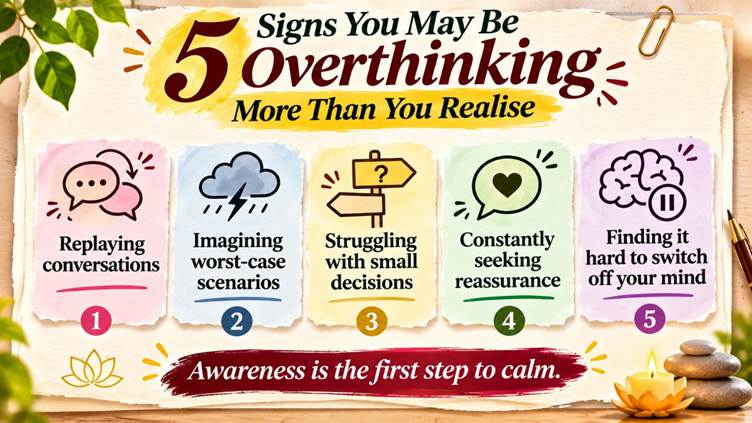
5 Signs You May Be Overthinking More Than You Realise
- You replay conversations in your head, long after they are over.
- You imagine negative outcomes before anything has happened.
- You struggle with even small decisions, like what to eat or wear.
- You keep seeking reassurance from other people.
- You find it hard to relax because your mind is always occupied.
An occasional overthinking night is a very human experience. These signs alone do not indicate a mental health diagnosis.
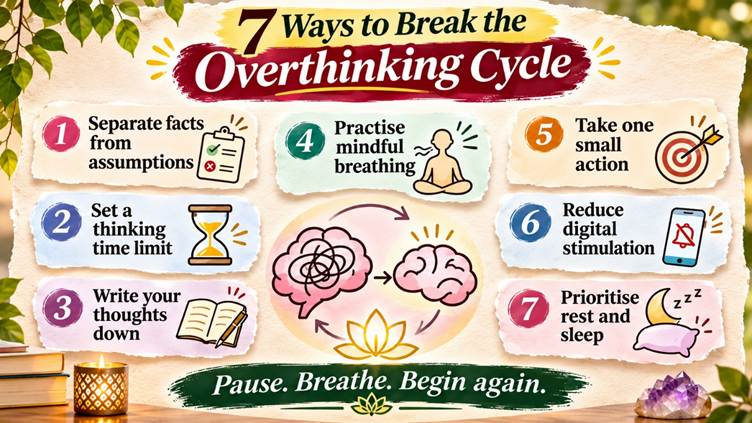
How to Stop Overthinking: 7 Practical Techniques
You cannot always control which thoughts arrive, but you can learn how to respond. None of these is a magic cure, so be patient with yourself.
1. Separate facts from imagined scenarios. Ask: What do I actually know? What am I assuming? What evidence do I have? Am I worrying about something that has not happened?
2. Give your thoughts a time limit. Set aside 15 to 20 minutes a day as thinking time. When a worry appears outside it, tell yourself, “I will think about this later.”
3. Write your thoughts down. Ask: What am I thinking about? What am I feeling? What is within my control? & What is one action I can take?
4. Practise mindful breathing. Breathe in slowly through your nose and out gently through your mouth. When the mind wanders, bring it back without scolding yourself. Even two minutes is a start. It will not erase overthinking, but it trains attention.
5. Take one small action. Instead of “I need to fix my career,” ask, “What is one step I can take today?” Maybe it is one email or one phone call.
6. Reduce mental stimulation. Take short digital breaks from notifications and scrolling, especially in the first and last half hour of your day.
7. Prioritise sleep, movement and rest. Research links sleep and physical activity with better emotional balance and clearer thinking. These are kind foundations, not guaranteed treatments.
Try This: The “What Is the Worst That Can Happen?” Exercise
When a “what if” thought keeps looping, the mind usually jumps to the worst story and then runs away from it. This exercise does the opposite. You look at the worst case calmly, once, and then you close the file.
Sit with a pen and paper and give yourself 10 minutes.
Step 1: Write the “what if.”
Write the exact fear. For example: “What if I fail this interview?”
Step 2: Name the worst that can happen.
Be honest and specific. “I do not get the job.” Then ask yourself, “And then what?” Keep going until you reach the real end of the story. You will often notice that the worst case is far smaller and more bearable than the vague fear that was spinning in your head.
Step 3: Ask how likely it really is.
Write a rough number from 0 to 100. Our minds treat a possible thing as a certain thing, so this step brings you back to reality.
Step 4: Write the best case and the most likely case.
The truth usually sits somewhere in the middle.
Step 5: Plan your “if it happens.”
Write two short lines:
- What can I do to make the worst less likely?
- If it does happen, what will I do next, and who can support me?
Step 6: Ask one last question.
“Will I be okay in a year?” Most of the time, the honest answer is yes.
Now stop. Close the notebook, take three slow breaths, and tell yourself, “I have looked at it. I have a plan. I do not need to think about it again right now.” If the thought returns, you can say, “I already answered this.”
A gentle note: this exercise is for everyday worries. If the worst case feels overwhelming or the fear will not settle, please speak with a qualified mental health professional.
Can Meditation Help You Manage Overthinking?
Many people believe meditation means stopping all thoughts. It does not. It changes the way we relate to them.
Through meditation we learn to:
- Observe thoughts instead of fighting them.
- Return attention to the present moment.
- Notice our emotional reactions.
- Build a steady routine over time.
Think of thoughts as clouds crossing the sky. You do not chase them. You simply notice them and let them pass.
Give Your Mind a Little Space to Breathe
If you would like a structured way to begin, I created 7 Days of Chakra Healing Meditation. It includes seven guided chakra meditations, healing frequencies and affirmations, and it aims to help you release overthinking and mental clutter. It is a reflective practice, not a medical treatment. Explore it whenever you feel ready.
Why Journaling Can Help You Understand Your Thoughts
Thoughts that stay inside tend to spin. On paper, they slow down. Journaling helps you recognise recurring patterns, identify emotional triggers, separate facts from assumptions and reflect on alternative responses.
Try these four prompts for five quiet minutes:
- What thought keeps returning to my mind?
- What emotion is connected to this thought?
- What am I afraid might happen?
- What is one healthier or more constructive way to respond?
Do not try to write beautifully. Just be honest.
Go Beyond Your Thoughts. Understand the Patterns Behind Them.
If the same worries keep returning in different forms, you may like my course Shadow Journaling for Inner Child Healing. It uses guided journaling, reflective prompts and chakra-based exploration to understand emotional patterns, childhood experiences, hidden beliefs and unspoken fears. Not every instance of overthinking comes from childhood, but for some people, gentle self-exploration brings real insight.
Crystals Traditionally Associated With Calmness and Mental Clarity
Some people keep a crystal near them during meditation or journaling as a symbolic reminder of an intention. The properties below are traditional and spiritual associations, not scientific treatments, and crystals are never a substitute for professional support.
Amethyst: Traditionally Associated With Calmness and Meditation
Amethyst is associated with calmness, intuition, spiritual awareness and restful sleep.
- Keep it near your meditation space.
- Hold it during quiet reflection.
- Place it by your bedside as a reminder to slow down.
Lepidolite: Traditionally Associated With Emotional Balance
Lepidolite is associated with emotional calm, life transitions and letting go of old patterns.
- Hold it during journaling.
- Keep it near your meditation space.
- Use it as a reminder to pause when overwhelmed.
Sodalite: Traditionally Associated With Clarity and Thoughtful Communication
Sodalite is associated with mental clarity, rational thinking, inner understanding and communication.
- Keep it on your work desk.
- Hold it during reflection.
- Include it in meditation or journaling.
If you feel called to bring one into your routine, you are welcome to explore these at my official shop.
When Should You Seek Professional Support?
Occasional overthinking is normal. But please consider speaking with a qualified mental health professional if repetitive thoughts:
- Significantly disturb your sleep.
- Interfere with work, studies or relationships.
- Create persistent distress.
- Feel difficult to manage on your own.
Asking for help is not weakness. It is one of the wisest things a person can do.
Your Mind Needs Guidance, Not Constant Criticism
Having too many thoughts does not mean something is wrong with you. It means you have a mind that cares and wants to protect you. You would not scold a frightened child for being scared, so give your mind the same kindness.
As you move through your days:
- Notice your thinking patterns.
- Stop treating every thought as a fact.
- Allow yourself to pause.
- Focus on what you can control.
- Practise meditation and reflection.
- Seek support when needed.
You cannot always control which thoughts enter your mind, but you can learn to change how you respond to them.
You do not have to solve every problem in your mind today. Sometimes, the first step towards peace is simply learning to pause.
Tell me in the comments: what do you tend to overthink the most? The past, the future, relationships or decisions?
With love and light,
Dr. Neeti Kaushik
FAQs
Q1. Why do we overthink everything?
Ans. The brain tries to protect us from uncertainty, mistakes and judgement. Fear of wrong decisions, past experiences, perfectionism, self-doubt, stress and lack of rest can all push the mind into repetitive thinking. It is a common human pattern, not a personal flaw.
Q2. What happens in the brain when we overthink?
Ans. No single area causes it. Threat-related regions like the amygdala may react to uncertainty, stress can reduce the prefrontal cortex’s ability to reason calmly, and the Default Mode Network, linked with mind-wandering, can get stuck on past or future concerns.
Q3. How can I stop overthinking at night?
Ans. Write your thoughts down before bed, set a daytime thinking window, practise slow breathing and avoid screens for 30 minutes before sleep. If sleepless worry is frequent, speak with a healthcare professional.
Q4. Can meditation help with overthinking?
Ans. It can help you notice thoughts without reacting to each one, and it trains attention and emotional awareness. It does not stop thoughts, and it is not a replacement for professional care.
Q5. What are some practical ways to calm an overactive mind?
Ans. Separate facts from assumptions, limit worry to a daily thinking window, journal, breathe mindfully, take one small action, reduce digital stimulation and prioritise sleep and movement.
Research References
- Nolen-Hoeksema, Wisco & Lyubomirsky (2008). Rethinking rumination. Perspectives on Psychological Science.
- Ehring & Watkins (2008). Repetitive negative thinking as a transdiagnostic process. International Journal of Cognitive Therapy.
- Raichle et al. (2001). A default mode of brain function.
- Buckner, Andrews-Hanna & Schacter (2008). The brain’s default network. Annals of the New York Academy of Sciences.
- Killingsworth & Gilbert (2010). A wandering mind is an unhappy mind. Science.
- Arnsten (2009). Stress signalling pathways that impair prefrontal cortex structure and function. Nature Reviews Neuroscience.
- Hölzel et al. (2011). How does mindfulness meditation work? Perspectives on Psychological Science.